A liveaboard sailor makes her list of essential gear
Issue 34: Jan/Feb 2004
OLDER BOATS USUALLY COME outfitted with a variety of gizmos, courtesy of the previous owner. It’s one of the perks of buying a tried and proven vessel. Nevertheless, it is likely that you will want to add to, or update, the inventory to suit your own cruising needs. If your plan includes cruising on bigger waters, such as the Great Lakes, the coastal U.S., or beyond, you may find, as we did, that some of the items you viewed as non-essentials become critical for safety, comfort, or both.
We have lived and cruised aboard our 1982 Baba 30, Kahlua, since January 2001. Because we want to be able to cruise for years, we take safety seriously. The following is a discussion of the items we would not want to be without.
GPS
This one almost goes without saying, yet we have encountered boaters who got into trouble and were unable to tell the Coast Guard their position be- cause they did not have GPS aboard. We carry a spare GPS as backup. Interfacing a GPS with other instruments aboard can provide the equivalent of crew to a cruising couple. Of course, the prudent cruiser will always navigate using multiple methods to ensure against errors — user or instrument error — or in case of sudden failure of all electronics. We always track our position, heading, and speed at least hourly on paper charts.
Autopilot
This is a highly valued crewmember. Used and monitored closely, an autopilot is a tremendous safety device, particularly for couples cruising without other crew. An autopilot prevents the fatigue that comes of steering a boat hour after hour. And fatigue has been found to be one of the most common causes of crisis on a cruising boat. Our autopilot is interfaced with our GPS to steer the boat and track a course, freeing us to change sails and to monitor water depth, other boat traffic, and our course.
The integration of GPS and autopilot is a wonderful convenience. The autopilot is able to correct for leeway and drift, keeping us on course. If the wind and seas are too rough for the autopilot to effectively steer, we place the autopilot on standby and steer by hand, using the cross-track error readout to help us steer the course. This is very helpful in the Bahamas when one of us is on the bow watching for coral heads and the other is steering around them. We still know precisely where our course is, thanks to the cross-track error readout.
Single-sideband (SSB) radio
We would not venture out into any bigger waters — whether crossing an ocean or coastal sailing — without an SSB radio or a ham radio. Period. VHF is wonderful and a must-have for communicating with other boats, marinas, bridge tenders, and so on. In fact, we prefer to have two VHFs, one a handheld. But when reception is poor or when you are out of range, such as when crossing the Gulf Stream to the Bahamas, there is a tremendous safety value in having SSB.
We left Rum Cay in the southern Bahamas one afternoon bound for Mayaguayana, 129 miles away. About 4 hours out, the winds picked up to 25 knots instead of the 10 to 15 knots that were predicted. The 5- to 7-foot swells grew substantially higher with waves on top of them, some breaking. We were closehauled and motorsailing.
Suddenly we were hit broadside by an errant wave and rolled more than 35 degrees while being simultaneously tossed in the air. The engine raw-water intake took a gulp of air. The engine lost its prime and became airlocked. The seas were so rough we were un- able to get the sea water pumping through again.
We diverted under sail to Clarence Town, Long Island, in the middle of the night. While struggling to get the motor working, we both suffered from significant seasickness. During that time we were able to talk to our friends on Windborne via SSB at our regular nightly chat time. Already in Clarence Town when they heard of our troubles, they decided to monitor their SSB through the night in case we needed help. In the morning when we arrived, they arranged a tow into the marina for us. Their support and assistance were very welcome during that long, dark night. With SSB, we could have called for emergency help, if needed. Without SSB, it is unlikely anyone would have heard us on VHF, as we were more than 25 miles from land, and most of the islands there are sparsely populated.
Other friends making the same trip 2 days later, but with only an SSB receiver and no way to transmit, were out in rough seas for 48 hours straight with no way to contact anyone in an emergency. After 8 hours, they lost VHF contact with their buddy boat. The buddy boat, meanwhile, developed an emergency, requiring one individual aboard to be airlifted off. I simply wouldn’t venture out without an SSB.
We also use our SSB to receive weatherfaxes and verbal weather reports in the U.S. and Bahamas and to listen to various cruisers’ nets, which broadcast important information about weather, sea conditions, and so on. In the Bahamas, particularly the southern Bahamas, there are few sources of weather information, and often no information is available via VHF. This makes the SSB our only reliable way to obtain weather reports. Cruisers can also arrange for personalized weather forecasts via SSB. Without SSB, cruisers can be left with no way to monitor a developing weather system. Many people use ham radio, requiring a ham license, giv- ing them an extended range of radio frequencies to use, but a SSB requires only a ship’s station license and no individual testing or licensing. It is, therefore, easier to obtain.
Radar
Before moving aboard Kahlua, we purchased a new radar unit. The new systems are nothing short of remark- able. They are invaluable safety features to have aboard. Fog is only one of several circumstances when radar is useful. We use radar to monitor the seas for other vessels, particularly large, fast-moving commercial vessels, which often travel at 25 knots or more. Day or night, we find we are able to spot such vessels earlier using radar. We use the radar to determine the vessel’s range and bearing to our boat, plotting it on a collision-avoidance plot chart every 3 minutes or so in order to determine the vessel’s heading, which, contrary to what you might think, is not always obvious.
We have also used radar to monitor the development of squalls, which show up on the radar screen, allowing us to alter course or run for a protected anchorage until the storm has passed. While we can see an approaching squall without it, radar allows us to determine the extent of the storm and whether there are more developing behind it.
And radar is invaluable in fog. We were able to make our way safely up the New Jersey coast from Cape May to Atlantic City in a fog that developed after we were offshore. We could see nothing but a thick grayness all around us, but the radar gave us “eyes.”
Life preservers
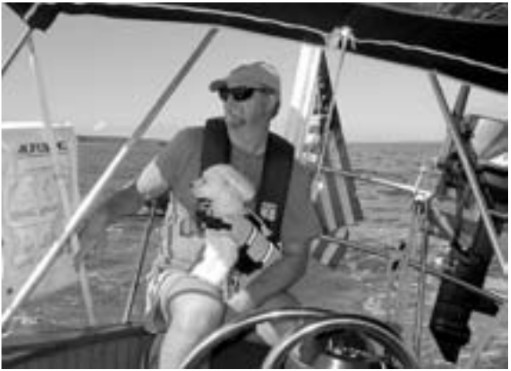
Ken and I each have a SOSpenders life preserver, which we wear whenever we are underway. These inflatable life jackets are so comfortable that we don’t balk at wearing them routinely. Even when cruising in bathing suits, we wear our inflatables.
We decided before we moved aboard that we didn’t want to debate about when the weather is rough enough to require life jackets. We agreed that the prudent thing is to make a habit of wearing them at all times when under way. Cruisers have been known to fall off or be knocked off the boat even in calm conditions. A human head floating in the water — about all you see when someone falls overboard — isn’t much bigger than a coconut and quickly disappears from view in even a light chop. Our life jackets have built-in harnesses, making it easy and convenient to attach ourselves to our jacklines in rough weather. And the easier it is to use a safety device, the more likely we are to have it in place it when we need it.

Generator
While we certainly can cruise with- out a generator, we found that when things go wrong at sea, the ability to maintain power to vital electronics (GPS, SSB, and VHF) can be critical. During our difficult night in the southern Bahamas, when we did not yet own a gas-powered generator, we were fortunate we did not end up out to sea for any longer than we did. Once we turned and sailed downwind in order to reach a safe harbor, the power output from the wind generator was reduced and couldn’t quite maintain our battery levels with the electronics we were using. The drain of the GPS, navigation lights, VHF, intermittent autopilot use, and SSB usage slowly depleted our batteries. This could have left us in an uncomfortable position if we had needed to cruise longer to reach a safe harbor.
Being able to call for help via SSB, which uses a substantial amount of power, could be critical. Being able to maintain power to the GPS or autopilot would also be desirable. A gas or diesel-powered generator is an excel- lent safety precaution and, in addition, offers the benefits of saving wear on the engine from running without load when charging batteries at anchor. It also allows us to use 110 volt-powered tools on the boat. We recently purchased one of the new, compact, ultra-quiet models, and folks moored next to us cannot hear it.
The above items are ones we consider beneficial for the safety and well- being of the crew. The next few items are ones we find greatly increase our cruising comfort.
Wind generator
A wind generator is wonderful for making power at anchor when the wind is blowing. If it is blowing at 15 knots or more, our wind generator keeps us in power — enough to run our refrigeration without running our engine. But beyond the convenience for charging batteries at anchor, a wind generator can also be important in a crisis. In the episode of engine failure, we were able to use our wind generator to produce enough power to keep our GPS, SSB, and other systems working for hours.
Watermaker
The benefit of a watermaker is not just saving 25 cents or more per gallon of water. If that were the only benefit, I’m not sure we would have one. We find the water made by our watermaker tastes far better than most of the water we can buy. In some places we have found the water for sale to be barely drinkable. But the real benefit of having a watermaker is that it allows us to spend days at anchor without being forced to go into a marina or port. This can be a safety feature when the weather does the opposite of what was predicted, and we need to remain with- in the safety of a protected anchorage for longer than anticipated. On one occasion in the Exumas, the weather changed suddenly, and we were held up at an anchorage for a week waiting for good traveling conditions. We know of cruisers who have left an anchorage in inclement weather because they were out of fresh water and had no watermaker. Our Little Wonder unit makes between 5 1⁄2 and 6 gallons an hour and allows us to sit happily at anchor for many days at a time.
Better dinghy
This is one item we are recommending that we don’t yet have ourselves. Our next dinghy will definitely be one with a raised bow and large tubes. Our 9-foot dinghy with relatively small tubes fits well aboard our 30-foot boat and has served us well in many areas, but we have found it to be an uncomfortable and wet ride when we have to travel a mile or more in it, particularly in choppy seas. Despite our 8-horsepower outboard, our dinghy will only plane when the seas are flat, the wind is from behind, there are only two of us aboard, the moon is in the seventh house, and Jupiter is aligned with Mars. Any kind of chop, and we don’t plane. From our observations and discussions with other cruisers, dinghies with a raised bow and large tubes give the most comfortable and driest ride.
Macerator pump
Marine heads are not the most delightful of subjects, but they are a reality of cruising. If you plan to cruise to the Bahamas, where there are no pump-out stations and it is quite legal and customary to pump waste overboard, you will be far more comfortable (and so will your anchored neighbors) if waste has been macerated before being pumped over. Brown liquid quickly dissipates in an outgoing tide and certainly beats the alternative. Enough said.
Windscoop
Windscoops are handy, inexpensive, lightweight, take almost no room, and can save relationships between crew- members. When sitting at anchor in 80- to 90-degree heat with winds of 5 to 10 knots, it can be difficult to breathe, let alone sleep. Pop up the windscoop and without using any power at all, you suddenly have fresh air flowing through the boat. The difference is truly remarkable. Put it up with more wind, and you get a nice wind-tunnel effect.
PocketMail
No, it’s not boat equipment, but we have found it so useful that I am including it in our list of recommendations. Wherever we go, whether in the U.S. or the Bahamas, we’ve been able to stay in touch with family, friends, and cruisers we’ve met via PocketMail. It is small, travels easily to shore and back, is reasonably priced, and has worked everywhere we have traveled. In the Bahamas, where phone calls to America cost $1 per minute and snail mail is truly snail, we are able to communicate more information with more people via PocketMail for much less than a 5-minute phone call to one person.
We find we rely on it even in the States because carrying the small device ashore prevents excessive wear and tear or water damage to the laptop we’d otherwise bring ashore. For $10 to $15 per month, cruisers are able to make an unlimited number of calls to send and receive email, and in the U.S., the calls are free. We recently upgraded to a new device, which works with any phone, including cell phones. We just aren’t comfortable cruising if we can’t stay in touch with family and friends.
Not necessary
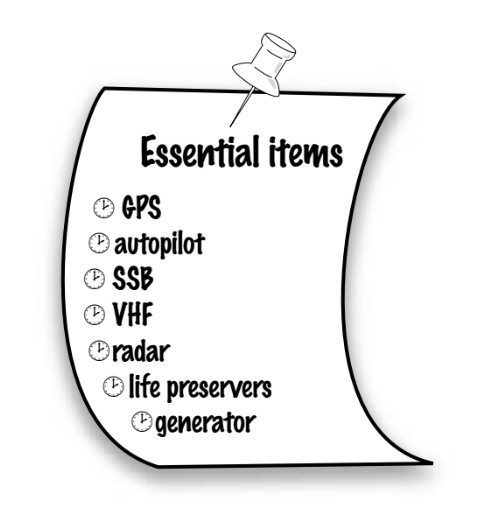
So, are all these items necessary? No. You may talk to other cruisers whose priorities differ from ours. But we would not cruise without the first six items (or seven if we include the VHF). They could prevent an emergency or save our lives. Nobody plans to get into trouble out there, and most of the time we don’t. However, every time we go out to sea, we are taking a risk that things might go wrong. We have listened to many emergency calls between the Coast Guard and cruising boats in trouble, and we have seen for ourselves how suddenly conditions can deteriorate.
Ken and I have come to see cruising as a calculated risk. We do not want it to be a crapshoot. Sure, many folks do just fine with very little fancy equipment. However, more often than not, their descriptions of close encounters with disaster suggest luck is a prominent reason for their survival. We have decided to do whatever we can to keep the odds tipped in our favor.
So who’s right? Nobody’s wrong — Jerry Powlas
AFTER READING HIS BOOK, INTO THE Light: A Family’s Epic Journey, we asked Dave Martin to write an article about keeping cruising simple. Not long after it arrived, Cathy McIntire submitted her view of what’s necessary for cruising. Neither has seen the other’s opinion. We think the reader is well served by offering these opinions in their original form, rather than making this a debate.
In the two articles, you will find two moderate opinions about how to equip a boat for cruising. I say moderate because I can easily find opinions on the subject that are much more extreme in either direction . . . and also are not wrong. Lin and Larry Pardey prefer to cruise without an auxiliary engine and without GPS. They are also strongly opposed to the use of epoxy in boat construction, preferring the use of other glues in every case. At the other end of the spectrum, the Amel Yard offers a well-thought-out boat ready to sail away as soon as you add provisions. It is very well equipped. It is one of very few high-priced boats that I really ad- mire for a variety of reasons, including the integration of an extensive list of equipment.
It would be easy for Good Old Boat magazine to choose the low-cost end of this spectrum, but it would not serve the reader as well. It would be easy to take the position that because Dave and Jaja Martin have more miles under their keel than Cathy and Ken McIntire do that Dave’s opinion is the right one. But this reasoning does not serve the reader well either. Cathy and Ken have more than enough experience to justify their opinion.
The selection of a boat is a very individual thing. That’s why there are so many different kinds of boats out there. The equipment list for a boat is also a very individual thing. That’s why there is so much equipment out there. What is exactly right for you may not be exactly right for another sailor. Here are my thoughts:
- You have to be able to afford it.
- You have to be able to understand it, which means use, maintain, and repair it.
- You have to be able to do without it because everything fails.
For one reason or another or perhaps for several reasons, you can’t have it all. Limits of cost, weight, and complexity will pertain. If you ignore these limits, they will no doubt get your attention at some point.
It is often said that good equipment will not compensate for good experience, and you will often see very experienced cruisers opting for simple setups. Why? One reason is that many of the sailors who have spent much of their lives cruising have needed to be frugal. These sailors may make a little money writing the books and articles we read, but most can’t afford a lot of gear. If you are fortunate enough to be able to consider this lifestyle at a very young age, and if you are also fortunate enough to be free of the encumbrance of great wealth, the simple approach is the obvious choice.
If you have been a working stiff for most of your life, wading through — or even enjoying — the complexities and demands of family, career, and other shoreside obligations before getting the opportunity to go cruising, you will probably find yourself with an older body, a less interesting sailing résumé, and possibly more funds to commit to cruising. I don’t think you need to sail around the world back- ward in high heels to join “the club.” You may choose to equip your boat more lavishly. You will be told that a good, well-equipped boat is somehow bad, and you will be told that a good, well-equipped boat is the only way to go cruising.
The reality is that you start from where you are when you cast off the lines. You apply the resources and experience you have at the time, and you go. You are never really properly equipped, and you never really have enough experience. That is why you go.
Thank you to Sailrite Enterprises, Inc., for providing free access to back issues of Good Old Boat through intellectual property rights. Sailrite.com