Highway hauling takes preparation and patience
Issue 92 : Sept/Oct 2013
Sometimes good old boats need to be moved overland. Many were not designed for that and present a challenge that may seem overwhelming, leading owners to hire professionals whose fees can be more than the boat is worth.
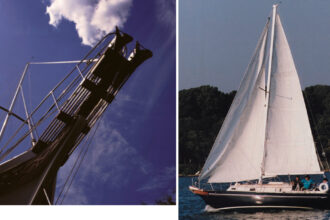
After searching three years for a boat with specific characteristics, I found her in a Maine barn, 2,000 miles from my home in Arkansas. Sitting on blocks just above ground level and supported by five boat stands, she was a Nantucket Clipper. She measured 31 feet 8 inches LOA with a 9-foot beam. She sat on a solid keel with 4-foot 2-inch draft and weighed 8,500 pounds. The weight could be moved easily, but a sailboat must be moved carefully if it is not to end up as shredded fiberglass strewn along a highway.
I addressed the matter with caution. My first idea was to hire a professional. The only quote returned was for $7,200, if she was accessible in a direct line from 200 feet and if she was sitting at least 18 inches above the ground. She was neither.
Do-it-yourself transport of a large boat is not for everybody. I am a professional at “making do” and have years of experience moving large objects: farm animals and equipment, research equipment, even a 1,000-pound meteorite no professional would touch fearing the liability of breaking a priceless object. Moving a sailboat is dangerous and must be done carefully. If you follow my example, get someone to check your rig and watch for anything that looks questionable. Have redundant safety braces and tie off the hull at multiple points. If at all possible, never work alone.
The boat’s previous owner let me leave my new obsession in her barn in Maine until the spring thaw, giving me time to prepare for the move. Those six months would see me sell my beloved 1969 Ford Bronco, buy an affordable (cheap) one-ton truck and properly rated trailer, and drive halfway across the country to drag my dream boat out of her barn, up on my rig, and home to Arkansas for a rebuild.
The highway rig
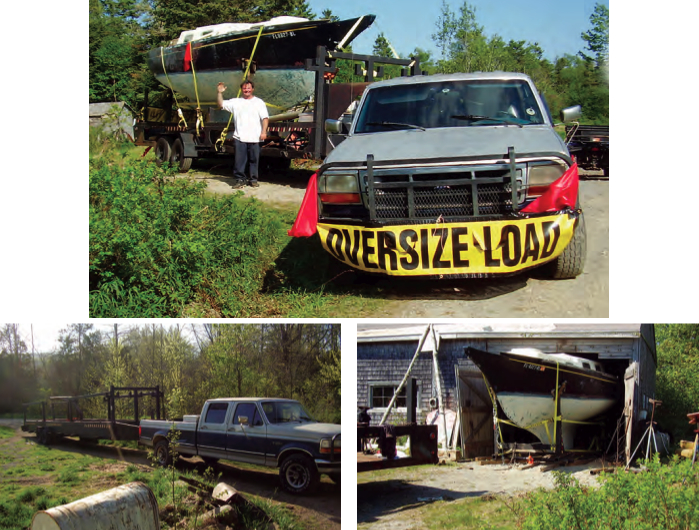
In Texas, I found a 1994 long-wheelbase F-350 diesel truck with a beefed-up suspension and gooseneck hitch. Down the road from the truck sat a 45-foot-long bumper-hitch, steel-bed trailer with axles that could handle a 14,000-pound load. The trailer came with a gooseneck frame to replace the bumper hitch and unusual vertical tubing that formed a frame along the front and both sides but was open on top.
I cut the back 12 feet off the bed, yielding L-shaped structures for a cradle that would fit perfectly inside the remaining trailer bed. Connecting the horizontal portion of the L-sections with pipe that slid inside the tubing gave me a frame that just needed a strong center beam to support the keel and pad arms to maintain balance. The remaining side rails on the trailer were perfect for additional vertical supports.
After a couple of months’ work on the truck and trailer, I ended up with a good-running truck, a 32-foot gooseneck trailer, and a transportable sailboat cradle that could be assembled around the keel then slid out of the barn and onto the trailer. I even had enough money left from the sale of the Bronco to pay for diesel fuel for most of the move. The final fit of the cradle to the hull would be done on site, so I collected a variety of materials that would fit in the vertical tubes and hold the hull. The clipper’s gelcoat had been removed below the waterline so I didn’t worry too much about protecting the finish. I built up steel pads and covered them with industrial-grade carpet to soften the contact points.
A maze of permits
Highway regulations require all loads wider than 8 feet 6 inches to have an oversized-load permit for each state where the vehicle will operate. The specifications for permits vary from state to state, so data such as weight, length, height, width, overhangs, axle weights, tongue weights, distances between axles, ground clearance, and drivers’ ancestral blood type may be required. States may have different requirements for liability insurance. My insurance company wrote a million-dollar policy for me and allowed me to keep it in effect while I was en route and then cancel it at my destination. This made the necessary insurance affordable.
As soon as I had confirmed dates for travel, I submitted oversized-load permit-request forms to each state along the way. The first problem was getting a permit to cross Missouri, the last state before I would get home and the easiest route to get into the Ozarks where I live. Missouri required a type of insurance that’s only available to trucking companies with DOT numbers. Even though my insurance exceeded the requirements, they would not accept it. The underwriter from my insurance company called the Missouri permit office and could not find a way to work with them. I took the long and inconvenient way home, bypassing Missouri.
If money is not a concern, it’s easier to secure permits through a trucking permit company. I was driving across 11 states, for which the highest bid quoted was $1,200. Price was a concern in my case, so I did it myself and saved $700. It forced me to take detours to a downtown Nashville office, along a beautiful 30-mile narrow side road through some nice Pennsylvania countryside, and later plead with New York DOT workers to issue a permit via fax to a truck-stop drivers’ lounge at the very last minute. I do not know if a permit office could have secured a Missouri permit for me. If so, that would have been a big benefit.
Extracting the boat
With a vehicle, insurance documents, folder of permits, trailer, and cradle secured, it can still be tricky for a do-it-yourselfer to access the boat and get it loaded. My boat had been settling in for 10 years on the dirt floor of her cozy barn.
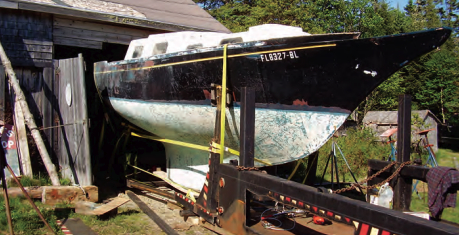
My rig fit well around her keel as I jockeyed boat stands in and out until I had the frame set in position. Then I ooched up 20-ton bottle jacks to lift her, still supported by boat stands, off the ground, adjusting the stands as she rose until I could secure the cradle in position. Tubular-steel horizontal braces let me slide the cradle into a position where the pads would support the hull where it was reinforced: under the bow, along the stringers and the engine beds, and at the tabernacle bulkhead.
I fitted the cradle pads on site by connecting them to the curved limbs of a bois d’arc tree from my home property. I would not do this with any other kind of wood. Also known as Osage orange, it is as strong as steel and more dense than old-growth teak. The curved limbs, fitted with curved plate-steel carpeted pads, matched the shape of the boat. The majority of the weight rested on the 2 x 12 plank keel support. For reinforcement, I strapped the cradle corners together with four webbed ratchet straps rated at 3,333 pounds each. Once the boat was set into the cradle and the two strapped together with four more straps, it made a very stable platform.
To move the cradled boat from the barn, I parked my trailer, still attached to the truck, in line with the keel and winched the cradle little by little along planks. At first I measured the movement at 1⁄4 inch every five minutes. The winches I used to drag the boat from the barn were rated at 8,000 pounds. Before the cradle reached the barn door, the first winch was destroyed and my arm was sore. I had a spare winch and, after the pulleys separated in the first one, I became more careful when setting the rollers for every move.
With 3 1⁄2-inch round tubing underneath the cradle, the boat moved easily. The strength of the cradle was tested when — while I was resetting the cradle on a roller — the balance shifted and the whole rig moved on its own. A pebble brought one side to an abrupt stop, while the other side fell 4 inches off the roller next to me. It happened so fast I couldn’t react to get out from under it. Luckily my welds held and securing ropes pulled the weight away from where I sat working the jack. I realized I had come close to being flattened. After that, I was more careful to have back-up supports and plan my escape route, just in case.
One full day of winching got the boat into the clear. A second day was needed to ramp the boat and cradle onto the trailer. Merrill, the property’s caretaker, saved the day by locating timbers for solid ramps. I used a third day to pack incidentals and secure for the road before I was ready to leave, just one day before my permit deadline in Connecticut.
On the road
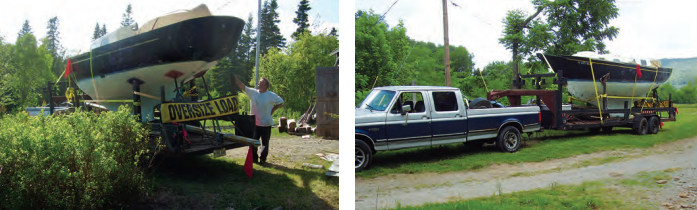
Permit offices determine the roads that oversized loads can travel. My predetermined route led down a road badly damaged from winter freezing. The pavement would fade into dirt with no warning. This turned out to be a good way to check that the load was secure. I aligned a spot on my side mirror with a point on the boat and kept a constant measure to see if anything shifted. One abrupt bounce, when the road disappeared into a pothole when I was driving too fast, put my heart in my throat. Then I looked over to see the spot in the same place. Lesson learned: slow down.
Speed is determined by road conditions minus 10 mph. I learned to take my time and enjoy the scenery while constantly scanning the boat’s position and keeping a watch out for vehicles pulling out in front of me. I developed a method of checking gauges. I kept a close eye on my exhaust-gas temperature more than anything else. Turbo boost was also important but more for telling me when to downshift. The main lesson of the speedometer was when to turn on my emergency flashers. That was whenever a hill dropped my speed below 45 mph for an extended period.
Sleeping in a truck cab is not ideal. At 5 feet 7 inches, I found no way to get comfortable. I had traded the rear seat of my truck for a futon mattress. I piled in all the pillows I could find and left a space for a small ice chest. I parked wherever large trucks gathered to bed down — rest areas or lots behind truck stops. Any time I stopped at gas stations or rest areas, I met people interested in the boat who asked questions about traveling with such a rig. It made a great conversation starter and even though many people probably thought I was crazy, many more were encouraged to approach me and learn about the boat and why I would be driving through the middle of the country where it would be so out of place. Every state border crossed received a honk of my horn. Crossing the Mississippi River gave me a fantastic feeling of joy. Getting into my home state gave me a great sense of accomplishment.
Oversize-permit pains include having to stop at night and holidays. Some states do not allow moving oversized loads on weekends. An Arkansas state trooper stopped me at sunset 100 miles from home. He checked my permit and found that the copy I had received from the permit office had lost a page in the fax transmission. It had looked good to me and I hadn’t noticed the skip in the page numbers. I sat on the side of the road with flashing blue lights in my mirror until the sun was all the way down. Then the officer told me to get off at the next exit and stay put until sunrise. After four days of driving, I was looking forward to getting home to sleep in my own bed and wanted to go on. I asked the trooper what the fine would be if I chose to drive after dark. He said, “It won’t cost much, but your load will probably be confiscated.” I spent another night in the cab wishing my boat had been just 6 inches narrower. I toasted a long trip with my last Yuengling from Pennsylvania. Although we weren’t home yet, we were close, and it felt like I had accomplished my journey.
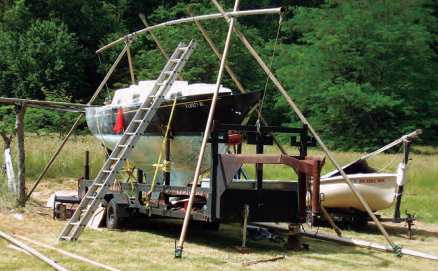
The next morning, I finished the trip. My truck made it over the steep pass into the Ozarks and the Nantucket Clipper found her new temporary home with the promise that she would be returned to the sea. Her next launch will be 70 miles away in the fresh brown water of the Arkansas River. She will see the same shores that were traveled by Native Americans, explorers, and the many immigrants who settled our country. She is already much closer to being back on blue water than she ever was in the 10 years she spent just a half mile from the ocean on the farthest eastern shore.
Walter Graupner is rebuilding the Nantucket Clipper in Arkansas while continuing to sail his Flying Scot on the Arkansas River. Known as “a MacGyver” in the research labs he manages, Walter has been a farmer, chef, toxicology researcher, avionics tech, poultry computer specialist, and developer of space simulations. He tries to convince all his students to focus on ways they can do something instead of getting hung up on reasons they can’t.
Thank you to Sailrite Enterprises, Inc., for providing free access to back issues of Good Old Boat through intellectual property rights. Sailrite.com