German-born sea adventurer settles in Florida
Issue 20 : Sept/Oct 2001
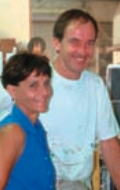
The term Renaissance Man has been used with abandon in recent years, but for boatbuilder Chris Bauer the term is not misapplied. Chris is a scholar, world traveler, wine connoisseur, gourmet chef, opera buff, boat designer, boatbuilder, and sailor. He is, in addition, a linguist who speaks English, German, Spanish, Portuguese, Italian, and French. Chris builds his boats in St. Augustine, Florida, where he lives with his wife, Laurie, and daughter, Kirsten. How Chris and Laurie came to settle in Florida is a fascinating tale.
At age six, German-born Chris emigrated to South America with his family. They lived there for eight years. After he’d completed college, the open road beckoned to Chris, and he began a motorcycle trip through Europe, ending up in Portugal. On the coast of Portugal a Danish-built Baltic-trader, oak on oak, was being converted by a group of Americans into a square-rigger. The converted ship was designed to be a replica of the brig Pilgrim, immortalized by Richard Dana in his book, Two Years Before the Mast, the book that exposed the brutal life of the common seaman to public view and influenced legislation to correct those harsh conditions. The replica brig, which would be used for charter work in the Caribbean, was also christened Pilgrim. Chris recalls that “it was 100 feet on deck and rigged in the traditional manner with wood blocks, dead- eyes, and belaying pins.
“Since there was a language problem between the new owners and the shipwrights, and since I was fluent in Portuguese and English, I signed on as interpreter and rigger, working for about eight months rigging the ship until it was ready to sail.”
California girl
Just before Pilgrim was ready to leave for the U.S., a California girl and her younger brother came aboard. They served in dual roles as crew and paying passengers. Laurie had just graduated from college and, at the suggestion of their mother who thought crossing the ocean in a square-rigger would be a memorable and exciting adventure, Laurie and her brother, Dodd, embarked on the square-rigger for the Atlantic crossing. By the time Pilgrim arrived in the Caribbean, Chris and Laurie were an “item.”
Before leaving Portugal, Chris had met a German industrialist who became enamored of Pilgrim and wanted a ship just like it as his personal yacht. So after the Atlantic crossing Chris took on the job of finding a suitable hull that could be modified. In that pursuit he and Laurie flew to Scandinavia. There they found a three-masted schooner, but couldn’t locate the owner. Eventually the project fell through and, as a German citizen, Chris decided that it would be an appropriate time to begin his obligatory 15-month tour of duty in the German Navy.
As a Morse code and teletype operator, he was stationed in Wilhelmshaven, on the North Sea. It was in northern Germany, in 1975, that Laurie and Chris were married. The service was performed by Chris’ father, a Lutheran minister and Navy chaplain.
“While in Wilhelmshaven, Laurie and I ran across a boatyard where they built small lifeboats for Germany’s tall ships. Although they were constructed of heavy fiberglass, they were made along traditional lines. In the boatyard we found a 28-foot fiberglass lifeboat that the yard was experimenting with, and for a few hundred dollars the boat was ours. For the rest of my navy tour of duty, I used all my spare time designing how our boat could be converted into a safe, small, cruising sailboat, one we could ultimately use to cross the Atlantic Ocean.”
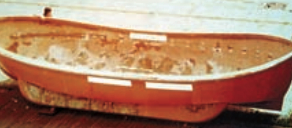
Construction of Emigrance
When his stint in the navy was completed, Chris and Laurie began work in earnest on the planned modifications that would make the little boat their new home. They rented space in an old barn and purchased a versatile power tool with attachments that could convert it into a lathe, table saw, router, joiner, grinder, and bandsaw. With this adaptable implement, they spent more than a year installing a long steel keel, ballasted with concrete and scrap iron. They framed out a deck, which was covered with plywood, and put on several coats of polyurethane paint that had ground cork mixed into it. This thick mixture provided a leak- and skid-proof deck.
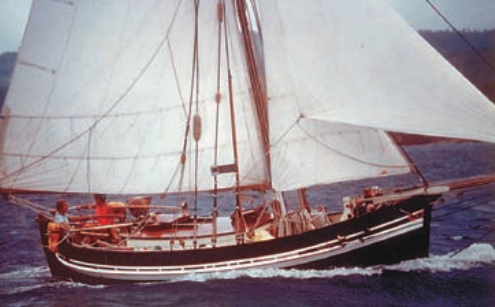
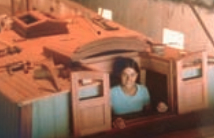
They then constructed 16-inch wooden bulwarks, a teak caprail, and a teak cabintrunk that gave them 5 feet 9 inches of headroom below. Their boat was lightning-grounded and had a simple one-battery electrical system. They also constructed an outboard rudder with a tiller. The final stages of construction included a homemade anchor winch, heavy-duty bronze hardware and a long retractable bowsprit. Their completed boat had a 30-inch draft, a 9-foot beam, and was 28 feet on deck with a 27-foot waterline.
Mediterranean, here we come
With the mast, boom, gaff, and bowsprit stored on deck, and with their bicycles and belongings (including the large multiple-use power tool) stored below, but with no rigging, Chris and Laurie began a motoring trip toward the Mediterranean in their newly christened Emigrance. Their cruising home was powered by a one-cylinder, 8-hp inboard diesel that, in calm water, could move them at about 3 to 4 knots. The fuel tanks were two 5-gallon jerrycans. Using Europe’s extensive network of inland waterways, they traveled from Bremerhaven into Holland and Belgium, then into France, spending a couple of weeks moored at a quay on the Seine River in the center of Paris. From Paris they traveled up the Seine, down the Saône and finally into the Rhône River, which flows south toward the Mediterranean Sea.
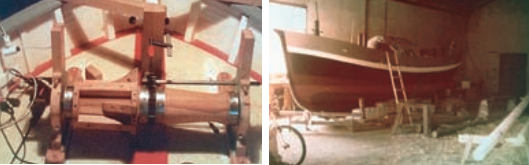
“Our trip through France was the quietest and most pleasant time I’ve ever spent on the water,” says Chris. “Since the locks on France’s inland waterways didn’t operate on weekends, we would moor our boat to a couple of stakes we would drive into the canal bank, take our bicycles off the boat, and go find the local boulangerie (bakery) and boucherie (butcher shop) along with a couple of bottles of wine. Then we enjoyed ourselves while waiting for Monday to come around.”
Near the mouth of the Rhône they found a small boatyard near the old walled town of Aigues-Mortes. It was on the west side of the wide Rhône River delta, 60 miles west of Marseilles and just two or three miles from the Mediterranean. It was from this harbor, in 1248, that Louis IX, king of France, assembled 1,500 ships and 35,000 men and embarked on the crusades.
By doing work for the yard two days a week, Chris and Laurie were able to spend the winter there while they rigged their sailboat. The rigging was done in the traditional style, just as the Pilgrim had been. The sailplan was that of a gaff-rigged Baltic cutter, with a long bowsprit and a square topsail.
Cruising the Med
Chris had become like a son to the boatyard owner. He wanted Chris and Laurie to stay and even offered Chris the boatyard, but they had a rendezvous with a sailing adventure, so with heavy hearts they bade au revoir and sailed out into the Mediterranean Sea on their maiden voyage. This was the first sailing test of their small boat. On the morning of that first memorable day, they headed east along the coast of France.
Chris recalls thinking, “Well, it should work. I think I did everything right.” And later in the day he thought, “This boat is not bad at all!” Marseilles was their first stop. From there they hopped from port to port along the Mediterranean coast, discovering that all the planning and work had paid off: their little boat was an able cruiser. They daysailed up the French Cote-d’Azur, to Monaco, the Italian Riviera, Elba, and Corsica, finally returning again to the island of Elba just off the west coast of Italy.
“We spent two years cruising the Mediterranean without ever sailing an overnight passage,” says Chris. “During the summer we would daysail the Mediterranean from port to port, and during the winter I would work at local boatyards. We stayed on Elba through the next summer, while I worked for a charter business, and then we spent our second winter on Elba again. If there were one place I would choose to spend the rest of my life, it would be Elba. It’s a perfect universe in microcosm.”
By then they had decided that their boat was a completely seaworthy vessel, and they began making plans to sail across the Atlantic to the United States. After two years of cruising the Med — on the first leg of their voyage, between the island of Sardinia and the Balearic Islands off the east coast of Spain — Chris and Laurie had their first overnight passage in Emigrance. Although it was a night filled with trepidation, they look back on it as one of the milestones of their sailing careers. Then, with all their belongings on board, they sailed from the Balearic Islands to Gibraltar and finally out into the Atlantic Ocean, traveling down the coast of Morocco and stopping at Casablanca and Safi for their final provisioning before starting the trip to the Canary Islands.
Across the Atlantic
“We stayed in Casablanca about 10 days, and just before leaving I got a weather report from the Casablanca airport,” Chris explains, “They said we would have a good wind. I guess it might have been a good wind for planes but maybe not for small sailboats. As we started our ocean voyage from the African coast to the Canary Islands, the wind was 30 to 35 knots from directly astern. We rigged our twin headsails wing-and-wing and began four-hour-on and four-hour-off watches, surfing down the faces of huge waves for three days. It required constant attention to the tiller, since we had no autopilot or self-steering.”
Fatigue probably contributed to a navigational error. Chris recalls: “I was using dead reckoning, and I added the deviation instead of subtracting it, so we were 14 degrees off course, heading for the coast of Africa instead of the Canary Islands. On the fourth day out the wind subsided a little, and we were finally able to put up the mainsail. That day a little bird landed on deck, so I thought we were close to the Canaries, and I fired up the radio direction finder to get a bearing. It was then that I discovered we were closing on the African coast!”
Finally, the exhausted couple saw the huge cliffs and inhospitable coastline of the island of Lanzarote, the easternmost island in the Canary chain, appear dead ahead. They continued past the island of Fuerteventura to Gran Canaria island, where they entered harbor. Once safely ashore they evaluated their tiresome ordeal and decided they would be physically unable to continue to the United States. As they were making plans to ship their boat home and fly back to Europe, large sailboats and racing yachts began limping into the harbor with broken equipment and stories of the terrible storm they had just been though — the same weather Chris and Laurie had experienced. As Chris surveyed the docks, where wet mattresses, bedding, and clothes were being laid out to dry and broken spars and blown-out sails were being repaired, he thought, “Well, we didn’t think it was that bad. It was uncomfortable, but we never had any real trouble. I guess we have a pretty good boat, and we’re able to handle things after all.”
Two modifications
At the end of December 1981, after three weeks in the Canaries, and with renewed faith and self-confidence, they decided to undertake their 3,000-mile trip across the Atlantic. They made two important modifications: buying an electronic Tillermaster autopilot and changing their watch system from the four-on, four-off to the Swedish 6-4-2. “With only two people on board, these changes made all the difference,” Chris recalls. “The two six-hour watches were at night, so we each had a good night’s sleep every night. We left the Canaries, and using celestial navigation, a cheap Casio watch I had bought there, and a shortwave radio to get GMT time signals and weather reports from French radio, we started our voyage. The first week out we were both seasick for the first time. I think it was the result of apprehension and the pressure of the commitment. But once the daily routine became normal, we felt much better.
“The second week out we began thinking, ‘This is really nice.’ By the third week it was, ‘Will we ever get there?’ By the fourth week we felt like we were in limbo and would be destined to sail on and on forever. Life on land became something out of our distant past that we could hardly identify with anymore. But soon we began receiving Caribbean AM radio stations, our first confirmation that we were actually where we thought we were.
“Finally, after 31 days, at around two or three in the morning, we saw a glow on the horizon, and our RDF showed Barbados just 10 miles away. We were just a few miles off course: my celestial sun sights worked!
“We had an enormous sense of accomplishment and euphoria. We had sailed across the Atlantic in a tiny little boat we built ourselves. We did it. This is it. Nothing is impossible!”
The first project on shore was finding a telephone and calling Laurie’s parents. “My mom had no idea we were doing this,” Chris says, “My dad never told her.”
Island hopping
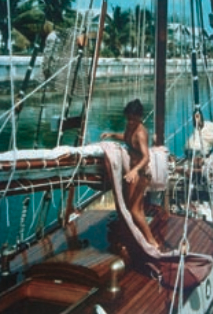
They soon began island hopping up the Caribbean: English Harbor in Antigua, Puerto Rico, the Bahamas, and finally Fort Lauderdale, on the east coast of Florida. From Fort Lauderdale they began a trip north on the ICW and, while in St. Augustine, they discovered that Laurie was expecting. So in St. Augustine the Bauers swallowed the anchor and began a life ashore. Chris, relying on his boatbuilding skills, founded Bauteck Marine Corporation in 1983, with the intention of building the ideal dinghy. Chris and Laurie built a home in St. Augustine, near their shop, for the family that now included their new daughter, Kirsten. About this time they sold Emigrance for the amount it cost to build her and, sadly, never saw or heard about her again. (If any readers are aware of the boat’s past or current whereabouts, we’re sure the Bauers would love to hear from you. Contact information is at end of this article. -Ed.)
The first boat to be produced by Bauteck Marine was the Bauer-10. Chris conceived this dinghy as the perfect yacht tender. It was a dinghy that could be easily rowed, sailed, or motored. The Bauer-10 was followed in 1988 by the Bauer-8, and in 1996 the Bauer-12 made its debut. All three models were designed by Chris, with the help of a computer-lofting program. “I decided to build small boats because I like the idea of being able to put out a completed boat in a relatively short length of time,” explains Chris. “In addition, the initial expense of starting out with a large hull would have been prohibitive for us.”
The Bauers’ factory is a 5,500-square-foot area that includes a separate building where the fiberglass layup is executed. The layup building houses modern equipment for keeping airborne pollutants to a minimum as well as an environmentally safe acetone recycling machine. About 55 percent of the 70 to 80 boats built yearly are the Bauer-10s and about 35 percent of the production are Bauer-12s, with the Bauer-8s coming in a distant third. It takes about 20 to 22 man-hours to do the fiberglass work on the 10-footer and, depending on how much wood is stipulated by the owner, the total man-hours for each of these boats is about 32. Seats and wood trim are teak, with some ash used in the tiller laminate for strength. Spruce is also used on the rare occasions when a customer specifies wooden spars. The staff at Bauteck Marine is usually about five. This includes Laurie, who takes care of all of the office work, with occasional help from Kirsten, who is now 17.
All custom-made
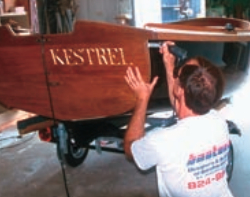
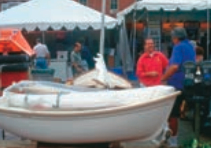
“We rarely build boats for inventory, since all our boats are custom made to each owner’s specifications,” explains Chris. “Usually we just have one boat of each size, which we use for boat shows and demos. About 60 to 70 percent of our boats are sold through boat shows and the rest through dealers or export. Currently we have only four dealers in the United States because most dealers find dinghy sales too time-consuming. Sailboat owners spend just as much time looking over a 10-foot dinghy as they do selecting their 32-footer.”
The Bauer hulls are constructed of hand-laid fiberglass and have an interior liner that does triple duty as a hull reinforcement, watertight flotation, and a huge storage compartment. In the Bauer-10, four watertight ports give access to this storage/flotation area that can be home to tools, flashlights, foul weather gear, mooring lines, anchor and rode, and a host of other paraphernalia that makes this little dinghy into a mini-cruiser. The double liner provides so much flotation that it can still be rowed, motored, or sailed when swamped. Whereas, in many so-called top-of-the-line dinghies, seating while sailing is awkward or non-existent, the Bauer liner provides a unique U-shaped stern seat that allows the sailor to sit athwartships for better balance and sail handling. High freeboard, wide beam, full-length keel, high loading capacity, and exceptional stability are designed into these hulls. And since it is a true displacement hull, it can be rowed for miles around a harbor with little effort.
The sailing models have kick-up rudders and kick-up centerboards, not daggerboards, and both the rudder and centerboard have an ingenious internal shockcord arrangement that pulls the rudder or centerboard back down again after it has kicked up. This avoids hanging over the stern trying to push the rudder down. Classic lines and exceptional performance are characteristics of the Bauer boats, which are not only aesthetically pleasing, but completely functional as well.
The rigging work that Chris did on the tall ship, Pilgrim, and the design and construction of their little Emigrance has all come together in a neat little line of dinghies that are built with personal care. It’s nice to see a boat designer and builder who has “paid his dues” on the water, knows what is required of a small craft, and has firsthand knowledge of what old man Neptune can throw at us.
Don Launer’s photo and bio appear on Page 17. Instead meet photographer Kirsten Bauer, 17, who took several of the recent photographs in this article and is the reason Chris and Laurie wound up settling down in St. Augustine 18 years ago. Kirsten is a senior in high school who hopes to become a journalist.
Thank you to Sailrite Enterprises, Inc., for providing free access to back issues of Good Old Boat through intellectual property rights. Sailrite.com