Exploring the world cheaply in an old wooden boat
Issue 20 : Sept/Oct 2001
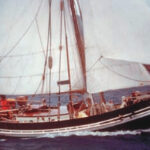
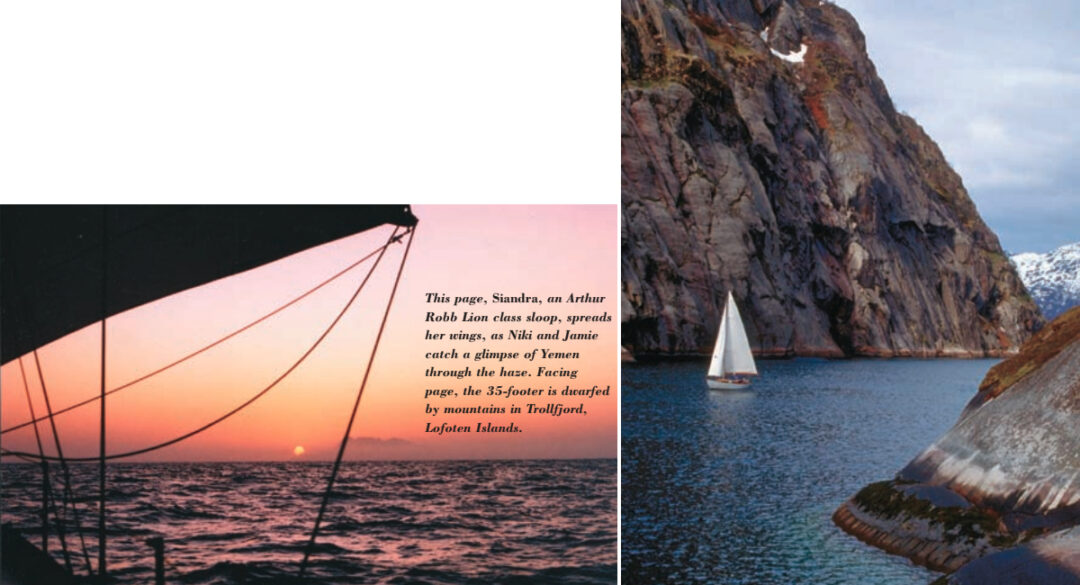
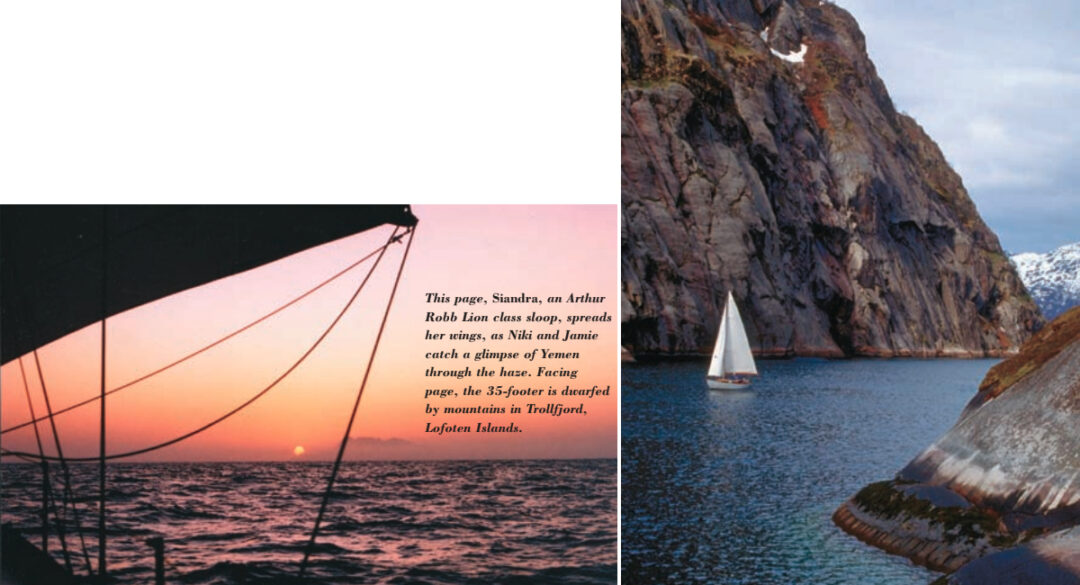
Losing your heart to an old wooden boat is careless, but falling for her owner as well can only be described as rash. It was Sydney, Australia, in 1988. She was a 1950s racer called Siandra, one of Arthur Robb’s Lion class, and he was a 20-year-old shipwright named Jamie Morrison, a sailor I’d met during a race series in Papua, New Guinea. We’d gazed at the stars together from the deck of an IOR racer and discovered a shared passion for old boats and a dream of long-distance cruising.
But that was New Guinea. Back in Sydney, reality was unavoidable. We were young and broke, and the future felt as far away as Mars. “When can we take your lovely boat out for a sail?” I asked eagerly. Jamie was evasive. There were many jobs still left to do on her. It would take ages to pack up the tools. “Don’t worry old girl,” I whispered as I waited for him to lock up at the end of that first visit. “Won’t be long before we shake out those sails of yours.”
A year later we embarked on our first cruise: a five-month scramble up the east coast of Australia. We’d made all the mistakes: underestimated how long it would take to recommission Siandra, spent most of our precious cruising kitty on gear before we’d even slipped the mooring, and finally got away at the tail end of the season. Despite hundreds of hours of labor, Siandra’s interior was still as Spartan as a prison cell, and to cap it all, the magazine I regularly wrote for was on the verge of bankruptcy and owed me for six months’ work. Any of these factors might have spoiled the trip, but we thrived on fish and tropical fruit, avoided costly marinas, and had a whale of a time.
Immense impact
On the northeast coast we met two sailors destined to have an immense impact on our lives. Peter Schouten and Els Van Drunen. While both were in their early 20s, they had set sail from Holland aboard a 47-footer they’d built themselves. Years of extended cruising later, they listened to our “one-day dreams” and asked: “Why wait until then? You have a good boat — keep it simple and cruise cheaply. All you need is a little money to get you started.”
Before we parted company they presented us with an Ebbco sextant they’d always carried as a spare. On a slip of paper inside the box were the words “One less thing to buy.” Their encouragement sparked an unquenchable flame: overnight, our fantasy of long-term voyaging turned into a serious campaign.
There was a lot to do. Five months on Australia’s east coast had taught us just how cheaply you can cruise, but we didn’t relish the thought of living solely on beans and rice for years at a time. We finally agreed on a budget of $6,000 per year and resolved not to set off until we had two years’ worth in the kitty. That way, even if Peter and Els’ confidence in our ability to earn along the way proved unfounded, we could feasibly girdle the world in 24 months without starving. In addition to saving $12,000, we had an old debt to clear and a million bits and pieces to buy for Siandra. Could we really raise so much cash in one year?
Back in Sydney, we knuckled down to the task. Jamie found a dozen traditional boatowners around the harbor who needed the services of a shipwright, while I turned my back on a creative (but unprofitable) writing career to join the city rat race. Meat, wine, and smelly cheese no longer featured on our shopping lists; second-hand clothes slunk into the wardrobe; and friends shook their heads over our new determination not to have fun if “fun” involved spending money.
Restoration mode
Meanwhile, Siandra was back in “restoration-mode.” To turn her into a comfortable cruising boat we needed to redesign and rebuild much of the interior. Long evenings and pads of paper disappeared in a flurry of ideas. Weekends converted the ideas into real bookshelves, a permanent dinette, new storage areas. Little by little, Siandra’s Spartan saloon became a light, open, practical living space.
As the months ticked away, we swung between dogged optimism and the grim knowledge that we wouldn’t be leaving at the end of the first year. The kitty was swelling, but so was the job list, and we still hoped to acquire about $22,000-worth of “essential” cruising gear. We pinned a world map to the wall for inspiration and continued working.
Year Two flew by. Our savings topped $12,000, and we celebrated with pizza and a six-pack of beer — the first luxuries in a long while. Siandra now sported a secondhand Aries windvane, a life raft, a shiny new anchor winch, a storm anchor, and a huge quantity of chain. We’d persuaded ourselves that the remaining items on the list were unnecessary. It was time to go. Neither our relationship nor our determination would stand another year of hard graft and miserliness.
Many cruising folk manage to sever their home ties in a calm and organized fashion (or so they claim). Siandra’s departure was a complete shambles. Friends and family loaded gear on board that we’d already decided not to take, while half the gear we really did need was nowhere to be seen. At the last minute I accidentally threw away a plastic bag containing our credit cards, and the 2-hp outboard escaped from Jamie’s grasp and bounced down an entire flight of stone steps. But somehow Siandra wrenched us away and, as her bows lifted to the swell and carried us clear of Sydney Heads on May 19, 1992, our spirits soared. We were free. The whole world lay in front of us.
Parched wilderness
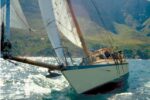
Our route took us north, and over the next eight weeks we covered 3,000 miles up the east coast of Australia, through the Great Barrier Reef, and along the parched wilderness of Arnhem Land to Darwin. In spite of her burden of cruising gear and all our worldly belongings, Siandra showed a clean pair of heels to the modern cruisers we passed along the way. On those first passages we set two records that remain unbroken to this day: a top speed of nearly 15 knots and a daily run of 167 miles through the water. (That was before we learned that if you sail an old boat as though she’s a go-fast racer, you have to be prepared to foot the repair bill.)
Her first major test was waiting for her in the Indian Ocean. Admiralty statistics show September as one of the safer months for crossing to Sri Lanka, but on September 27 we found ourselves running under bare poles through mountainous seas. We were anxious and exhausted, and when our radio receiver spewed out the devastating news that tropical cyclone Aviona was heading our way, we began to have doubts about our 40-year-old boat. Was she strong enough to survive a cyclone?
As conditions worsened, we hove to and lay on the cabin sole waiting for something to break. “Would it be the mast?” we fretted. “The rudder?” But Siandra was more resilient than her crew believed, and when the storm finally abated, our search for damage revealed only one broken engine mount and one topside stripped of paint. We arrived in Sri Lanka with renewed confidence.
Turned into lifestyle
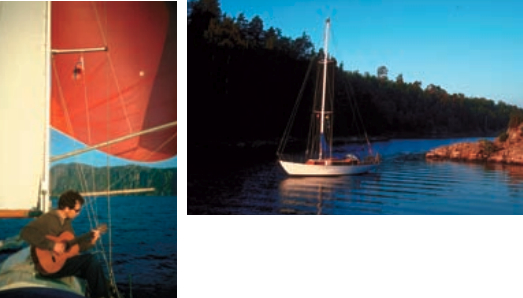
Since then, her sails have taken us to places we never imagined we’d visit. We’ve played football with Omani coast guard officers, dined on rotten goat’s-milk cheese in Sudan, and picked olives with the Greeks. We’ve haggled in Turkey, crossed a canal-bridge over a French river, and spent a sub-zero winter north of the Arctic Circle in Norway. Somewhere along the route our “circumnavigation” has turned into a lifestyle. We work as we go, but the lure of the sea rarely lets us stop in one place for very long.
If by now you’re picturing an idle existence of aimless wandering, you’ve overlooked maintenance. Cruising folk on old wooden boats are always busy. There’s no wriggling out of it. Siandra would sink if we carried all the tools we’d like, but with a reasonable selection and a lot of improvisation we’re almost self-sufficient. Doing our own work not only saves money, it ensures we end up with the result we want.
That’s the theory, anyway. In practice our enthusiasm usually sputters out somewhere between the crucial jobs on the list and more cosmetic details like interior paintwork. But from time to time we stumble across the right materials or facilities to do one of the non-crucial numbers, and the restoration creeps toward completion.
It’s been said a thousand times: “Simplicity is the key to inexpensive, hassle-free boating.” Unfortunately, in this age of aggressive marketing, it’s easier to say than to do. Even though we live simply, so strong is the push for technology, we have to constantly remind ourselves we don’t need it.
The bottom line is that gear equals money, equals labor, equals time ashore (and we’d prefer to be sailing). We don’t feel deprived in any way. Sextant navigation is fun and keeps the brain cells pumping; a solar shower and bucket toilet are just as efficient (and much easier to clean) than their permanently-installed counterparts; and life without a fridge is no hardship if your tastebuds are adaptable. We try to restrict gizmos to things we can fix ourselves (anchor winch, windvane) or ones with little to go wrong (solar panel, diesel heater).
Six months’ provisions
I suspect that when Arthur Robb penned the Lion’s graceful curves, he was more interested in aesthetics than in load-carrying capacity. We like to travel with at least six months’ worth of basic provisions, so weight is something we’re always trying to whittle down. (Dried foods are the trick; we avoid tins, glass jars, and cartons whenever possible.) Finding space for everything is a monumental challenge, but as other liveaboards will testify, no matter how big your boat, the lockers will always be bursting.
Maybe Siandra’s not the perfect cruising boat, whatever that might be, but no other would suit us as well. Since 1992, she’s been our home and our ticket to freedom. She’s given us hours of joy at sea, led us into a thousand adventures, and introduced us to friends we’ll value for life.
Niki and Jamie left Australia in 1992 to cruise in their 35-foot Lion class sloop, Siandra. After crossing the Indian Ocean, they spent several years exploring Europe, including an icy winter in Arctic Norway. They are spending this summer in Maine.
Thank you to Sailrite Enterprises, Inc., for providing free access to back issues of Good Old Boat through intellectual property rights. Sailrite.com