 Install a day tank to ensure a clean fuel supply at the ready.
Issue 129: Nov/Dec 2019
Few things give me the willies more than the thought of navigating an inlet, cut, or tricky channel when we’re running on fumes. The threat of sucking air, water, or dirt into the engine when the tanks are nearly empty is too great. Coupled with somewhat less-than-accurate fuel gauges on Andiamo, our 1988 Brewer 44, this kind of scenario ensures that I never let the diesel level in the tanks drop below a quarter full; in fact, I fill up even sooner than I probably need to.
This abundance of caution means that we carry around a lot of fuel, but a usable capacity of much less. From the 130 gallons we carry in two main tanks, we should have a range of about 675 nautical miles (at 1,600 rpm), in theory. In practice, our range is closer to 500 nautical miles.
However, I recently discovered a brilliant solution that has extended our motoring range by some 25 percent, while letting me drain my main tanks dry without fear of clogging my injectors or running out of fuel at a terrible time, as well as a few other benefits. I installed a day tank.
A day tank is a small fuel tank that draws from the main tanks and feeds the engine. Plumbed into the existing system between the primary fuel filter and the lift pump, a day tank effectively isolates the engine from the main tanks. Day tanks used to be common, but they’ve fallen out of favor for some reason. I couldn’t be happier with mine.
I generally fill the day tank at the beginning of each trip or at the beginning of each watch, keeping an eye on its fuel gauge. When I see the level drop to about the halfway point, I fill it up again from one of the main tanks, which takes about five minutes. If I didn’t have a gauge on the day tank, it would be easy to peek into the engine room and glance at the translucent tank to see how much fuel is left.
Another great feature of the day tank is that I’m able to run the fuel pumped from the main tanks to the day tank through the 10-micron primary fuel filter, ensuring that the fuel in the day tank is always free of dirt and water. If rough seas stir up dirt or sediment in the main tank and clog the primary fuel filter, I will still have several hours of run time using the clean fuel in the day tank to solve the filter problem. And, a day tank eliminates the need for a separate fuel polishing system.
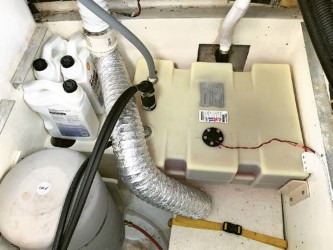
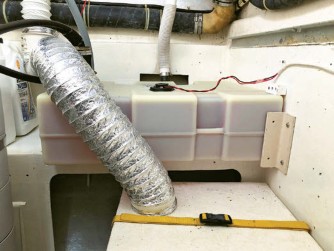
Aboard Andiamo I found a convenient spot in the engine room above the engine to install a 12-gallon off-the-shelf polyethylene tank that I bought from Moeller. I also bought an additional electric fuel pump to move fuel from the main tanks to the day tank, some fuel hose for the plumbing, a switch for the pump, and a fuel gauge.
It’s critical that the tank be solidly secured. You can either strap it down or secure it as I did with aluminum L brackets bolted to the deck and wooden blocks glued to the deck with 5200. It’s wedged in and does not move at all, even in the roughest seas.
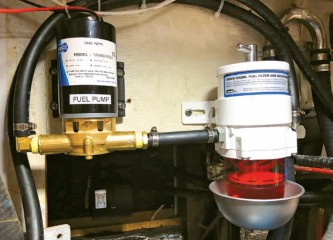
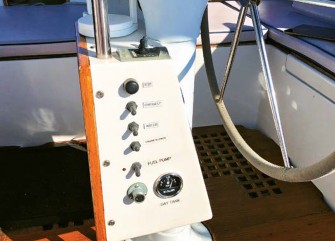
Next, I installed the new electric fuel pump between the main tanks and the day tank, after the primary filter. I ran a hose from the filter to the pump and from the pump to the day tank. I wanted a dedicated switch on the binnacle to operate the pump, so I installed that switch with its attendant wiring, including a wire from the day tank’s sender to a new fuel gauge, which I also installed on the binnacle.
I then re-routed the return hose on the engine to the day tank (if you skip this step the fuel in your day tank will be consumed too quickly). Lastly, I re-routed the fuel line from the lift pump to the day tank and installed a vent from the day tank to the outside.
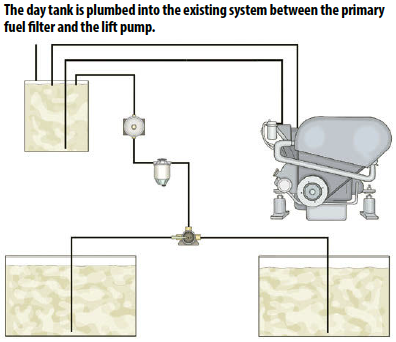 One mistake I made initially was to plumb the day tank directly to the secondary fuel filter, bypassing the lift pump, because I assumed gravity would provide enough pressure to feed the engine. This didn’t work because the secondary fuel filter needs more incoming pressure to keep up with the draw from the high-pressure pump that feeds the injectors. As a result of trying to rely on gravity, the engine would stall after about 20 minutes.
Bonus benefits aside, the day tank’s greatest advantage is peace of mind. As I’m about to enter that ocean cut with a 10-foot swell nipping at Andiamo’s stern, I know with certainty I’ve got at least a few gallons of clean fuel that will keep the engine running sweet and steady.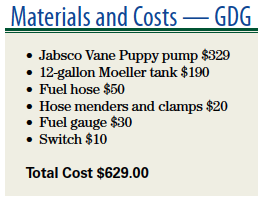
Gino and Carolyn Del Guercio have lived aboard their Brewer 44 Andiamo for the past two years, spending summers in New England and winters in the Bahamas. Andiamo is a two-time Good Old Boat cover girl, appearing most recently on the September 2019 cover.
Thank you to Sailrite Enterprises, Inc., for providing free access to back issues of Good Old Boat through intellectual property rights. Sailrite.com