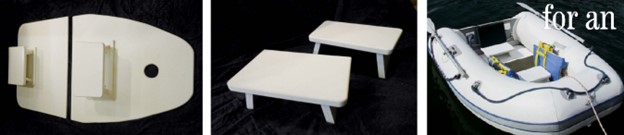
A deflated blow-up makes way for something solid
Issue 117: Nov/Dec 2017
We bought our Mercury inflatable dinghy 11 years ago, despite some misgivings about the concept of its inflatable floor. The dinghy has proven to be very durable and, at just 60 pounds, is easy to lift in our davits. Unfortunately, the inflatable floor hasn’t fared so well. Dogs, fishhooks, anchors, and general wear and tear led to lots of holes and many patches. And there were two other problems: a design goof had the inflatable floor blocking the hole for the transom drain, and the dinghy was very cramped with two people sitting on the floor while rowing. It was time to add a rigid floor with fixed seats.
We had several criteria for a rigid floor. It would have to be light, weather-resistant, tough, attractive, easy to fabricate, and inexpensive (the necessary materials should be available at Home Depot). I decided on expanded cellular PVC for the floor material. A 1/2-inch-thick 4 x 8-foot sheet of this cousin of basic PVC pipe costs twice as much as pressure-treated plywood, but weighs the same. Its surfaces, including the cut edges, are impervious to water intrusion, it has a faux wood-grain pattern on one side, can be cut and shaped with standard woodworking tools, and is easy to glue.
I started by tracing the shape of the inflatable floor onto the cellular PVC sheet, then cut it out using a table saw and a jigsaw. I cut a hole in the floor to give me access to the inflating port for the keel tube and another to allow the transom plug to drain. To make it possible to fit the floor between the dinghy’s tubes and its bottom, I cut the floor in two athwartships.
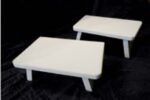
I fashioned two seats and their supports from a double thickness of the PVC glued together and glued them to the floor. The passenger seat, in the stern, has a padded back that we fold down when we attach the outboard.
While cellular PVC is almost impossible to break, the sheets are flexible. To stiffen the floor, I laminated a narrow piece of 1/2-inch marine plywood transversely on the under-surface of each section. In a belt-and-suspenders move, I used steel pins to back up the adhesive.
For the adhesive, I used polyurethane (Loctite PL Premium) for everything, including the marine plywood. It is easy to work with, stores well between applications, and the overflow from clamping cleans up easily. It’s also cheaper than two-part epoxies.
Even though I’d softened them, I was concerned about the edges of the rigid floor abrading the hull tubes. To guard against this, I cut the padded perimeter off the original inflatable floor. Before inflating the dinghy, I fit it around the chamfered edge of the rigid floor, where it’s held in place by the pressure between the floor and the hull.
The result was a two-piece rigid floor that is durable, attractive, easily installed, and cost less than $100 to build. Our davits and biceps can handle the 20 pounds the new floor and fixed seats add to the weight of the dinghy. Most important, the new floor will never, ever need a patch.
Fred Bagley and his wife, Jennifer, live in Vermont but sail the Upper Great Lakes out of Cheboygan, MI, near the Mackinac Bridge. They primarily cruise Georgian Bay, the North Channel, and Lake Superior on their Caliber 38, Catamount.
Thank you to Sailrite Enterprises, Inc., for providing free access to back issues of Good Old Boat through intellectual property rights. Sailrite.com