Narrowing the field
Issue 55 : Jul/Aug 2007
This excerpt from Beth Leonard’s new book, The Voyager’s Handbook, second edition, is the first of a three-part series on selecting the right sailboat for extensive passagemaking. Adapted with permission from International Marine.
Marine books and pages devote thousands of pages and millions of words to describing the “perfect” offshore yacht. Yet very few of us can afford the new boats reviewed in the pages of the marine magazines. Those of us with fi nite resources and a desire to do more than dream have all had to compromise to find a capable, seaworthy boat that fi ts our budget. As much as most cruisers love their boats, we’ve never met a crew who claimed their boat was perfect.
When it comes to boats, the opinions of experienced bluewater voyagers are often difficult to reconcile and sometimes even completely contradictory. Should you buy a 30-foot, heavy-displacement, full-keel design like Lin and Larry Pardey’s Taleisin; a 78-foot, light-displacement, fin-keel design like Linda and Steve Dashew’s Beowulf; or one of the thousands of designs in between? Or should you consider one of the many production cruising multihulls now on the market? Where do you start when figuring out what boat will be right for you?
The first and most important step is determining how much boat you can afford. The amount you can spend will reduce the galaxy of available boats to a mere solar system.
You will be able to narrow the options even further when you decide what type and size of boat best suits your needs and what age of boat best fits your budget. From there, it’s a matter of legwork and perseverance. You’ll need to evaluate individual boats against the requirements for a competent offshore voyager until you find the right boat for you — one you can afford that not only meets your requirements for comfort and safety but also touches your heart and captures your imagination.
Go to a place like Papeete in Tahiti or Las Palmas in the Canaries at the height of the cruising season, and you will find every conceivable combination of design, hull material, keel configuration, rig, age, and size. Older, smaller, less expensive boats allow people without much money to live their dreams and keep company with those who can afford the newest, biggest, and most modern blue-water voyagers.
What type of boat do you want?
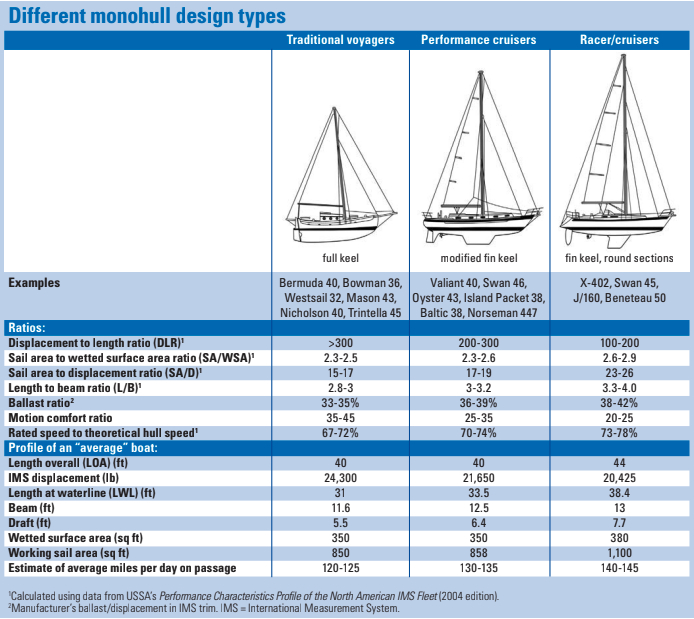
Even a cursory look at the variety of “expert” opinions out there makes it clear that reasonable people can come to very different conclusions when picking a boat for cruising. One key to finding a boat you will be happy with, one you will trust and enjoy living aboard, is understanding how your needs match up against the strengths and weaknesses of the various types of cruising boats. Offshore monohull design has produced four major cruising boat types; the three most popular are shown in the table on Page 29. Each new type has incorporated proven innovations in design and materials from offshore racing yachts into offshore cruising boats. These types are not discrete — they lie along a continuum, and many boats straddle the borders between them. But they differ markedly along all the major design parameters and make different trade-offs between comfort and speed.
Over the last century, production yachts designed for offshore sailing and bluewater cruising have become lighter, more powerful, and more manageable. Boats at the cutting edge have always pushed the limits of durability and comfort, and sometimes of safety. Each stage of yacht design includes seaworthy, livable vessels that can make excellent long-term bluewater voyagers as well as boats that lack the stability or durability to live up to the sea’s exacting standards.
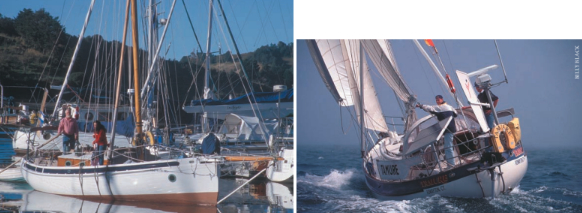
Traditional voyagers – Early offshore cruising boats were made from wood and incorporated the knowledge gained over generations to create strong, safe, seaworthy boats. The lines were taken from small vessels meant to brave the meanest of seas, such as coastal trading and fishing boats, whaleboats, and Scandinavian double-enders originally designed as pilot boats and rescue craft. Spars were constructed from wood; sails were made from canvas; line was made from hemp. These materials limited design innovation. The traditional voyager that resulted had been taken to the highest level of design possible, given the strengths and weaknesses of the materials available.
When fiberglass began to replace wood as the material of choice for boatbuilding in the late 1950s and early 1960s, many boatbuilders took proven wooden designs and built them in the new material. Thus, most of the earliest traditional voyagers have long full keels, often with transom-hung rudders; most are relatively shallow for their length, and many are double-enders. Examples include the Bristol Channel Cutters, the Colin Archer designs, and the Westsail 32. These are the types of boats that sailing authors Lin and Larry Pardey advocate for offshore cruising. A few production boatbuilders — such as Cape George and until recently Sam L. Morse — produce such boats. Other builders — such as Pacific Seacraft, Cabo Rico, and Malö — build modified fin-keel boats with skeg-hung rudders whose ratios put them in the traditional voyager category. Sailing author Nigel Calder prefers these boats, which combine some elements of modern design with the strength and comfort of traditional voyagers.
As the table shows, traditional voyagers can be characterized as slow but safe and comfortable. By modern stan- dards, they displace a lot and don’t carry much sail area for their displacement. They will rarely reach hull speed and will exceed it only if caught by a 40-knot squall while running downwind under full sail. The large keel area and heavy displacement damp motion in a seaway, allowing the crew to move around safely and sleep comfortably.
Traditional voyagers take care of their crews and are comfortable even in a blow. They are easy to heave-to and to control when running off in anything but extreme breaking seas, and they can manage just about any conditions as long as they have sea room. But their shallow keels and low ballast ratios make for disappointing performance to windward. They are sluggish under power, difficult to maneuver in a marina, and all but impossible to back up in a straight line. They’ll get even inexperienced crews safely to port, but they may take a few days longer to do it than more modern designs.
Performance cruisers – In 1973, Bob Perry drew the lines for the Valiant 40, which married a skeg-hung rudder and a modified fin keel to the balsa-cored fiberglass decks and larger rig becoming prevalent in the offshore racing fleets. With a displacement to length ratio (DLR) around 250 and a sail area to displacement (SA/D) ratio around 17, the Valiant 40 had more in common with the racy Cal 40 than the offshore cruising boats of the time. The term “performance cruiser” was coined to describe this groundbreaking example of a new genre of bluewater cruising boats.
Over the last three decades, dozens of production boats have been built incorporating many of the elements of the Valiant design philosophy. A number of these are still being manufactured today and are considered by many to represent the perfect marriage between performance and comfort. These include the current range of Hallberg-Rassys, all but the newest Swan and Oyster designs, Calibers, Passports, Shannons, Tayanas, Taswells, and, of course, the Valiants, to name just a few. Some older designs with modern underbodies originally intended for coastal cruising or offshore racing — such as the Ericson, Cal, Tartan, and International Offshore Rule (IOR) One-Ton designs — have also joined the ranks of offshore voyagers.
When we began our first circumnavigation in 1992, most new charter and coastal boats carried fin keels and spade rudders, but these had been incorporated into only a few offshore production cruising boats. By the time we left on our second voyage in 1999, more than a quarter of the production boats being built for offshore cruising had fin keels and spade rudders. Today it’s hard to find a newly introduced bluewater design with a full skeg or relatively long keel. In practice, this means that new boats maneuver much more easily under power, but it also means the occasional rudder failure as new materials such as carbon fiber are adapted to this high-load purpose.
The vast majority of cruising boats sailing the world’s oceans fall within the performance cruiser category. They run the gamut from the Island Packets with their cutaway full keels to middle-aged Swans with their fin keels and spade rudders. Over the course of three decades, new materials such as foam cores, S glass, and more recently Kevlar and carbon fiber have been incorporated into the next-generation hulls. Each time lessons have had to be learned about the shortcomings and limitations of the new materials, and some production designs suffered from osmotic blistering, core failures, and delamination. Over time, boatbuilders have learned how to address these issues to create lighter, stronger boats.
A number of well-known sailing writers have made voyages in boats whose ratios put them into the performance cruiser category, including Liza Copeland, John Neal and Amanda Swan-Neal, Webb Chiles, and John Gore-Grimes. Both of our boats have been performance cruisers, though at opposite ends of the spectrum. Our Shannon 37, Silk, fell near the border with traditional voyagers, while our Van de Stadt 47, Hawk, lies near the border with racer/cruisers. Their quite distinct sailing characteristics help clarify the differences between the various categories.
As the table below shows, although the performance cruisers are still heavy enough to carry cruising loads without sacrificing performance, they are large enough, light enough, and have enough sail area to average an extra 10 to 15 miles per day on long passages. Their moderate keel areas and displacements keep motion comfortable even in large seas, while more efficient ballasting provides greater stability (and therefore sail-carrying ability) than many traditional designs. Depending on keel configuration, these boats range from easy to all-but-impossible to heave-to, but their greater stability means they need to heave-to infrequently, if at all, in trade wind conditions. Most run off very well, although those capable of surfing may require some active management (such as trailing a drogue) to remain in control. Performance cruisers sail much better to windward than traditional voyagers and are reasonably agile under power.
The performance cruisers also have more interior volume than traditional voyagers and are almost as comfort- able and as hard to get into trouble with. In the most extreme conditions, however, they are slightly less forgiving and demand slightly more from their crews.
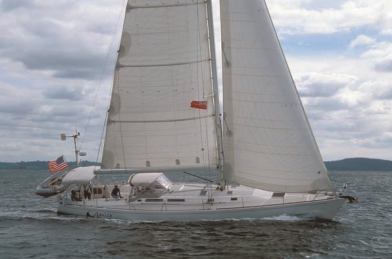
Racer/cruisers – New, lighter, stronger materials — including carbon fiber for hulls and spars, Kevlar for hulls and line, and Spectra for line and sails — have been developed for use on sailboats. In some cases they failed initially, but eventually they proved their usefulness aboard round-the-world racing boats. These materials, along with aspects of high-performance boat design, have slowly been adapted to offshore cruising boats.
When the materials became light and strong enough to build a durable, offshore-capable boat with a DLR of less than 200, the bluewater racer/cruiser was born. Many of these, such as the J/40 and J/120, were intended for racing first and foremost; others, like many of the Beneteaus and Jeanneaus, were designed for the burgeoning charter market. As these designs have grown dated, boats like the Beneteau First 40.7 and the larger Js have found their way into the offshore cruising fleet. Others, such as the J/160 and Farr Pilot House designs, were introduced as high-performance offshore cruising boats capable of sailing 200-mile days.
Like the boats at the performance end of the performance cruiser spectrum, racer/cruisers all have fin keels and spade rudders. But their keels and rudders tend to be deeper, and their hulls have flatter sections, have finer entries, and carry their beam farther aft. Keel and rudder foils have improved in both hydrodynamic efficiency and balance. Ballast is often concentrated in a bulb end plate attached to the bottom of the keel, which increases the righting moment created by a given weight of ballast. Their lighter displacements allow them to carry less sail area than a similarly sized traditional or performance cruiser design, easing sail handling for a shorthanded crew. In International Measurement System (IMS) trim, these boats sail faster on every point of sail, point higher, and surf far more easily than performance cruisers.
However, the current racer/cruisers have some drawbacks as long-distance offshore voyagers when compared with their heavier counterparts. Their flatter, fatter hull shapes surf well and create spacious accommodations, but their shallow bilges offer little in the way of stowage and don’t keep bilge water confined to the sump. To maintain their performance edge, these boats need to be kept reasonably light, which means they can’t carry the same payload as heavier boats. While modern sail-handling techniques have made large sail plans manageable for a shorthanded crew, racer/cruisers can be unforgiving if caught with too much sail up in a 40-knot squall. The speeds these boats are capable of reaching can lead to pounding in big seas. Many crews we’ve met on racer/cruisers slow the boats down in stronger winds to improve the motion, which reduces their performance advantage.
Running downwind in heavy weather and large waves, these boats will surf at exhilarating speeds even under bare poles. Although most remain under control if hand steered, some will not look after themselves under self-steering unless slowed down. The forces generated when a boat falls off a wave at 15 or 18 knots instead of 6 or 7 puts huge shock loads on sails, rig, rudder, and hull; as a result, these boats need to be significantly stronger than heavier boats, in large part because they can sail faster. At the same time, some extra material here and there to add strength makes little difference in a heavy boat, but a light boat has to be engineered and built exceptionally well to stand up to more than a few years of offshore cruising.
The difficulties of building strong, lightweight production boats have led to a number of problems, including broken rigs and rudders, bulkheads separating from hulls, keels cracking, keel bolts breaking, and hulls flexing and sagging. Boats marketed as offshore cruisers from their inception are more likely to stand up to the rigors of long-distance bluewater cruising than those originally designed and built for racing and chartering.
As the table shows, racer/cruisers deliver, on average, 10 to 15 miles more each day than performance cruisers and 20-plus miles more than traditional voyagers. To realize that potential, however, a boat must be kept light, which normally means not taking along many gadgets and goodies. It also means not carrying as much in the way of stores, fuel, or water, which translates into less self-sufficiency and a more limited cruising range. And although passages may be faster, they’re likely to be more uncomfortable in boisterous conditions. The boat will need to be actively managed instead of left to her own devices running before strong winds and big seas.
On the other hand, even when slowed down, these boats can easily and comfortably average 6 knots over the course of a long offshore passage, more than respectable for any cruising boat. Racer/cruisers sail extremely well on any point of sail, so they will be able to sail themselves out of just about any situation. They are agile and efficient under power and easy to maneuver in a marina. These boats need an experienced crew to keep them out of trouble, but they’ll often be the first boats into port, and their crews will be relaxing on deck drinking margaritas when the rest of the fleet makes its way in.
Cruising sleds – In the last decade, materials and building techniques have improved to the point that the fastest monohulls in the world now have DLRs of less than 100 and SA/D ratios well over 30. Sometimes called ultralight-displacement boats (ULDBs), these include maxi racers such as Skandia, the 2004 winner of the Sydney-to-Hobart race, and the Open 60s used in the Vendée Globe nonstop, round-the-world race. It was only a matter of time before someone translated this thinking to production cruising boats, and today there are a few examples of what have been dubbed “cruising sleds,” most notably the Santa Cruz 52.
All the attributes of racer/cruisers apply even more so to cruising sleds. The boats can be very fast, and they do manage 200-mile days, but they must be kept very light. Hal Roth completed two BOC races in his Santa Cruz 50, American Flag, which proves that at least some of these boats can withstand Southern Ocean-style punishment. However, production cruising sleds are too new to have a proven cruising track record, so their long-term durability remains to be demonstrated.
Many design innovations are occurring in this category as naval architects try to adapt aspects of the maxi, Vendée Globe, and Volvo raceboats to cruising boats. Designers have been experimenting with ways to reduce keel depth, and the current approach uses hydraulically lifting keels. These are complex and take up a lot of space in the interior, but several newer cruising boat designs have incorporated them. Other innovations from racing boats, such as water ballast to make a boat sail flatter and faster and twin rudders to prevent rudder stalling and cavitation, have made their way into some of these cruising designs.
Whether racer/cruisers and cruising sleds ever come to dominate offshore cruising as performance cruisers have done in the last two decades will depend upon how durable and comfortable they prove to be. No matter what the majority decides, there will always be people willing to sacrifice comfort and cruising luxuries for sailing performance, just as there will always be people willing to sacrifice sailing performance for comfort and manageability.
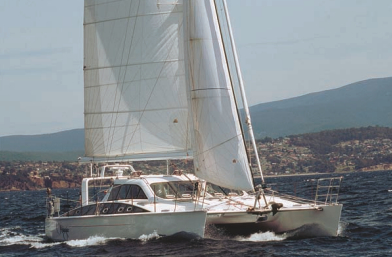
Cruising multihulls – Monohulls still make up the vast majority of the offshore cruising fleet, but multihulls, particularly catamarans, represent a small but growing percentage. In 2003, 9 percent of the boats participating in the Atlantic Rally for Cruisers (ARC) were multihulls, and that percentage is likely to continue to increase.
Most of the performance ratios used to evaluate monohulls cannot be applied to multihulls, nor do multihulls sort themselves into convenient groupings that can then be compared. But multihulls sail and cruise differently from monohulls. To decide if a multihull makes sense for you, you’ll need to weigh the advantages against the disadvantages, just as when trying to choose among different types of monohulls.
We have met dozens of crews cruising in multihulls, and we interviewed a half dozen of those who have cruised catamarans for a long period of time and through a wide variety of conditions. We have never met anyone living aboard and cruising a trimaran. Even 50-foot trimarans are too limited in space and weight-carrying ability to function as comfortable, long-term homes. The following comments, therefore, focus on modern cruising catamarans.
When most sailors think of catamarans they think of speed, but speed is not one of the first advantages cited by most experienced catamaran cruisers. Other things — such as space, shoal draft, and sailing flat — usually get mentioned first. When the discussion turns to speed and sailing performance, many of the comments mirror what we hear from those aboard racer/cruisers or cruising sleds.
If kept light, multihulls surf much more easily than any monohull. But in practice, very few of those we know aboard cruising catamarans under 45 feet in length manage to keep them light. Weight in the bows can be a particular problem, as the bows will bury going downwind, limiting the cat’s ability to surf. On average, over long passages, an overweight cruising cat won’t outperform a monohull with a similar waterline length, and we’ve met many cruisers who have been disappointed with their cat’s performance in the real world.
On the other hand, like Steve Dashew’s hybrids, bigger cats with enough waterline to absorb some payload do manage to sail significantly faster than monohulls with similar waterline lengths. Steve and Dorothy Darden on Adagio, a 52-foot Morrelli & Melvin-designed catamaran, have averaged between 190 and 200 miles per day on a half dozen passages, including the slantwise run from New Zealand to Alaska across all the weather zones of the Pacific. The fastest cruising cat we’ve encountered was a 55-footer designed in Australia. The first 12 feet of each bow consisted of sealed, watertight buoyancy compartments. This greatly reduced interior space but kept the boat light and the bows from burying in waves. The family of four still had more room aboard than most cruisers have on a 60-foot monohull, and they averaged 190 to 200 miles per day.
But large cruising cats, like large cruising sleds, are often not sailed to their full potential. Under certain conditions, most catamarans will suffer wing slams, waves that come up under the bottom of the boat and crash into the bridge deck or into one of the hulls. The two conditions that cause this, either alone or in combination, are sailing at high speeds, when the bow waves interfere with one another, and sailing in confused seas. If this “thunder down under” gets too violent, the crew will often slow the cat down. Extra bridge deck clearance helps reduce slamming, but at the expense of increased windage. Multihulls have the advantage over similar-sized monohulls only when sailing off the wind in light to moderate air, when their speed helps bring the apparent wind forward and their limited underbody profile minimizes drag.
So although speed may play a part in the choice of a catamaran, in all but the biggest cats it often turns out to be less important in practice than in theory. Most multihull cruisers we’ve interviewed rate space as the number one advantage of catamarans over monohulls. When cruising with children or guests, the separate hulls offer a degree of privacy virtually unobtainable in a monohull less than 60 feet long. Mechanical and electrical equipment can be completely isolated from living areas, eliminating noise, vibration, and unpleasant odors. Most catamarans 40 feet and over have plenty of room for a dedicated workshop or a dedicated office, and often for both.
Shoal draft probably ranks second among the considerations for picking a catamaran. Even relatively heavy cats in the 50- to 60-foot range will have a draft of only 4 1⁄2 or 5 feet, a foot or more less than fixed-keel monohulls of similar size. If the hull is designed properly, a cat can be safely beached in order to paint the bottom or repair damage.
Several other advantages become clear only after you’ve spent some time aboard. The fi rst time we entered Adagio’s main saloon, Steve Darden greeted us with, “Catamaran advantage number one — visibility.” We were treated to a 360-degree view of the cliffs of 4,000-foot-high Mount Wellington towering over the city of Hobart in Tasmania. In addition to its aesthetic advantages, 360-degree visibility from a dry watchkeeping station increases safety on passage.
Many experienced sailors value the redundancy a catamaran provides. Dual rudders, dual autopilots, dual engines, and dual tankage offer an added margin of safety when things go wrong. The twin engines make a catamaran significantly more maneuverable than a monohull without a bow thruster. They also provide redundancy in power generation. Having two engines makes catamarans excellent “powerboats,” especially if the engine rooms are isolated from the living quarters. Of course, all that redundancy also translates into higher costs and more maintenance — nothing comes for free!
Sailing flat comes as a revelation to anyone who has always sailed on a slant. You can leave the dock without stowing the tomatoes sitting on the counter or the computer on the nav table. You can head off on passage without putting up leecloths and move around the boat without having a hand firmly on a handhold. When other boats are rolling gunwale to gunwale in an anchorage, a catamaran will do little more than sway a bit from side to side.
Catamarans do have their disadvantages, but these are not as obvious as they might appear. The motion, which most people see as an advantage, can be a problem for some. When the U.S. Navy was testing hull forms for use on troop ships, the multihull form proved to be more fatiguing than comparable monoholls. Anybody who has sailed a monohull knows that the body learns to anticipate what will happen next and compensate for it. But the two hulls on a multihull often move to two different waves, with no discernible pattern. When conditions really deteriorate, some crewmembers may feel “like a golf ball teed off in a bathroom,” as one experienced offshore multihull sailor put it.
If you’re like most sailors, you know how you react to the motion from strong winds and big waves on a monohull but have never experienced such conditions on a multihull. If you’re considering purchasing a multihull and have never sailed one, charter a catamaran with your crew for a few weeks and make sure to take it out in some moderate waves to see how everybody reacts.
Many people are put off by the fact that, with a catamaran, what goes down doesn’t necessarily come back up. Monohulls depend upon weight in the keel for stability; catamarans depend on their beam and overall size to stay upright. If a well-designed monohull capsizes, its keel will help bring it back upright. But when a catamaran capsizes, it won’t right itself. On the other hand, monohulls sink, which properly designed catamarans shouldn’t do. In the end, a large, well-built multihull is about as likely to capsize as a large, well-built monohull is likely to sink. Both events are rare. In our decade of offshore voyaging, we know firsthand of one case of a monohull sinking and none of multihulls capsizing.
One serious disadvantage of a multihull can be finding a place to “park.” In some cruising areas, few marinas have slips large enough to accommodate the beam of a catamaran over 40 feet in length. Where space is available, marinas may charge for two slips or by the square meter, doubling marina costs. On the plus side, a cat can easily carry a large dinghy with outboard motor on davits, making anchoring and dinghying to town more convenient than on many monohulls. Still, fi nding places to take on fuel and water can be problematic in parts of the North Atlantic, South Africa, Japan, and South America, where marinas were built to cater to 35-foot monohulls. Like racer/cruisers and cruising sleds, cats need to be built strong enough to withstand the forces they generate. When a monohull heels, it dissipates much of the force of the wind in the sails. Multihulls don’t heel, so their rigging and sails must be significantly stronger than on a similar-sized monohull.
As with racer/cruisers and cruising sleds, building a strong, light, durable boat is much more difficult and expensive than building a strong, heavy one. Cruising cat design is still in its early stages compared with monohull design. Catamarans now 15 to 20 years old were built very early in the design evolution, when many structural issues had yet to be resolved. Rudder loads can be quite high on a catamaran, and this is a common area of failure in older cats. This is where duality makes a big difference — a cat that has lost one rudder can still be steered with little difficulty until the rudder can be fixed.
Ten years ago, new catamarans could easily be double the price of a new monohull of similar overall length. Very few of the catamarans available are more than 15 years old, which means there aren’t many inexpensive ones around. Prices are slowly coming more in line with monohulls and are now almost comparable in the 40- to 50-foot range for 10- to 20-year-old cats. Given that a 40- foot catamaran has at least as much space as a 45- to 50-foot monohull, it can be argued that catamarans cost less than comparable monohulls. The table on the facing page summarizes average prices for 81 offshore catamarans listed in national sailing magazines in the same month.
Many of these catamarans have worked the charter trade; these will have many hours of use on mechanical equipment and may have suffered groundings. After five years in charter, many cats will have 3,000 hours or more on their engines. Engines, transmission, refrigeration, and charging systems may all need to be replaced. Bottom repairs will be the most difficult to spot, since they are often covered well with fiberglass and bottom-paint. Yet there are more good-quality catamarans available now than ever before, and prices should continue to come down as more cats leave charter fleets and find homes with voyaging crews.
As with the different types of monohulls, catamarans suit the needs of a specific set of sailors. If your plans call for a large crew (four or more), a catamaran will be the least expensive way to get a boat with comfortable accommodation for everyone. If you plan to sail in areas with light winds, shallow waters, and good anchorages, a catamaran will offer significant advantages over most monohulls. But you’ll need to buy a strong, structurally sound catamaran, and you may need to reinforce key structural areas like the rudders and the rigging.
What size boat?
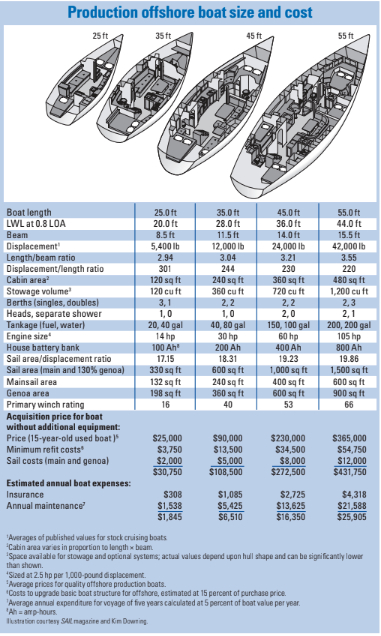
An overly large boat can ruin a voyage. For each 10-foot increase in boat length, the hours spent on maintenance double and boat-related costs triple. Unless you can afford full-time crew, cruising a monohull over 55 feet or a catamaran over 50 feet will likely force you to pick up extra crew for passagemaking. In many places, a large boat will limit the choice of marinas and make it harder to get fuel and water. The larger the boat, the more likely it is to sit for long periods of time once it has arrived somewhere. Very few people take a boat over 55 feet out for a daysail. All of that means more work and less pleasure.
But an overly small boat can cause just as many problems. A boat under 30 feet will be uncomfortable and wet in anything but idyllic conditions. Limited space makes it difficult to have friends aboard for more than a day or so, or to take along the personal items and the comforts and conveniences the crew might want. The lack of stowage space can result in a monotonous diet, and the boat won’t be able to carry much in the way of water, tools, or spares. Self-sufficiency and cruising range will be more limited than on a larger boat. The lack of privacy can turn minor annoyances into irreconcilable differences.
Everything aboard a cruising boat is a trade-off, and size is no exception. During our circumnavigation aboard 37-foot Silk, she was about average in size for an offshore cruising boat. At that time, the conventional wisdom was to buy the biggest boat you could afford, and almost everyone we met wanted a bigger boat. Those we know who went cruising a second time all went up 10 feet in length, from an average of 33 feet to an average of 43 feet. We wanted a boat around 42 feet, but we couldn’t find one that met our requirements and included a well-integrated hard dodger. At 47 feet, Hawk is just a bit above the average among today’s offshore boats. Now most of the long-term cruisers we meet do not want a boat larger than the one they are on. Instead of the biggest boat you can afford, I would say that you should buy the smallest boat on which you can live comfortably.
Advantages of a larger boat
Our experiences in moving from Silk to Hawk help clarify the trade-offs between different sizes. By going up 10 feet in boat size, we have gained stability, speed, and space, but the benefits of these gains, while real, have not always been exactly what we expected.
Stability – Size does matter when it comes to stability, but smaller boats can be perfectly safe as long as their limits are respected. In conditions where Hawk will happily keep sailing, we would have hove-to on Silk. We might not have been making miles toward our destination, but we would still have been perfectly safe. Hawk’s stability and her ability to sail well to windward keep us sailing in a lot of conditions where she’s far happier than we are. But we have depended upon that stability to keep us upright several times in our five years of high-latitude cruising, particularly on the 9,000-nautical-mile Southern Ocean passage eastabout from Cape Horn to Fremantle, Australia.
Speed – We’ve averaged 148 nautical miles per day on Hawk compared with 117 on Silk, with part of that increase coming from Hawk’s stability; that is, her ability to keep going in heavy weather instead of heaving-to. Yet what does that speed really buy us? On a 1,500-nautical-mile passage it means we spend 10 days at sea instead of 13. That may sound like a lot, but after the first week, once we get into the rhythm of a passage, a few days doesn’t make any real difference to us. We still cannot outrun fast-moving low-pressure systems.
Our increased hull speed benefits us most where we least expected it, by extending our coastal cruising range during daylight hours. We can now sail some 30 percent farther between ports during the day, which has greatly reduced the need to sail at night in reef-, rock-, or iceberg- infested waters.
Space – Most of Hawk’s 10 feet of extra length have been devoted to watertight compartments in the bow and stern and a large sail locker forward. As a result, we don’t have much more usable interior length than we did on Silk, but we do have much more space. Hawk’s 3 feet of extra beam translate into a tremendous amount of interior volume (see the table on Page 33). Most of that space is devoted to stowage: twice as much water and fuel tankage as Silk carried, three times as much clothing storage, twice as many large compartments dedicated to food, four times as many bookshelves, and five times as many toolboxes. This, in turn, translates into much greater self-sufficiency. Our extended cruising range has allowed us to spend up to three months in isolated and uninhabited areas like the Chilean channels.
Disadvantages of a larger boat
We knew there would be downsides to a larger boat, though for our higher-latitude, liveaboard agenda, we didn’t think they would begin to outweigh the benefits, and indeed they have not. None of what follows should have surprised us, but as with the advantages we envisioned, the reality hasn’t always matched the theory.
Cost – Costs to maintain a boat at least triple with every 10-foot increase in size. We averaged about $5,000 per year in boat-related expenses for Silk, but we’ve averaged over $15,000 per year for Hawk. Both numbers are pretty typical for moderately complex boats of their respective sizes insured at least part of the time. The initial expenditure to buy and outfit the boat also tends to triple with a 10-foot increase in boat length.
Seamanship – Though Hawk is much more stable than Silk and therefore much “safer” in extreme conditions, Silk was much more forgiving. If we misjudged a squall and didn’t get the chute off in time, we could wrestle the sock down over it and manhandle it to the deck. If we wrapped the jib during a jibe, we could unwrap it by hand in light air and with a winch in windy conditions. But brute force gets us nowhere aboard Hawk. She requires much greater forethought, because the forces she generates quickly become unmanageable and dangerous. Silk offered the perfect learning environment while we made every mistake in the book; Hawk demands all the skills we’ve acquired to sail safely.
Fitness – Before we started sailing Hawk, I’d been of the “bigger boat, bigger winches, no problem” school. But we quickly discovered that bigger winches won’t wrestle a weightier anchor out of a locker, won’t flake and tie down an ill-mannered mainsail, and won’t claw down and secure a furling sail if the furler breaks. Only after we moved up to Hawk did I start to notice the direct correlation between the waterline length of racing boats and the size of the crews’ necks and biceps — and those boats have big winches!
Reliance on mechanical aids – No matter how fit we are, we still have to rely on mechanical aids to handle the forces generated by Hawk’s sails and anchors. Some sort of mechanical device needs to be between those forces and us at all times: a self-tailing winch, rope clutch, furler, or windlass. We need additional leverage from some sort of mechanical advantage to adjust our checkstays, vangs, and most of our halyards. We find ourselves constantly walking a fine line between controlling the forces on Hawk and becoming dependent on mechanical aids. Adding in-mast or in-boom furling would greatly facilitate handling our mainsail but would leave us with few options if it broke.
Scale – On a bigger boat, everything is bigger. When coiling lines, your hands need to be larger to hold the loops. You need to be taller to reach the top of the boom to put sail ties over the sail or to attach the halyard to the headboard of the mainsail. You need to be stronger to wrestle an anchor off the bow or out of a locker. A bigger boat may mean that smaller crewmembers can’t manage simple things like putting the sail cover on by themselves.
Our conclusions
In considering the pros and cons of moving up 10 feet, we’ve come to four conclusions. First, it would have been a mistake for us to have started out on Hawk. Given our almost total lack of offshore sailing experience, we needed a boat that would help us get out of trouble, not one that would help us get into it.
Second, somewhere around 40 feet seems to be the optimal length for a “first” offshore boat. This is large enough to stow the basics and some luxuries, such as spare light-air sails and extra fuel and water; to carry a generator and a watermaker without making major compromises in other areas; and to offer guests some measure of privacy without using the main saloon as a sleeping area.
Third, it will be fairly obvious if you really need a boat larger than that. If you have children, intend to have visitors or crew aboard more than a third of the time, plan on “expedition sailing” to remote places for extended periods, or want to pursue some activity, like scuba diving, that requires a great deal of space, a larger boat may well make sense — but only if you’re certain you can afford it.
Fourth, boat size needs to be limited by the fitness and strength of the regular crew. If a furler breaks, the crew must be able to drop a jib in gale conditions and gather it on deck. If the electric windlass fails, the crew still has to be able to retrieve a storm anchor. Otherwise, overall safety actually decreases in a larger boat. Most experienced couples who don’t want to depend upon crew feel comfortable with a maximum length somewhere around 50 feet.
Next issue, in the second part of this series, Beth will discuss screening criteria, such as stability and durability.