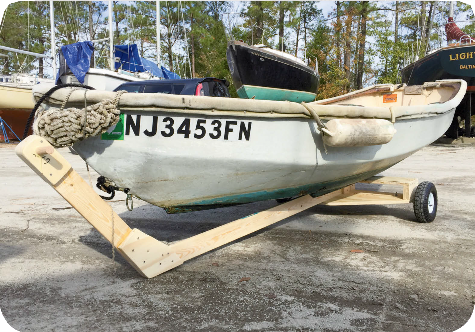
An old design puts cheap wheels under a long-loved tender
Issue 126: May/June 2019
When I moved from New Jersey in the spring of 2018, I sold, gave away, or abandoned a lot of my stuff, including the handcart I used to move my dinghy around. Among its many graces, the cart was cheap to build and maintain, light (I could carry it on the roof of my car), and perfectly balanced with the dinghy on it. Even with the dinghy fully loaded with the outboard and enough gear for a weekend on the water, the cart balanced perfectly at the handle with just a few pounds of load. But after it had given me 30 years of reliable service, I decided the cart didn’t owe me anything and that I would leave it behind for the next guy. I would build a new one when I got to North Carolina.
I built the new cart from half a sheet of ¾-inch CDX plywood, a 10-inch length of broom handle, an 8-foot length of 1 x 4 fir, a 6-foot length of 5⁄8-inch all-thread (for the axle), two stainless steel U-bolts, two 10-inch-diameter inflatable wheels (bigger would be even better), stainless steel deck screws, and exterior-grade Gorilla Glue.
Because I knew the dimensions from before, it wasn’t hard to spec out the new cart. I knew the point of balance on the dink had to rest directly, or nearly so, over the axle, the wheels had to clear the dink in case it wasn’t centered on the cart, and the handle for hauling the cart had to be at waist height.
For the base of the cart, I cut a 36- x 18-inch piece of plywood in the shape of a triangle truncated at the corners. The top piece, on which the dinghy would rest, is a 36- x 6-inch piece of plywood (photo 1).
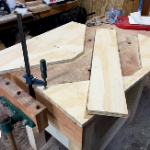
The top and bottom are separated by plywood end pieces consisting of 3½- x 6-inch double thicknesses of plywood glued and screwed together and, in the middle, by the cart’s 1 x 4 spine sandwiched between 3½- x 6-inch pieces of plywood (photo 2). The additional plywood helps stiffen the cart against lateral loads.
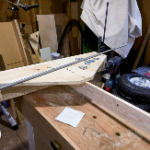
The 1 x 4 spine has a 30-degree (more or less) dogleg at the 6-foot mark, sistered with plywood at the butt joint (photo 3). Where the dowel handle is fixed through it, I reinforced the spine with two pieces of plywood (photo 4).
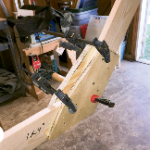
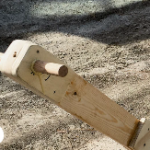
Once the cart was all glued and screwed together, I went over it with a sander and knocked down the edges — I hate splinters. I then fixed the U-bolts, which would hold the axle, to the bottom pieces. They are near the back and outboard, almost at the edges, but I left enough room so I could easily tighten the screws (photo 5).
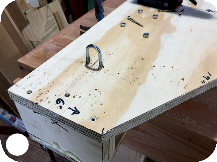
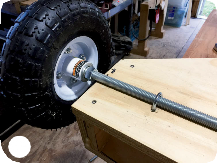
I ran a nut on the length of all-thread far enough for the first wheel, leaving just enough room for another nut outboard of the wheel (photo 6). When one wheel was in place, I installed the axle with the U-bolts, ran another nut all the way back to the outside of the bottom piece, and fitted the other wheel and nut (photo 7). That done, I cut off the excess all-thread and applied a drop of thread lock at each of the four nuts. Experience has taught me that the all-thread should be cut off short enough that none of it sticks out at ankle height.
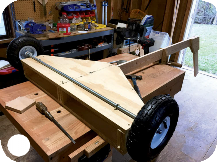
I left the cart unpainted in any way, as I had my previous one.
On the old cart, I had an eye at the butt joint to attach to the bow eye on the dink. That added some stability when hauling it around corners and up the boat ramp, so I’ll add a small cleat at some point in the future. Also, in the past, I made wheels by cutting out plywood discs and gluing enough of them together. That works, but they tended to bog down in mud or wet sand. I’ve come to prefer inflatable wheels, which only require a touch-up with a bicycle pump a few times each season. They last only three or four years, but at $4 each from Harbor Freight, I can live with that.
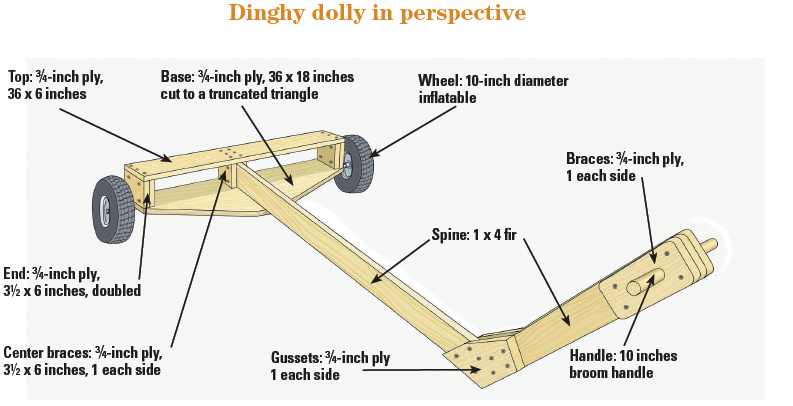 All the dimensions are arbitrary and meant for my dinghy, which is 11 feet 6 inches long (see “Dinghy Ramblings,” May 2016). The spine might well need to be shorter or longer depending on the length of the dinghy to be carried. I made my previous cart with a 2 x 4 spine, but decided I could get away with a 1 x 4 if I could find one without too many knots.
The cart cost less than $50 to build and drew rave reviews at my new boatyard here in New Bern, North Carolina. I expect it to provide many years of service.
Cliff Moore is a Good Old Boat contributing editor. His first boat was a Kool Cigarettes foam dinghy with no rudder or sail. Many years and many boats later, he’s sailing Pelorus, a 26-foot AMF Paceship 26 he acquired and rebuilt after Hurricane Bob trashed it in 1991.
Thank you to Sailrite Enterprises, Inc., for providing free access to back issues of Good Old Boat through intellectual property rights. Sailrite.com