Issue 2 : Sept/Oct 1998
Wet exhaust systems with waterlift mufflers are the common choice for sailboats being built today. They are quiet and, for the most part, reliable. As the good old boat fleet ages, and original exhausts need to be replaced, wet exhaust systems are the preferred retrofit. Unfortunately, there can be problems fitting the standard arrangements into some good old boats. Engines are mounted as low as possible, and hull bottoms may slope upward in a way that eliminates the space needed for the standard arrangement. There are, though, other exhaust systems that are useful and date back practically to the first installation of internal combustion engines in boats. These older systems can solve specific engine and interior arrangement problems. One of the most useful of these is commonly known as the North Sea exhaust. Strangely, this arrangement has been largely forgotten. Indeed, when I employed it on a 42-foot motorcruiser I was designing, the engine manufacturer’s technical staff had never seen the arrangement before. Being a suspicious lot—in spite of all my assurances—they insisted on running it through their computer back-pressure analysis before giving it their official seal. They seemed genuinely surprised, when—after much number crunching—the old and tested North Sea arrangement proved to be very satisfactory.
A North Sea problem-solver
The fact is the North Sea exhaust solves one of the big concerns for any exhaust system: how to prevent water from being forced back up the system into the engine. In addition, those long exhaust runs take up valuable space and are expensive to fit. With the North Sea exhaust, the answer is that you don’t take the exhaust to the transom. Instead, you run it out the side of the hull—on both sides.
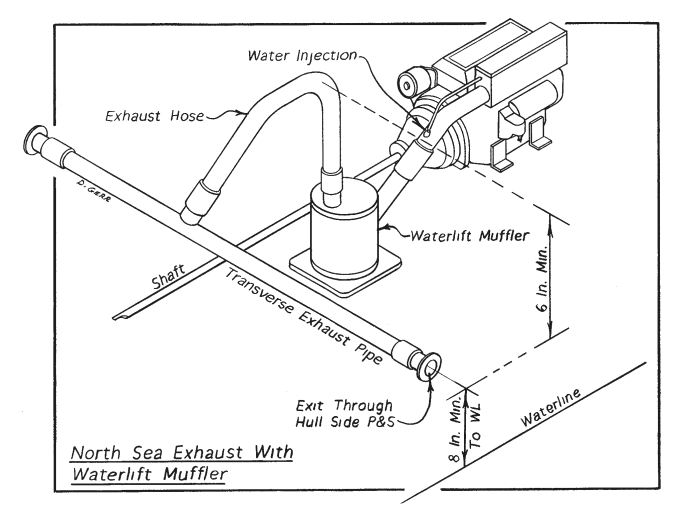
You can see how the system is arranged in the accompanying drawing. This is a modern version using a waterlift muffler. The original North Sea configuration simply had the exhaust riser from the manifold make a large loop up and then a drop down to the transverse pipe. (Sometimes a standpipe was used; more on this later.) Both methods work, but the waterlift muffler is quieter and makes installation even easier. Once the water exits up out of the waterlift canister, it doesn’t care which direction you lead it, as long as there aren’t sharp bends or numerous curves which are back pressure no-nos. On one boat, I even ran the exhaust up from the canister and forward, then down to the transverse pipe.
The beauty of the North Sea exhaust is that it eliminates the long run to the transom and it has twice the outlet opening area. You can’t get back pressure problems ever (once the system’s set up properly, that is). When the boat rolls or when a sea slaps against one side, the other side is clear for full exhaust flow and for instant drainage. Because the outlets don’t face aft, you’re also free from worry about flooding from following seas.
The two port and starboard outlets should be covered with standard clamshell vent covers. These should face down and aft at about a 45-degree angle. In normal operation, the exhaust fumes exit the hull low enough so they trail aft before they can rise up to deck level, where they’d create unpleasant smells. Even in a beam wind and sea, the fumes are driven clear. The breeze blows through the windward outlet, blasting the fumes out the lee side and away from the boat. The old-timers who worked this all out seem to have had their heads screwed on pretty tight, but then they’d have to. The North Sea exhaust is so-named because it first became popular on the North Sea. A colder, rougher, nastier bit of ocean would be hard to come by. Everything on North Sea boats had to work and work well, or they’d be in for serious trouble.
The North Sea set-up
If you follow the height clearances shown, along with the engine manufacturer’s standard wet-exhaust-line diameter recommendations, your own North Sea exhaust will work fine. Remember, the maximum lift for a waterlift canister (from the bottom of the canister to the highest point on the vertical pipe or hose exiting it) has to be less than 42 inches, to keep back pressure acceptable. The transverse exhaust pipe (and most of the rigid wet-exhaust piping) can be ordinary, inexpensive fiberglass exhaust tube. Don’t forget, however, to install flexible connectors between the pipe and anything rigid: the side outlets, the engine, etc. Usually, this should be CoastGuard-approved wet-exhaust hose (simple, cheap, and easy.) If you connect to some dry exhaust section, however, you have to use flexible metal exhaust bellows.
An exhaust rising solution
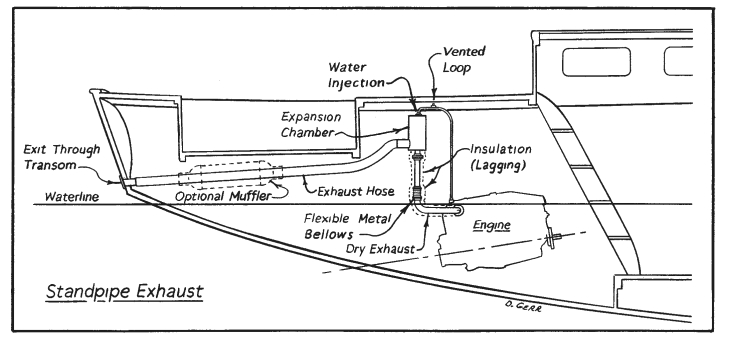
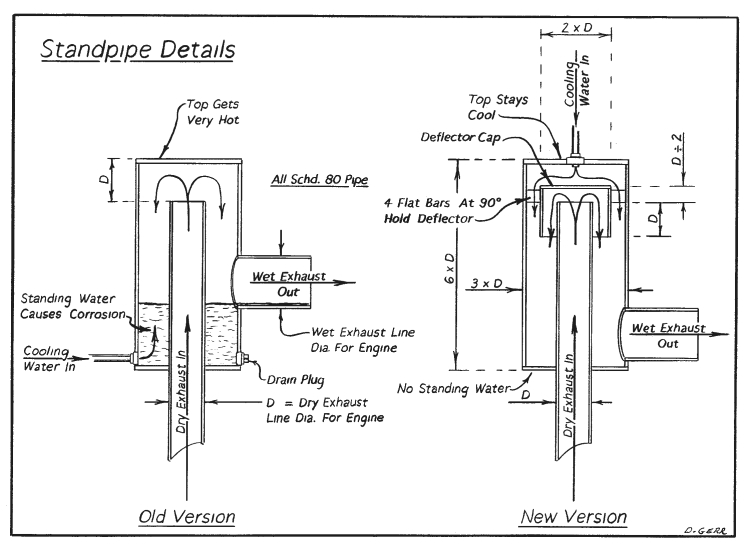
A very different exhaust problem is getting the exhaust up high enough to run out the transom without flooding the engine when the motor is installed low in the hull. This is a frequent difficulty on displacement motorcruisers and on sailboats. One solution is the waterlift muffler. Another useful—and these days largely forgotten—approach, however, is the “standpipe exhaust.” (This can be used in place of the waterlift muffler in a North Sea exhaust.) With the standpipe, the exhaust is led vertically, directly up from the exhaust manifold. This first portion of the run is dry and is quite hot, so it has to be very well and securely lagged (insulated) to prevent burns or fire. Don’t forget a flexible metal bellows at the joint between the manifold and exhaust piping. If you do, you’ll get dangerous cracks surprisingly soon. The engine cooling water is injected into a large standpipe that caps the dry exhaust line. Here, the water and gases mix, exiting the bottom of the standpipe to run out the transom.
Standpipes—old and new
The accompanying drawing shows the old version and the new version of the standpipe. The old version works fine, except for two details. The first detail is that the top of the standpipe gets extremely hot. This arrangement has been—over several years’ use—known to cook the underside of the deck above, till it looked as black as charcoal briquettes. The second detail is that standing water lies in the bottom of the standpipe until you actually drain it manually, making it a corrosion headache. The new version of the standpipe injects water into the top of the pipe. With the protective deflector cap to distribute the flow, the entire standpipe is kept cool, and the water and exhaust gases mix more completely than in the old version. There’s also little standing water in the bottom. The dimensions given in the drawing will allow you to fabricate an excellent standpipe system. Keep in mind that you should use only the very best grade stainless, specifically 316L (“L” for low-carbon). Anything less is asking for corrosion problems down the line, which is false economy. If you really want to do it perfectly, hunt around for Hastelloy C or Inconell. (This can be some hunt, and the material is expensive, but worth it.) These alloys of nickel, chromium, and iron have the best resistance to wet-exhaust corrosion you can buy. Whatever the alloy, all the metal piping should be from schedule-80 (double-weight) pipe or heavier. The plate caps and fittings should be equal to, or slightly thicker than, the thickness of the pipe wall they’re fastened to.
The muffler option
By the way, some folks—on low-powered displacement vessels—don’t bother with a muffler on a standpipe exhaust system. The process of mixing the water and exhaust gases in the standpipe—along with the expansion and cooling that takes place there—makes it a pretty fair silencer in its own right. Nevertheless, if you really want a quiet boat, you won’t be sorry you installed a separate in-line muffler aft of the standpipe. After all, who wants to listen to three jackhammers and a yowling cat?
Thank you to Sailrite Enterprises, Inc., for providing free access to back issues of Good Old Boat through intellectual property rights. Sailrite.com