Finding the right (and affordable) boat could be a matter of initiative, perseverance and mathematics
Issue 6 : May/Jun 1999
I had our opening statement memorized. “We’re looking for an offshore capable boat for under $25,000.” After saying this, I always felt a little silly. What sounded good at home, seemed naïve as Jan and I sat in yacht brokers’ offices. Each had his or her own reaction to our request, and some even took us seriously. In this way, we spent a wonderful and, at times frustrating, 18 months investigating potential boats by telephone, mail, and numerous trips throughout the Great Lakes and the Atlantic Coast. Some brokers were surprised by our systematic analysis of what they considered to be the low end of the used boat market. A few agreed with our system and became our allies.

We started by considering a potential boat’s designer, builder and basic structural condition. To us, these three components formed the sides of an equilateral triangle. Just as a triangle needs equal strength in each side, we reasoned that no boat could be considered a good choice if any of these three issues was weak. Since this was the first step, we relied on our own observations regarding condition and the opinions of authors — such as Dan Spurr, editor of Practical Sailor and author of Upgrading the Cruising Sailboat, and Don Casey, author of This Old Boat and other books — regarding designers and builders.
Next we compared the boat in question with a list of desirable features that we developed from our previous cruising and racing experience. We had definite likes and dislikes and were not hesitant to debate them at length with each other. This list included:
- Quality fiberglass construction.
- Draft 5 feet 6 inches or less (for use in the ICW, Florida, and Bahamas).
- Good sailing performance; Jan was adamant about this.
- Reliable engine — gasoline or diesel.
- Two good sea berths — useable on either tack.
- Strong rig with double lower shrouds
- Companionway with bridge deck and sea hood.
- Storage and more storage.
- Headroom.
- Good ventilation — even with the hatches closed.
- Workable galley.
- Bulkhead folding table in salon (a real space saver).
- Room to carry a dinghy on deck (no towing).
If boats passed these first two steps in our screening process, we attempted to “test sail” each by calculating four ratios or indexes. We used the displacement-to-length and sail-area-to-displacement ratios along with the comfort and capsize screening indexes. These formulas gave us a chance to compare four important aspects of any boat. (See formulas on Page 38.)
Sailing Priority on paper
The following formulas were helpful to us as we attempted to compare boats during our search. We used an inexpensive scientific calculator (Texas Instruments TI-30) and the specifications provided by the builders. Our goal was to find rough indicators of performance rather than absolute values.
Displacement-to-waterline-length
disp. in tons / (.01 x LWL)3
(tons may be calculated by dividing displacement in pounds by 2,240)
This ratio will yield a quick idea of whether the boat in question is a light, medium, or heavy displacement vessel. Dan Spurr notes in Upgrading the Cruising Sailboat that CCA rule boats will have artificially high displacement/waterline length ratios due to their long overhangs. Priority fell into this category with a score of about 320. We recognized that this number would not be indicative of her performance and moved on. The more modern boats that we considered had scores of 190 to 270.
Sail-area-to-displacement
sail area / (disp. lbs. / 64).67
We considered this to be our indicator of horsepower. Priority scored 15, compared to 13.2 to 16.8 for other boats. As indicated by this ratio, she carries her sail area well in a breeze.
Capsize screening index
max. beam / (disp. lbs. / 64).33
Dan Spurr again provides a good explanation of this index in Upgrading the Cruising Sailboat. Since our goal was an offshore-capable vessel, we wanted an index of less than 2.0. Calculation yielded 1.84 as compared to 1.74 to 2.08 for others.
Comfort index
disp. lbs. / .65(.7 lwl + .3 loa) x beam1.33
We first encountered this delightful formula in Compute Your Boat’s Comfort Ratio by Ted Brewer (Cruising World, Nov. 1980). Since that time, we have used it to compare the level of comfort of various boats that we have owned, raced on, or considered purchasing. Priority scored well at 28.8. Among the boats that we compared, the range for this index was 19.6 to 28.8.
The actual search involved many weekend trips to inspect boats in the Great Lakes from our home in Michigan and longer journeys to Maryland and Connecticut. After the frustration of four rejected purchase agreements due to survey problems, we decided to concentrate on the Annapolis area. Brokers there, it seemed, were able to show us better quality boats within our budget.
We had been shown three 1970-vintage Tartan 34Cs, but I had been put off by their single lower shrouds and the fact that the price was above our limit. Coincidentally, I saw an ad for a company that offered support for classic Tartans. Picking up the phone, I found myself talking to Joe Palmer of Classic Sailboats. After a short description of our search, I plunged ahead: “Do you think that a Tartan 34C would be suitable for offshore sailing?”
I could almost hear the humor in his voice when Joe came back with, “That’s what Sparkman & Stephens designed her for.” I began to feel a rush of excitement as he detailed how a babystay or inner forestay with runners could be used to improve the rig. Memories of other Cruising Club of America-era boats brought our enthusiasm to the point of action.
Placing a call to the Annapolis broker who had shown us the most promising Tartan, I made arrangements to see her. Since it was February, she sat in her slip surrounded by small fragments of ice. My excitement grew as I sensed that a great sailboat was hiding under a layer of dirt, oxidation, and splotchy gray teak. Back in the broker’s office, I called Jan at work and said that this could be our boat. She remembered seeing this Tartan the previous summer and suggested that we make an offer.
By the end of March she was ours, but the road had not been smooth. A survey revealed blister problems that carried a $5,000 price tag to solve properly. Due to the extent of the problem, we did not feel qualified to tackle this job ourselves. The consensus was that the bottom needed to be stripped of gelcoat and the first layer of mat. Then after a new layer of mat was laminated in place, 10 coats of vinylester would be applied before finishing. We made a final offer that would allow us to have the bottom work done professionally and stay close to our budget. We prepared ourselves for rejection. But a very gracious owner agreed, and during Easter vacation of 1995, we moved her to a yard on Maryland’s Eastern Shore to begin outfitting.
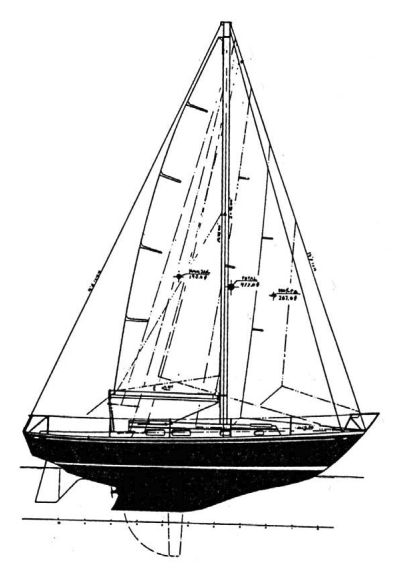
Now almost 5,000 miles later, we continue to be very pleased with her. Priority’s cutaway forefoot, skeg-hung rudder, and four-foot (centerboard up) draft provide excellent handling with the extra bonus of access to thinner water anchorages. As for performance, our first Gulf Stream crossing from Miami to West End (85 miles in less than 11 hours) demonstrated her ability as a comfortable and swift sea boat. “Petey,” our autopilot, handled this broad reach in five- to seven-foot seas with no problem.
After a period of working out the gremlins and converting to freshwater cooling, the direct-drive Atomic 4 engine provides reasonable performance under power. We accept the need for constant vigilance along with reduced range when compared to a diesel. The smooth, quiet operation of the Atomic 4 pleases us, and we reason that we can buy quite a bit of gasoline for the cost of a diesel conversion. Besides, we prefer to sail!
Except for the cumbersome, folding chart table, our Tartan’s standard interior works well for us over extended periods of time. Sure, I wish we had more counter area in the galley, but we enjoy extra room in the saloon by folding up the table after use and love the roomy forward cabin with its drawers, bins, shelves, and hanging locker. This forward cabin was not a big issue when we bought the boat, but with the addition of Jan’s custom-made bedding, pillows, and shams, we have an attractive area that can remain “made up” at all times. Food and supplies for more than four months fit easily into the numerous storage areas in her midsection. Additionally, the interior can be dismantled for access to the hull and deck.
We are very concerned about what constitutes an offshore companionway. Our Tartan’s narrow vertical opening with parallel sides, wide bridgedeck, sturdy sliding hatch, and seahood inspire confidence. Even with the hatches closed, she is well ventilated through her twin Dorade boxes and foredeck cowl. This is essential for tropical rainstorms.
On deck, our Avon dinghy rests diagonally between the forward end of the dodger and the mast. Also, our 3.5-hp outboard stows readily in the large cockpit locker. The dodger gives the helm a bit of protection since it is located forward in the cockpit. Wide sidedecks allow easy movement between cockpit and foredeck. The Lofrans manual windlass and bow anchor mount, that we added early in the outfitting process, handle our 35-pound Delta anchor with ease. Incidentally, this anchor and our standard deck fittings withstood the fury of tropical storm Josephine in a less-than-perfect anchorage. In short, our Tartan meets almost all of our desired features.
To date we have seen nothing that compares to Priority for the money we had available. The frustrations of the long search have been more than compensated for by the pleasures that she brings us. She certainly is a good old boat!
Thank you to Sailrite Enterprises, Inc., for providing free access to back issues of Good Old Boat through intellectual property rights. Sailrite.com