Issue 7 : Jul/Aug 1999
I didn’t start out to own a steel-hulled boat. In fact if you had asked me two weeks before I bought it if I wanted a steel boat I would probably have said, “No, I would prefer a fiberglass or wood boat.” But I had not yet owned a steel boat.
On December 1, 1996, I was having a cup of coffee with my secretary and commented that I was about to have a “late mid-life crisis.” Late, because I was already 60 years old, and you are supposed to have those things when you are 40. I was about to admit to myself that a lifelong dream of sailing around the world was dead. I did not own a boat and had no prospects of owning one at the time. I didn’t even live on a body of water any more. Tears came to my eyes as I related the death of a dream. Inside I was praying, “God, please don’t let me give up this dream.” I think God heard me.
Two days later, I drove to Rockport, Texas, to have a bon voyage dinner with a friend who was getting ready to cut loose and head for the Caribbean in his Hunter 37. During dinner, Gene commented on a man he knew who was about to sell his boat and buy a motor home. We all laughed at the absurdity of that, and the conversation went on to other subjects.
The next day I remembered the comment, and a light went on in my head: “Boat for sale? . . . Where? . . . How much? . . . Who?”
I immediately shot off an email to Gene and asked those questions. The return post gave me an address in the middle of the west Texas desert in Abilene. I sent a letter asking questions and a week later got a phone call. It was a 20-year-old steel-hulled ketch named Ironsides and was in Port Lavaca. Was I interested? The price was right (just matched my IRA balance), so the next day we drove 200 miles to see the boat.
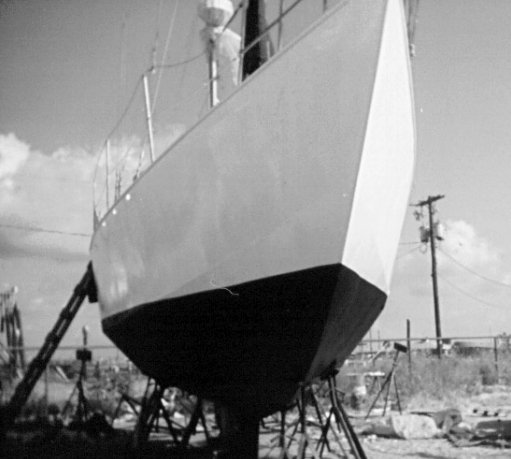
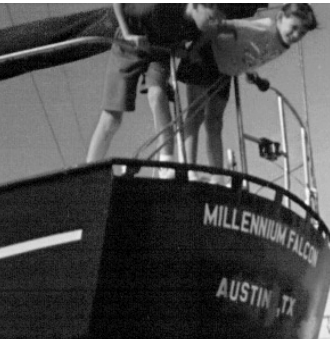
When I saw the boat my first thought was, “What a rust bucket.” It was streaked with rust, and the paint was in need of replacement. My thoughts were something like Luke Skywalker’s must have been when he first saw Han Solo’s spaceship. That is why, after I bought her, I decided to change the name from Ironsides to Millennium Falcon. She didn’t look like much . . . but what a ship.
On boarding her I had an immediate feeling of solidity, security, and just plain mass. It felt like she could take a hurricane and shrug her shoulders. Here, on the Texas coast, hurricanes are a reasonable concern. Shallow water is also a concern here, and she had a steel keel.
More importantly, it was the first boat that both my wife, Martha, and I had agreed on in our entire lifetime. We fell in love immediately. A week later we took her out for a sea trial and on return to the dock agreed on the price. In just two weeks I had gone from having a dead dream to owning the boat that could fulfill the dream, and . . . it was a steel boat.
So far I’ve only told the emotional side of the story, but this really wasn’t an impulse purchase. A lot of soul searching and research went on in the two weeks leading up to the purchase. I had never owned a steel boat before, and I had never contemplated owning a steel boat. Why would I want a boat made out of a material that salt water just loves to destroy? Isn’t it true that, “If God had intended for us to have steel boats, He would have planted steel trees?” I always remind myself He, in fact, did plant ironwood.
Every material has its pros and cons. I purchased my steel-hulled boat for reasons that made sense to me; your reasons will surely be different.
I can’t compare ferrocement boats since I never owned one. But I have owned a 30-foot wooden boat, a 26-foot fiberglass boat, and now a 44-foot steel boat. Each, in its own time, was the right boat for me.
The wooden 30-footer was my first large boat. I built it myself and sailed it for several years. It was the boat for its time because it was inexpensive to acquire. I had intended to do a solo circumnavigation in it but later came to my senses and sold it.
The fiberglass boat was a Balboa 26 swing-keel cruising boat that I tried to race. It didn’t race worth a damn, but it was a good family boat. At the time I had a family of four, and I sailed on a large lake in Texas, Lake Travis. It was perfect for that use and that time of my life.
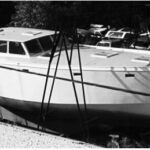
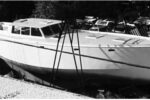
But Millennium Falcon is an entirely different boat. She is a Bruce Roberts 44-foot center-cockpit ketch built in the Houston shipyard in 1978 by commercial shrimpboat builders. The hull is multi-chined 3/16-inch steel plate.
Fiberglass is impervious to salt water, and wood floats even when its full of water. Steel rusts, corrodes and, most of all, sinks like a rock. But . . . it is strong.
We are contemplating ocean crossings. One concern is the cargo containers that are sometimes lost from the decks of ships. They float, just awash, at the surface. It’s not a large percentage bet that you will hit one of these, but if you do, the fact that statistically it might never happen doesn’t make it any easier to survive. I looked at the substantial steel bow on Millennium Falcon and decided that if it did hit a container at sea, there was a good chance that, instead of holing, it might just dent and ride up over the container.
There have been several stories of steel-hulled boats being tossed up on a reef and later being winched back into deep water to sail away with just some scratched paint and a few dents. As one of my friends said sometime later, “You don’t need insurance. After the hurricane you just take a truck out to the golf course where the storm left your boat, pick it up, and relaunch it.” Steel can be holed, but it’s much stronger than wood or fiberglass in an encounter with a UFO (undetected fixed object).
When I brought Millennium Falcon home to Aransas Pass, Texas, a skipper in an adjacent slip who has a fiberglass boat suggested that I would always be cleaning rust streaks off the hull. Well, it is true that steel rusts, but fiberglass blisters, and wood rots. Is any one of them worse than the others?
There are ways to treat steel to minimize the rusting, just as there are ways to treat fiberglass and wood to minimize problems they face. I have done all of the above, and I think rust prevention is easier. My wooden boat now rests on the bottom in 300 feet of water because the last owner let it rot through at the waterline. If my steel boat were to rust through, and it already has once, it starts to seep slowly. The seep is very noticeable in the normally very dry bilge. It could seep for years before the leak became big enough to sink the boat. The previous owner of Millennium Falcon didn’t even have a working bilge pump on board, such was his confidence. I have three pumps. It’s not that I don’t trust the hull, it’s that I also believe in Murphy’s Law.
I said the hull had rusted through. What do you do then? The repair is simple. Place a piece of 3/16-inch steel over the bad area, and weld it in place. One of the big attractions of steel, to me in planning a world cruise, is that no matter where you go in the world, you can find competent welders. In the most desolate backwater there is always someone who can weld. But try to find an experienced shipbuilder in wood or a qualified fiberglass technician with fresh materials in some of the out-of-the-way places where you might find yourself on a world cruise.
Double-plating a hull is relatively inexpensive. I know of one boat that was double- and then triple-plated without significantly affecting its waterline. You can carry the welding torch with you on the boat, and almost anywhere you go there will be scraps of steel available. Man seems to have had wars everywhere in the world, and war machines are made of steel. Maybe it’s not the grade you would choose, but for an emergency repair it’s usable. Even some desert islands I have been on have had scraps of steel lying about. Wake Island is a virtual stockpile of material for a steel boat. And if you have a welding torch on board and a few small plates of steel in the locker, you can actually patch a hole from the inside while under way!
As I explained to my wife as we contemplated the purchase, “If it needs to be repaired, we will go to a shipyard. If a fiberglass boat needs repair, you go to a yacht yard. Now which one do you think would be more expensive?”
My grandson asked me one day, “Steel sinks, doesn’t it?” Sure it sinks, but so do boats made of other materials. Every boat carries more cargo than its natural buoyancy will support. The engine alone is enough to sink most of them. The only time the building material will make a difference is when you’re installing a positive flotation system. In the case of steel, it will require more flotation. No matter what it’s made of, if your boat sinks you will be more concerned about whether or not your life raft floats and if the EPIRB is working.
Another concern about steel boats, mentioned every time a dockside discussion starts, is maintenance. My first big boat was a 30-foot wooden, hard-chine sailboat. I was most concerned about the prevention of rot. I spent most of my maintenance time trying to keep the inside of the boat dry so rot could not develop. The bilges had to be pumped whenever it rained and water always found its way into the bilge. The boat was in fresh water, so the problem was even worse than in salt water. I kept bags of salt tucked under the deck and routinely salted any water in the bilge. I watched the painted canvas deck (very traditional but a pain in the neck) for the slightest lifting or tear that would allow water to reach the wood. A wooden boat can rot through in just three years. I watched Eglantine, in the hands of her next owner, sink at the dock as she rotted through at the waterline because of fresh water in the bilges.
My second big boat, the fiberglass Balboa 26, Shamrock 5, required constant waxing to prevent clouding of the gelcoat in the intense Texas sun. I was not at all concerned about water in the bilge, however, because it couldn’t hurt the fiberglass. Water in the bilge, as long as it is not rising, is not a big concern in a fiberglass hull. But on the outside of the hull, water can lead to blisters.
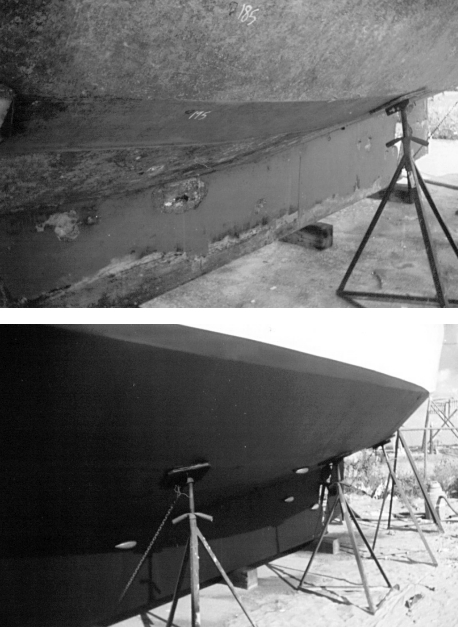
Now on Millennium Falcon my fears are of galvanic action and rust. By using a good two-part paint, I can control the rust. And by keeping the zincs fresh and watching the hookups at marinas, I can keep galvanic corrosion to a minimum. I can now go two years before repainting the bottom as long as I keep after the zincs. My bottom maintenance is not as time-consuming as the work I did on the other two boats. The rust on the deck whenever a chip in the paint lets water in is really easy to keep ahead of since it announces its presence immediately by a brown stain. Neither fiberglass nor wood give you any such signal. I find that my bilges are dryer now, probably because of my preoccupation with preventing rust.
If the hull is not protected by zincs, isolation transformer, or isolation diodes, the hull material on my boat can be etched away. But rust is not a real worry. It takes decades for rust to do much damage. Rust is more a cosmetic worry than a safety concern. When I first dove into the bilge of Millennium Falcon, I found some large scales of rust. The previous owner had sailed for eight years in the Caribbean with no protection on the inside plating of the boat. The owner before him had let it sit filled with water for 12 years.
Some of the scales were as thick as 1/8 inch. I was very concerned until I had an ultrasonic survey of the hull done and found that there was a barely noticeable reduction in thickness of the hull plating in the area of these scales. Steel expands 16 times when it rusts, so a 1/8-inch rust scale represented .008 of an inch of steel plate out of .188 of original thickness. She had lost less than 5 percent of the thickness of the hull. This loss occurred over a period of 20 years! I couldn’t live long enough to see it all rust away. But just to be safe, I have since treated the bilges with a corrosion preventive and paint.
A bonus on a steel boat is that it will not be as musty smelling as most fiberglass or wooden boats. When you are concerned about rust, you tend to be a fanatic about a dry bilge. Recently I was aboard a fiberglass boat in a nearby slip. As I entered the boat I looked down and could see water through a grate in the sole. “Hey,” I said, “You have water in your bilge, did you know that?”
The response was, “Yeah, how far is it from the top?” He explained that he always had water in the bilge, but as long as the bilge pumps kept it pumped down, he was happy. My bilge is dry and dusty. If I develop a port leak or a deck leak, I fix it immediately and don’t depend on the bilge pumps to take up the slack. The previous owner of my boat stored his electric drill and bits in the bilge.
Another comment I hear commonly when I mention that I have a steel boat is that steel boats look like steel boats. This is also heard when people describe ferrocement boats. It just isn’t true. A steel boat, as well as a ferrocement boat, can be made to look just like any other boat. A large number of ferrocement and steel boats are handmade by their owners and, of course, the quality of the construction depends on the person doing the job. Most large fiberglass boats are built in a factory in shiny molds. But a well-built steel or ferrocement boat can be virtually indistinguishable from a “plastic boat” until you rap on the hull with your knuckles.
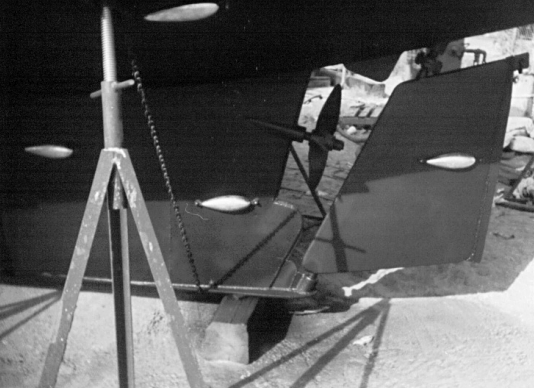
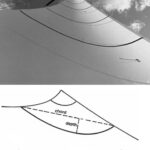
Many people think steel can only be made in a hard-chine design. My boat is a multi-chine design and has beautiful lines. Steel can also be done in smooth round-radius chine designs. But even a hard-chine design, if properly executed, can be beautiful. The plywood Thunderbird 26 is a beautiful hull in hard-chine.
There are many other reasons why steel is a good hull material. First, there is the simplicity of adding features such as davits or cleats or any other item that has to be deck-mounted. When the support structure is 3/16-inch steel, all you have to do is drill holes and bolt them or weld them. No need for under-the-deck stiffeners. I am thinking about lengthening the bowsprit on Millennium Falcon, and the job will be easy: just get my welding torch out and start welding. The masts can be stepped on deck, which results in more room below. The pilothouse is 3/16-inch steel and is welded to the deck. It won’t be carried away when hit from the side by a wave. The anchor windlass and cleats are bolted to the deck and will not pull out in a storm.
One of the biggest advantages of a steel hull is lightning protection. With the masts and shrouds grounded to the hull, any lightning will be carried through the hull and into the water. The hull will act as a Faraday cage to protect all equipment and persons inside from the effects of the lightning. I don’t have to worry about the lightning emerging from the hull at the grounding plate and blowing a hole in the bottom of the boat or cutting through the hull at the chainplate to find a way to the water.
So, would I buy another steel boat? You bet I would if it fit my needs. I would also buy another wooden boat or another fiberglass boat if they fit my needs. The choice of material depends on what you want the boat to do and what kind of maintenance you feel you can handle the best. But there is no reason to shun steel as a hull material. It’s a strong, easy-to-maintain, permanent method of enclosing some dry space to stick in the water.
Thank you to Sailrite Enterprises, Inc., for providing free access to back issues of Good Old Boat through intellectual property rights. Sailrite.com