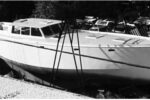
When a troubled economy drove Tartan Marine under, Joe Palmer continued the customer service work as before
Issue 8 : Sept/Oct 1999

Your boat’s been out of production for 20 years, and the company that built it shut its doors a decade ago. But you can still pick up the phone and call customer service for technical information and parts.
If your good old boat is a Tartan, that’s more than a pipe dream. Joe Palmer’s Classic Sailboat Customer Service is a resurrection of the Tartan Marine customer service department that he managed for most of the company’s last decade.
When a troubled economy drove Tartan Marine under in September, 1990, Joe convinced its owners to sell him the company’s customer service division, complete with technical records, ship sets, drawings, and customer lists, along with molds and tooling for replacement components like rudders, centerboards, and hatches.
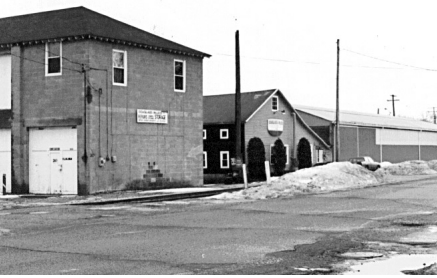
Classic Sailboat Customer Service opened its doors Oct. 1, 1990, in the second floor loft of a concrete block building at the Douglass & McLeod boatyard on the banks of the Grand River, about 30 miles east of Cleveland, Ohio. The location of the shop is almost eerily appropriate: Douglass & McLeod built the very first Tartan — the Sparkman & Stephens-designed Tartan 27 centerboarder — on that site in 1961. The loft that houses Classic Sailboat Customer Service was once the deck layup room for the Tartan 27.
The entire Tartan line, which would eventually encompass 22 models, was built at Douglass & McLeod until 1971, when a disastrous fire destroyed much of the Tartan shop. This precipitated a decision by Tartan founder Charlie Britton to move the business to a separate production facility.
Almost 30 years later, that fire still haunts Joe Palmer. While he has all the technical information and drawings Tartan Marine had in its files when the company folded, many records of the type he relies upon to serve his customers were lost in the fire.
That loss notwithstanding, Tartan owners have in Joe and his company a resource that many owners of good old boats can only envy. Classic Sailboat Customer Service not only stocks parts for Tartan sailboats, it builds them. On the day we visited, the large tables which dominate the room contained a rudder, an anchor roller casting, a tiller and tiller head fitting, teak trim parts, and upholstery fabric awaiting delivery to customers.
While Joe does much of the fabrication work himself, including all the laminating and molding of rudders and centerboards, he does employ a number of subcontractors to handle stainless steel fabrication and some of the more intricate woodwork, like laminated mahogany and ash tillers. He is quite proud of the quality of his subcontractors’ work, like the cabinetry being turned out by an old Scottish craftsman (Joe’s term) who built the original cabinets for many of the Tartans produced in the company’s Douglass & McLeod days.
“That’s the type of person I want working for me,” he says. “Someone who knows what I need, knows how to find the right material, and how to build with it.”
Replacements for most of the original Tartan deck hardware are still available, though the items in Classic Sailboats’ catalog may be improvements on the originals. Many of the old aluminum castings have been replaced with stainless steel. Many custom polished stainless parts have also been fabricated.
Fuel tanks for the classic Tartans are constructed of aluminum plate, and holding and water tanks in aluminum and stainless steel are also manufactured, as are interior components, such as cushions, headliners, teak bin boards, and cabin sole drop-ins. Electrical system parts (AC and DC), plumbing components, and parts for Westerbeke, Universal, and Yanmar engines are also stocked.
Joe’s principal tools are the telephone and computer. He reviews about 150 email messages a day, both to his own site and to other Internet sites dealing with older boats, searching the latter for better solutions to problems common to all aging sailcraft, so he can share them with his customers. Through the quarterly subscription newsletter he publishes — also called Classic Sailboats — he urges his readers to keep a log of their problems and fixes to share with others. “We shouldn’t keep reinventing the wheel on problems,” he says.
He also personally answers all the calls that come in on Classic Sailboat’s three phone lines. The day we visited, the calls that frequently interrupted our conversation seemed to deal mostly with engines — an owner looking for guidance on replacing an Atomic 4 with a diesel, another from a voyager in transit on the ICW looking for help with what sounded like a clogged fuel filter. The engine-related bias of questions that day was merely a coincidence; Joe dispenses information on all aspects of Tartan maintenance and restoration, from replacing a teak-and-holly cabin sole to finding replacement parts locally.
In his spare moments, Joe maintains his informative Tartan Internet page — an innovation that he still considers very much a work in progress. Eventually he wants it to be interactive, with on-line ordering from his extensive catalog of replacement parts for Tartans.
Joe admits to certain ambivalence about the brave new online world. He has built his company on a foundation of personal service. He’s still working out how to balance the desire to deal directly with customers against the impersonal efficiency of a website. His one-man operation is supported by subscriptions to his newsletter and sales from his catalog, and these, he believes, are best built by sharing his encyclopedic knowledge of Tartan sailboats directly with fellow owners.
The 40-year-old Joe is an accomplished sailor as well as a Tartan technical whiz. He has done his share of racing since he learned to sail on a home-built Sunfish at the age of 14. But today he spends most of his sailing time cruising with his wife and three sons on their 1980 Tartan 33.
“When I race, I race on other people’s boats,” he says.
The astronomical cost of new boats makes Joe optimistic about the future of good old boat-oriented companies like his.
“Look at the hard numbers of, let’s say, a Tartan 37,” he says. “You can invest maybe $70,000 — a third of the price of a new boat — and you’ll have a Sparkman & Stephens-designed boat that will outlast you and can take you anywhere. “And, through companies like mine, you’ll have quality replacement parts and technical advice pretty much on par with those available to many new boat owners.”
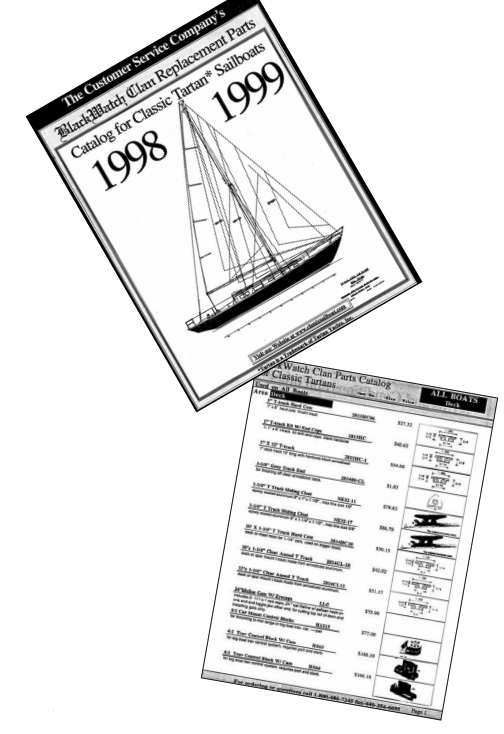
Joe has begun branching out in two new directions, both growing directly from his core business. Since his expertise in Tartan restoration and maintenance has led many people to ask him to either help them sell or find Tartans and other classic yachts, Joe has become a broker in classic boats, charging only a three-percent commission, in contrast to the industry standard of 10 percent. Brokerage boats are advertised on his website. And he has begun offering advice and parts for Morgans, Islanders, Sabres, Ericsons, C&Cs, and other classic lines.
Though he has not yet assembled the sort of definitive information on these types that he has amassed on Tartans, he notes that there is much about maintaining and restoring older boats that is universal, and he is motivated to fill in the gaps — something others may not be.
“Even existing manufacturers of sailboats may not have the incentive or manpower to provide customer service for all the boats they ever built,” he says. “That leaves a big niche out there for someone like me to fill. Right?”
Right! And the more someones like Joe Palmer there are, the better the world will be for those of us who own boats old enough to vote.
Dennis Boese, his wife, Dyane, and faithful boat dog, Cincinati (sic), spend their summers cruising the Great Lakes aboard their Catalina 28, Whisper. In addition to his work as a freelance writer on marine-related subjects, Dennis worked for the former Bay Mariner and is a staff writer with Great Lakes Cruiser.
Thank you to Sailrite Enterprises, Inc., for providing free access to back issues of Good Old Boat through intellectual property rights. Sailrite.com