Issue 9 : Nov/Dec 1999
I recently read that relieving oneself over the leeward rail is the most common reason for men falling overboard. You can’t help but wonder why this potentially dangerous practice has become so common. Maybe it’s because many find the risk of falling overboard preferable to using the head.
The boat my wife and I bought to sail in a no discharge zone (NDZ) has an illegal marine toilet that pumps waste directly through the hull into the surrounding water. It was built in 1974 and hadn’t been sailed in a handful of years. We bought it knowing something had to be done before launching it.
Cedar buckets excluded, the family tree of waste disposal options onboard has three main branches: permanent marine toilets plumbed to some type of holding or treatment apparatus (marine sanitation device or MSD), portable toilets, and composting toilets. The biggest branch is permanent toilets and the seemingly endless combinations of pumps and tanks.
Prudence dictates that you ready your system for compliance in an NDZ. That means having some sort of holding tank. If the waste is treated while in the tank (chemically or electrically) so that it meets standards for bacterial content and contains no visible solids, it meets the requirements of a Type I or II MSD. A Type III MSD is simply a holding tank.
Type II MSDs offer the highest level of sewage treatment. They are more complex and more expensive. The ones most commonly found on small-and medium-sized boats are Type I and IIIs.
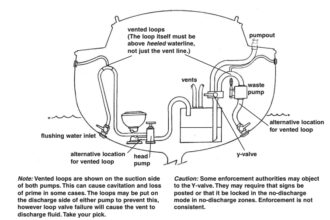
The most common toilets have manual or electric pumps. Typically, raw sea water or water from an onboard source is pumped into the toilet. Then the water and sewage are pumped into a holding or treatment tank. Electric macerating heads also use raw water and, as the name implies, puree the mixture while flushing it.
Legally, a holding tank must be adequate for the time the vessel will have to retain sewage, be used solely to hold sewage and flushwater, and not be used to recycle gray water or galley waste. Seamless polyethylene is recommended. Bladder tanks are probably not a good idea because of the difficulty in keeping them clean and in keeping fittings in place. Metal tanks of any kind should not be used because of the corrosive nature of urine.
There are tradeoffs in the area of pumps. If you opt for the convenience of an electric pump, make sure your electrical system can handle the load. Manual pumps may be more reliable but still require maintenance. A macerator pump grinds waste and reduces the chance of clogging. These are usually placed between the head and the tank. If you’re going to discharge, you’ll need another pump after the tank.
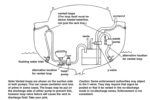
Y-valves add to the versatility of a system. But versatility and complexity go hand-in-hand. Even if you remember to turn all the valves in the right direction will your crew? Another important piece of hardware is the vented loop. Any two below-the-waterline openings must have an above-the-waterline vented loop between them to prevent water from siphoning into the boat.
Composting heads use microbial action and evaporation to reduce human waste to a dry odorless product that can be used as fertilizer. Although many companies use the words “marine” or “boat” in their list of possible uses, I could only find two that make models specifically for use on a boat.
Incinolet’s marine model boasts a vibration-resistant mounting plate and USCG certification, but also lists as a requirement 120-volt AC power. This limits its practicality on small boats.
Sun-Mar’s Ecolet marine model can use both AC or DC power, has a 45-degree angle built into the rear of the base to fit against the hull if mounted athwartships, is gasketed to prevent leakage, is designed to handle violent motion, and is rated for the constant use of one to two people or weekend/vacation use of three to five people. Sun-Mar’s website posts the following caution: “Evaporation capacity on Ecolet units is limited by the size of the heater, the surface area, and the volume of air movement. Thus, although Ecolet has a large reservoir (about 20 liters), this will not be sufficient for continuous use by more than one person. Consequently, arrangements may have to be made to connect the Ecolet drains to a container or small holding tank for disposal in an approved manner.” The cost of either unit is around $1,000. Composting may be the future of marine waste disposal but at present there are not many practical alternatives to the MSDs common on boats today.
If the options discussed so far make your head spin (no pun intended), take heart, there are simpler solutions. The most obvious is the Porta-Potti. This is a Type III MSD. It is self-contained, easy to operate, and typically comes in 2.5- and 5-gallon sizes. It requires no installation, however the tank part has to be brought ashore to be emptied.
Sealand Technology makes a head that is a real porcelain toilet mounted on a 9.5-gallon holding tank. It is self-contained except that it uses water from an onboard source. This particular unit, like some portable toilets, can be fitted with a vent and sanitation hose to allow for pumpout.
In order to get an idea of the cost for my situation, I entered numbers into my calculator. When I finished, the words “Porta-Potti” appeared in the display, so that’s what we’ll install in our boat.

John Kowalczyk teaches high-school science. He and his wife, Suzanne, spend too much time working on sailboats and not nearly enough time sailing them . . . yet. They will soon be sailing a Bluewater 277 on the East Coast.
Thank you to Sailrite Enterprises, Inc., for providing free access to back issues of Good Old Boat through intellectual property rights. Sailrite.com