Issue 9 : Nov/Dec 1999
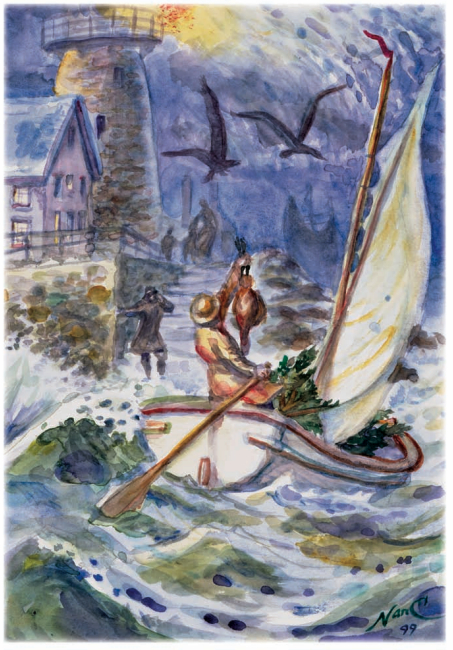
December of 1899 was particularly vicious along the coast of Maine. Just off a promontory jutting into the sea, rose a wind-swept half-acre of bare granite named Kinery Rock, on which stood a stone lighthouse. Although it was termed a “secondary” lighthouse by the Lighthouse Service, the beam of its 125-candlepower oil lamp provided the coastal schooners a warning against the half-submerged rocks offshore that were washed by the restless sea and waiting to do them harm. To the landsman it was a desolate spot, merely a barren rock bereft of soil, but to the lighthouse keeper, Joshua Bennett, his wife Martha, and their two children, Thomas and Kathryn, it seemed far from desolate.
They were regaled by the sounds of gulls, terns, and migratory waterfowl; they frequently saw pods of grampuses out where the water ran deep; and they enjoyed watching the coastal schooners, wallowing low in the water under their loads of timber, fish, stone, or ice, as they plied their trade, guided by this string of beacons that outlined the coastline. The gray pastel skies of winter were often aflame with reds and lavenders at twilight, and during cold calm winter evenings, eerie displays of northern lights lit the sky.
Many packets had strayed and gone to pieces on this inhospitable coast, but many worthy seamen had been saved through the efforts of the lighthouse keepers and their families. Two months earlier, in the middle of October, the Lighthouse Service tender had made its twice-yearly visit to Kinery Rock Lighthouse, delivering winter supplies from the General Lighthouse Depot on Staten Island — winter oil, wicks, mantles, cleaning cloths, glass, lumber, and cement. A few years before, President Grover Cleveland had managed to have the lighthouse keepers included under Civil Service laws, and Joshua’s new yearly salary of $1,200 provided them their other necessities, which were brought to the lighthouse from the village on the mainland, inside the crook of the promontory. For this purpose, a 16-foot dory was their link to shore.
When weather permitted, fish, shellfish, and crustaceans supplemented their diet, as did the occasional migratory duck, which, following the lighthouse beacon as though mesmerized, would dash itself against the tower. But none of these treats had been available for seven days now. Since the middle of December, the weather had varied between gale and full storm out of the northeast, with winds reaching a senseless fury. In daytime the mainland disappeared behind squalls of rain and sleet as the clouds marched down upon them, and at night the breaking waves glowed phosphorescently as the howling wind blew off their crests and flung the spray against the cottage.
Joshua had hoped a lull in the storm would allow him to go to the village to fetch their Christmas goose and the tree for the children that the storekeeper had put aside for them. The storm, however, showed no signs of abatement, and the small boat from the lighthouse could not possibly be launched without being smashed to bits.
Thomas and Kathryn understood the limits of their existence, and set about fashioning a Christmas tree from a piece of driftwood, some kelp, and shells that had been tossed up on the rock. Although they wanted to bring their proud creation into the cottage, their mother would not put up with the onerous smell, and the little Christmas tree was relegated to a spot outside, near the door of the vestibule.
The night of December 23, wind-driven rain mixing with sleet beat against the shuttered windows, and tons of water in the form of gigantic waves, flung themselves against the rock with a thunderous roar. By morning the sea had swept the rock clean, and the children’s Christmas tree was no more. A barren celebration seemed in store, but daily chores had to be taken care of.
After breakfast Joshua climbed the steps to the gallery where the first jobs of the morning were cleaning and polishing the lamp and the huge Fresnel lens, filling the fuel tanks, and trimming the wicks of the four-wick lamp. The clockwork mechanism that rotated the beacon was powered by a weight suspended by a rope that traveled down inside the length of the newel column of the spiral staircase. The final chore of the morning was cleaning and oiling these gears and cranking the weight back up to the top of the tower in preparation for nightfall. When he returned below to the cottage, it was nearly time for lunch.
“Then there’s no chance of fetching our Christmas goose and tree?” Martha asked, already knowing the answer.
“This ain’t no weather to set a trawl,” was the reply, falling back on a phrase used when he was a fisherman on George’s Bank.
“But the children . . .”
“Martha, it jest don’t make no sense riskin’ me and the boat in that sea, — it’s a matter o’ jedgment.” Martha went to the cupboard and brought down six rock-hard slabs of salted codfish, put them to soak in a pan of water, and began plans for a Christmas dinner of codfish stew and apple pie.
After lunch Joshua announced, “I’ll be goin’ above fer a spell,” and reclimbed the steps to the gallery. Although there was no pressing need for him above, he felt ill at ease among his family, as though the failing was his for the Christmas gone awry.
He scanned the dim horizon which merged with the gray skies overhead and the storm-tossed seas all around. To seaward, graybeards raced down the face of monstrous waves in purposeless malevolence, while toward shore the rocks struggled to raise their heads above water. Lost in admiration of the violent spectacle around him, he suddenly became aware that the wind had fallen away to a mere breeze, and a patch of sunlight, shining through an acre of blue in the sullen sky, was passing over the lighthouse. He watched as the spot of sunlight traveled to shore, where he saw a speck of white emerging from around the promontory, a striking contrast of whiteness on the dark water. Joshua picked up his brass telescope, extended its four sections, and focused on a small skiff with a loose-footed spritsail, close-hauled, heading toward Kinery Rock. Around the skiff, the water burst into sheets of foam, as the bow shouldered away the dark seas into a smother of white, while several storm petrels flew about in circles, shrieking their excitement.
“There’s a power o’ virtue in anyone that would tempt a sea like this,” thought Joshua, “or a fool.” He hurriedly descended to the cottage where the whole family donned their oilskins. A quick glance at the barometer showed that it still had not begun to rise. Leaving the cottage under a shower of spray from the seas breaking on the rock, they huddled on the leeward side of their island, where stone steps, hewn from the granite face, led down into the water.
Joshua strained to recognize the skiff and its skipper as they entered the confused seas to the lee of the rock, but knew neither.
“By thunder,” he said to himself half aloud, “he’s lyin’ a point nearer the wind than any-un’s a right to expect.”
As the skiff drew closer, Joshua descended to the lowest step which was engulfed in foam, and, cupping his hands around his mouth shouted, “What be your mission?” The figure in the skiff rose up holding a fat goose for all to see, then with deft seamanship, born of a lifetime on the water, brought the skiff up into the wind just as a swell lifted him close enough to Joshua to pass him a small pine tree and the goose.
As Joshua cradled their bounty, he looked to their benefactor to express his thanks, but the skiff had already fallen off on the other tack, making the turn back toward shore. He had a fleeting glimpse of a spray-soaked face he did not know, more like that of a drowned man than of a hearty seaman.
Almost without warning, the wind picked up again, and the rest of the family retreated inside while Joshua stood looking after the skiff as it appeared and disappeared on the crests and into the troughs, laboring its way back toward shore on a broad reach with huge following seas breaking behind. When the sail had been eclipsed by the promontory, Joshua sat down on the step of the vestibule, pulled off his seaboots and emptied the water out of them, thinking, “It’s quite providential that that fella manages his skiff so well. My dad learned me to handle a boat as well as the next man, but dunno as I wud ’uv tried it. He’s sure wuth his salt. Yep, quite providential all around.”
Christmas time at the lighthouse that year was a day to be pressed between the pages of memory. The tree was decorated, presents were exchanged, opened, and marveled at. A special prayer was said for the stranger in the skiff. The aroma of goose with stuffing and apple pie permeated the cottage while the storm raged on outside.
It wasn’t until the third day after Christmas when, finally, a rising barometer and calm weather settled in. Although large swells were still running, the confused and breaking seas had subsided, and Joshua decided to make the trip to the mainland for needed supplies and to thank the one who had risked so much for them that Christmas Eve.
He didn’t return till nearly dusk. As he entered the door, he seemed deep in thought. He set down the heavy canvas seabag filled with provisions, hung his oilskins in the wet locker, and walked over to the stove to warm his hands. Martha, waiting for a comment that didn’t come, finally asked, “So, did you thank whoever it was that gave us our Christmas, Joshua?”
At first she thought he hadn’t heard. Then he turned around slowly to look hard into her eyes. He seemed troubled.
“Our Christmas goose and tree was still at the store waitin’ to be picked up. I dunno where the ones we got come from. I asked everybody in town.” He paused a moment, then went on, “They all said that no livin’ soul could have taken a boat out in a storm like that.”
How did this purely fictional story originate? Don explains: “Many years ago I received a nautical Christmas card. When I looked at it, I thought, ‘That would make an interesting story.’ That was the genesis of my Kinery Rock creation.” At Good Old Boat, we wanted to share the original card with you, but were unable to locate anyone who could give us the rights to republish it. The illustration here, by Nancy Christensen, is a likeness based on the card which inspired Don.
Don Launer has held a USCG captain’s license for more than 20 years. He built his two-masted schooner, Delphinus, from a bare hull and sails it on the East Coast from his home on Barnegat Bay in New Jersey. He’s a frequent contributor to boating magazines, has had a regular boating column in a New Jersey newspaper, was field editor for Waterway Guide, and is the author of the book, A Cruising Guide to New Jersey Waters.
Thank you to Sailrite Enterprises, Inc., for providing free access to back issues of Good Old Boat through intellectual property rights. Sailrite.com