No task is too difficult for these female sailors — they navigate, paint, fix the engine, and cook
Issue 10 : Jan/Feb 2000
You may have seen the comic strip featuring the guy placing the ad that says, “Man looking for good woman (who can clean and cook fish, sew, dig worms, and who owns boat and motor). Send photo of boat and motor.” Recently I’ve met some women who just might be the answer to this man’s prayers. These women can fix his motor while he cleans the fish and cooks them. They’re women with the attitude that no task is too difficult for them to master. Sometimes they tackle plumbing, electrical wiring, and rigging problems. Some of these women own and maintain their own boats and others work aboard them as paid crew or have in the past. In some cases, men aren’t even in the picture.
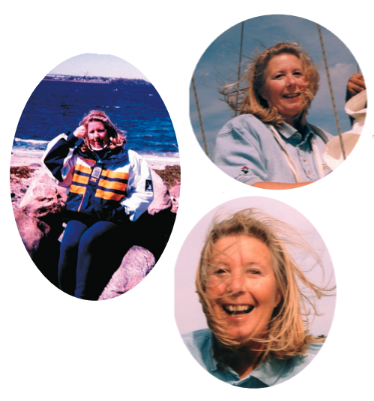
Hope Beecher Wright has been a sailor all her life. For her fifth birthday, her father built her a sailboat. It was five feet long, called a Pipsqueak, with a bright red lateen sail, a little deck with a bow cleat and stowage down below. The keel bolted on, and it came with its own trailer. At age 5, she packed her peanut-butter sandwich, a jar of water, life jacket, and portable radio. She was gone for the day. Out daysailing and exploring. Spring always meant time in the boatyard painting the bottom of her own or the family’s boat. Summer meant independence.
She recently bought a 1968 Bristol 27 from Ramon Diaz, a retired engineer. She says, “He’s 82, and sharp as a tack. I look at him and I see my late father. Struggling with illness, he wears a smile on his face and a song in his heart. I want to make Ramon happy, to sail on his old beloved Bristol in Bristol condition.” She admits it needs a lot of work.
Right attitude
Hope has taken this project on with the right attitude. “I am a single woman, an experienced sailor, and I feel confident that I can handle the task at hand,” she says. She will replace deadlights, install four portholes, recover cushions and make seatbacks, make a small galley, make a bulkhead table, buy and install a head, put stern rails on, and make an awning and dodger.
She says, “I’m buying an old outboard motor from one friend, getting an old mainsail from another friend. Hey, you know, where there is a will, there is a way. Having a supportive group of great friends makes life so much easier. Someday I will be able to return their favors.”
She admits that the biggest challenge on her boat is twofold, “the time to do the work and the money to pay for it. My father had a saying. The difficult takes time, the impossible just a little longer.”
Hope and her boat projects suffered a setback earlier this year when she fell head over heels down a flight of stairs. She has been in physical therapy ever since.
It’s a mindset
Hope’s philosophy on sailing is that it is the ultimate challenge, physically and mentally. It has become a way of life . . . a mindset. She says she is drawn back to the water when she is experiencing stress in everyday life, adding, “The ultimate challenge comes when mind and body work together automatically to get you safely from Point A to Point B. It could just be across a five-mile-wide lake, a 1,500-mile coastal cruise, or a long open-water crossing. The key is being prepared before you go. Know where everything is. Read reference material and have notes handy in case the going gets rough. Have confidence in yourself, a positive mindset. Then you can enjoy the trip.”
Hope believes that to fully enjoy sailing, you also must have an appreciation of nature and believe that a higher being made it all possible. She says, “I have seen the most wondrous scenes at sea which could never be duplicated anywhere else. All senses come alive. You know that this is what living is all about. Harmony. Interdependence.
Phases of the moon and tides, currents, winds. Think about all the creatures swimming under your keel, watch as a frigate bird makes an appearance, and you know you are near land. Become a resting place for an exhausted gull after a storm. You have to know what you are doing, because one mistake can take your life or someone else’s.”
Now in her 40s, Hope continues, “I think sailors are a bit of an elite group. . . not financially, just intellectually perhaps. We are more sensitive than most, always have ‘our radar on.’ We pick up on things all around us because that is how we are programmed,” she adds.
Taught navigation
When she was 18, Hope was delivering boats. She earned her captain’s license and taught navigation at Marine Simulation, in New York City. Her captain’s license later became a master’s license with an auxiliary sail addendum and a radar unlimited endorsement.
She says she can’t imagine her life without salt water and something that floats. She lives on a small peninsula overlooking a marshy wildlife preserve on one side and a rocky shore on the other. When she was a youngster, her family often spent nights aboard their boats. She used to wake up before the rest of the family and row the dinghy out. Once, she rowed the dinghy ashore to explore the Port Jefferson sandpit bird-nesting area. She was too young to understand the warning sign, so she walked into the area. The birds dive-bombed her head. Her screaming alerted her father, who dove into the chilly water and swam to shore. He found Hope cowering with her eyes shielded by her hands. He grabbed her up like a football and ran with her out of the area.
At the time of her accident, Hope was working as Executive Director of the Bayside Historical Society, located where Long Island and the East River converge in New York. There she was involved in planning the Maritime Festival and putting together a permanent exhibit, “The Spirit of Sail: A Salute to the Tall Ships.” She says, “Being a life-long sailor, of course I have water on the brain, and it was reflected in my programs.”
Hope was also working a part-time job as Assistant Manager at the new West Marine store in Port Washington. As a job perk, employees receive a discount on marine equipment and supplies, an important factor for this self-sufficient sailor. After this interview was conducted, Good Old Boat asked Hope to serve as director of marketing, managing advertising contacts.
Beyond healing and getting that boat shipshape, Hope says her long-term plans, “include being on the water . . . anywhere, anytime.”
Living wood
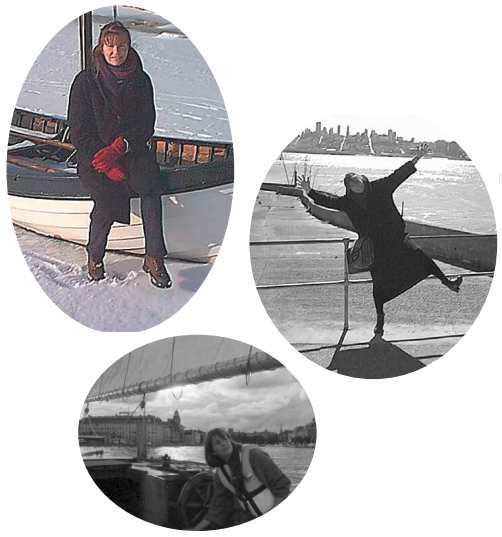
Cilla Lundstroem lives on Tranholman, an island in the inner Stockholm archipelago in Sweden. She came to our attention on an Internet listserver discussion group for women cruisers. She’s a 36-year-old skipper, islander, campaigner, and entrepreneur who owns more than one boat. Her main boat is Joanna av Stockholm, a 43-foot traditional wooden boat. Built in 1974, Joanna is a replica of a 1900-1910 Sandkil. These boats were used to transport sand and lumber from the country-side into Stockholm.
As the owner of a wooden boat, Cilla believes, “Wood has its own life.” Her philosophy on maintaining her boat is always to keep the hull healthy, changing planks, doing linseed oiling, and keeping up with tar treatments. “My boat is 43 feet long and 15 feet wide, clinker, so there is much surface to scrape and oil. In the beginning of the season, the arms ache after some hours. But, with some days’ work, one learns how to adjust tools and the body to the movements so that minimum effort is made. My favorite work is to mix the linseed oil and turpentine and see how the boards drink it. I like the tarring as well,” she says. For bigger renovations, she brings in people who offer help and advice.
She admits to liking most of the work she’s done on her boat but, when she gets stubborn about doing it herself, there have been a few problems . . . such as the time when, with the engine torn apart, and pieces lying around, she had no specific plan for the next step. She says, “I just sat and worried about it for days. I’ve seen grown men stress over that one.”
Cilla has strengthened the deckhouse foundation and has made plans to add a new interior to it. She bought the boat in 1989 and has made longer charter cruises to the Baltic countries and to Denmark. She also uses her boat in sea safety and navigation courses.
Different seas
But her sailing is primarily coastal. “The sea I know is the Baltic. It is a cold and very deep sea in northern Europe. The waves get sharp, narrow, and high, icing over in winter and wonderfully connecting lots of countries and islands together. I’ve made daysails in other seas and find them all very different. Sea water isn’t just water at various places. It creates whole different ecological and human cultures. It also has different colors, movements, and scents,” she says.
Other boats in Cilla’s fleet include a wooden sailing dinghy (an old rescue boat) and a small wooden rowboat. She personally maintains these three vessels. Her partner maintains three fiberglass transport boats they own together. They also own a Shark 24 in a partnership, a buoy boat, and a couple of workboats in a separate partnership.
When she’s not sailing, Cilla is the coordinator for an international organization that provides Internet access and defends Internet user’s rights.
She isn’t planning any long cruises for the near future, Cilla says. But she’ll always be “attached to the sea because it is never the same. It surprises, challenges, and gives new ideas and views.” This summer, she dressed in early 1900s costumes and offered historical tours aboard the Johanna av Stockholm.
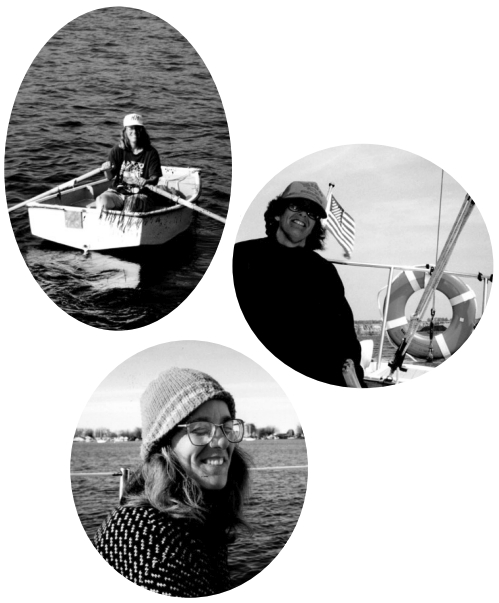
Teacher and author
Susan Peterson Gateley has sailed Lake Ontario for many years. She’s a 48-year-old sailing instructor who is licensed by the U.S. Coast Guard as a master to 25 tons. An upstate New York native, she has also lived in Maryland, Massachusetts, and Iowa.
Susan is a classroom teacher and has written books on her sailing experiences. With a master’s degree in fisheries science, she also has worked as an ichthyoplankton taxonomist.
She says, “One of my earliest memories of visiting the lake was searching the beach for pretty pebbles. The variety of polished, colorful stones fascinated me then, as it does now. The stones underfoot represent a billion years of geologic history jumbled together. “In that area, on Lake Ontario’s south-eastern coast, lie unusual landforms that geologists call drumlin fields. These landforms end abruptly in a series of highly eroded, steep bluffs. The beach underfoot, the gullies, rills, slumps, and slides of each bluff represent hours, days, and weeks of erosion.
These bluffs change so quickly, Susan says the change is noticeable each time she sails by. This is part of the fun, part of the experience of sailing on Lake Ontario. Because of this constant and rapid erosion, the bluffs discourage colonization by plants and animals. However, they are inhabited by a variety of birds that are always there for the watching.
New webpage
Susan started a newsletter, Lake Ontario Log, seven years ago and just recently discontinued publishing this singular mix of history, ecology, and sailing memories. Not long ago she introduced a webpage to educate visitors about Lake Ontario and to introduce her sailing classes. These classes are varied. Her Start to Sail course is taught aboard a 19-foot Lightning sloop. With this course, she teaches basics like getting underway, picking up a mooring, docking, and basic safety afloat — but then she goes one better. She’s added simple ship-keeping and maintenance skills to the curriculum.
Some of her classes are taught aboard the 32-foot Sparkman & Stephens sloop she bought with a partner. During one of these courses, Susan was asked to help cure a woman of her fear of heeling, at the request of the woman’s husband. Susan recalls that this woman did seem a bit nervous at first in a 15 knot breeze but soon she was quite at ease. “Not being a psychologist, I just chattered away at her and acted normal,” Susan says, “And soon she did too. A few days later her mate called and said, ‘What did you do? She’s cured.’ In retrospect, the wife and I decided she had simply been trying so hard not to be afraid that she got nervous about being nervous.”
Biggest challenge
Together with her new husband, Chris, Susan offers special sailing excursions throughout the summer. They are especially interested in helping other women get afloat with their own boats.
“I suppose the biggest challenge is to keep pushing to learn and to try new things. It’s awful easy to get in that old rut and stay there,” she says. As far as maintaining the boat is concerned, now that she’s married she admits that she and her mate share in that. “I don’t do electrical work though, that’s strictly Chris’ department,” she adds. When they talk about doing an ocean passage, she’s the one who’s far from certain that she has the nerve to do a big offshore trip, even though she has sailed to Bermuda in the past as a crew member.
In Sweet Waters, one of three books she’s written, Susan presents stories from the log of her previous boat, a 23-foot, 50-year-old sloop called Ariel. She sailed Lake Ontario solo from 1979 to 1996, “searching for stories.” In Ariel’s World, an Exploration of Lake Ontario, Susan tells about cruising to historical ports, visiting a lighthouse keeper, putting out a trotline for eels, and meeting all kinds of other colorful individuals along the way.
These three women are representative of many more like them. As role models for other sailing females, they are ambitious, adventurous, and intelligent in their own pursuits. They know who they are and where they’re going.
Beverly Jill Warner has been a sailor for 10 years. She’s the proud owner of two vintage sailboats, an all-wood 1963 Colin Archer double-ender and a 1976 Albin Vega. Her dream is to locate one boat on the Upper Atlantic Coast and the other in southern Texas. A single sailor, she has learned to maintain her boats and feels pride in doing so.
Thank you to Sailrite Enterprises, Inc., for providing free access to back issues of Good Old Boat through intellectual property rights. Sailrite.com