For good old boaters, life holds three certainties: death, taxes, and antifouling. We tell you what coatings are available and how they work
Issue 10 : Jan/Feb 2000
For hundreds of years, copper was the only effective antifouling for boat and ship bottoms. First it was used in the form of tacked-on copper sheathing, then in copper-oxide paints. But copper has never been a fully effective deterrent to sedentary sea life, and it is only a minor discouragement to weed and slime. So it was with great enthusiasm that mariners of all sorts embraced tributyltin (TBT) antifouling paints when they appeared, for they really and truly worked.
Unfortunately, they worked too well. They killed or damaged sea life, especially crustaceans and mollusks, well away from the boat’s bottom, so TBT paints were ultimately banned to recreational boaters in this country and many others. TBT is now classified in the U.S. as a pesticide.
TBT antifouling paints were such a success while they were available that copper-based bottom paints nearly disappeared. But since the widespread restrictions on tin paints in Europe, Canada, and the U.S., copper-based bottom paints have once again become the mariner’s mainstay against barnacles, mussels, oysters, seaweed, algae, and slime.
The boat-paint industry has tried, with some success, to make copper-based paints more effective. Compared to TBT, however, copper and its oxide, cuprous oxide (and copper thiocyanate, another derivative of cuprous oxide) are not particularly toxic, even to the small plants and animals that foul boat bottoms. In high-enough doses, for a long-enough time, these copper biocides can kill shellfish like barnacles, the worst fouling bane in salt water, but they work as much by “discouragement” as by killing power. These metals “taste” and “feel” both chemically and electrically unpleasant to plant, animal, and bacterial life.
Bottom paints use two different methods to dissolve copper salts into the surrounding water. The “conventional” method is by leaching or dissolving copper compounds through a water-permeable (but not water-dissolvable) paint base or “binder,” which may be soft or hard, or anything in between. The tiny copper particles gradually leach out of the paint, until there are none left to dissolve. Some time before this, however, the amount of copper being bled out of the paint — originally quite high, but declining over time as less and less copper is left to dissolve — becomes too low to be an effective antifoulant. Then the old bottom paint has to be replaced or recoated.
Impermeable paint
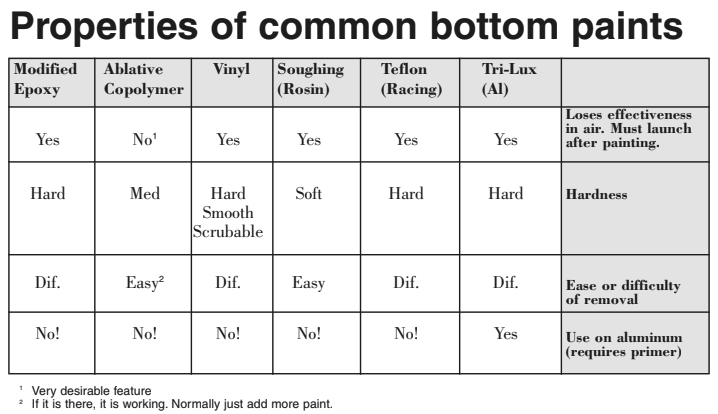
The other method of delivering copper into the surrounding water is with a paint that is impermeable to water, but that dissolves and/or wears away little by little. These ablative or “self-polishing” paints do not allow the copper bound in them to leach out through the paint; only the copper exposed at the paint’s surface is able to dissolve into the surrounding water. Because only “fresh” metal is exposed, there is no need for overly large amounts of copper initially to make up for depleted levels later, so ablative bottom paints can get by with notably lower proportions of copper than similar “hard” paints. Early ablative paints were on the soft side, but now the copolymer binders for ablative paints are generally of medium hardness. Because they are usually softer than the modified epoxy or vinyl binders used for “hard” leaching paints, ablatives do not give as much protection against scrapes as “regular” paints. Then again, because they wear away in use, they do not build up with repeated coatings. Furthermore, they can be exposed to air on the hard almost indefinitely without suffering any loss of antifouling properties.
Sloughing paints
Old-fashioned soft sloughing paints have been around for over a century, and they are still the least expensive antifouling paints available. Because the rosin binder used as the base for these paints is so soft, it cannot be sanded or burnished to a racing smooth finish, and it is very easily rubbed off. This can be an advantage at haul-out time, however, as these paints are easily removed by pressure washing, allowing recoating without buildup. Sloughing paints cannot stand much exposure to air without rapidly losing their effectiveness, so they must be immersed within a couple of days of application. That, plus their extreme softness, makes them completely unsuited for use on trailered boats. For non-racing boats that are hauled every winter for the off-season, sloughing paints can be an economical season-long antifouling solution, especially in moderate- to low-fouling areas, where their generally lower copper quantities are offset by quick release rates. Rosin-based sloughing paints are very easily brushed or rolled on, and their simple removal means that the entire job can be done by a boatowner with very little painting (or sanding) skill or experience.
Sandable finishes
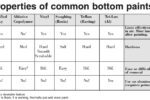
At the other end of the hardness spectrum are vinyl-based paints such as VC Offshore, Interlux Baltoplate Racing Finish, and Woolsey Vinelast, all of which provide a very smooth, sandable, burnishable surface. These paints are especially appreciated by racers who need the slickest surface possible on their hulls and are willing to go to the extra trouble of fine-sanding them. VC Offshore also has Teflon as a go-fast, surface-slicking additive.
Like other non-ablative paints, vinyls are contact-leaching paints, dissolving their biocides (cuprous oxide in all three of these paints) into the surrounding water through a water-porous but non-dissolving base. In fact, vinyl paints are so hard and tough that they are difficult to remove, either by sanding or by chemical removal. This makes them great for trailering, beach-launching, and other rough treatment that would be tough on softer paints, but it also presents a removal problem after repeated coatings have formed an excessive build-up. Vinyls also use solvents so powerful that they will lift almost any other kind of paint, so they can only be used over a bare hull or a previous coat of vinyl.
Modified epoxies
Most boatowners find something in between extra-hard vinyls and soft rosins more practical. The majority of conventional, leaching bottom paints are hard or medium-hard modified one-part epoxies (epoxy-esters). In these paints, there is a wide variety of copper levels and release rates. Some paints offer less fouling protection or shorter effective lives at a reduced cost. It is important not to fall into the trap of thinking that more is better, however. More antifouling than necessary accomplishes nothing, but it costs more and dumps more copper salts into the water.
Many good bottom paints are formulated to last several seasons, which requires slower biocide release than single-season paints, plus enough copper to last through two or more years. These paints inevitably cost more than single-season paints, but the savings in hauling, prepping, and painting costs can easily outweigh the extra expense.
Like vinyls, however, most epoxy-based leaching paints cannot be left out of the water for more than a month or two; exposed to air they lose their effectiveness little by little, so conventional multi-season paints cannot be used on boats that spend much of the year on land.
Water-based paints
A number of new water-based paints have joined the modified epoxies and copolymers on the shelves of chandleries in the past few years. Most of the new water-based paints are self-polishing or ablative paints like the other copolymers, but water-based paints can be formulated as water-permeable, hard, leaching paints as well, like Woolsey Hydrocoat, a hard, burnishable, Teflon-impregnated paint intended to appeal to racers. It has the same general benefits and drawbacks as other leaching paints, but because it is water-based, Hydrocoat (and other acrylic paints) release less volatile organic compound (VOC) vapors into the air when they dry (or cure). They are easier to thin and clean up, too, of course, but not necessarily to apply, as they are more sensitive to temperature and humidity than other paints.
Because of their low VOC production, water-based bottom paints are sure to be the wave of the future when the Environmental Protection Agency begins to enforce the tougher air quality standards already on the books. Right now California and, to a lesser extent, Michigan are the only places in this country placing restrictions or bans on high-VOC antifouling paints, but the paint companies are well on the way to compliance whenever it is demanded.
Incredible variety
If water-based paints are the way binders will go, ablative surface paints, whether water-based or not, set the standards of overall performance, so it is little surprise that the manufacturers are spending most of their research-and-development funds on acrylic ablative bottom paints. For the moment, though, an incredible variety of paints is available, including both hard and self-polishing paints of every strength and durability, at least one of which will surely match up with your own local conditions, boat use, and budget. There are plenty of specialty paints as well, such as VC 17m, the very-thin-coat Teflon-and-copper “speed-skin” paint so favored by many racers, despite its limited antifouling capabilities.
Other bottom paints worth a look are Hot Bottom and No-Foul ZDF. Barnacle Ban Hot Bottom V-15 is a hard vinyl leaching paint that uses Habañero hot-pepper oil, which contains a very strong alkaloid to beef up its modest 33 percent cuprous-oxide biocide and deter fouling growth. E Paint No-Foul ZDF is another vinyl, but with an ablative medium-hard surface (or an extra-hard non-ablative finish for the Racing White version), that uses zinc oxide to produce hydrogen peroxide under sunlight. The peroxide works as an antiseptic against small animals (like barnacle larvae) and bacteria, but breaks up quickly into plain water and oxygen, leaving no biocide in the water.
Aluminum hulls
Copper and cuprous-oxide paints cannot be used on aluminum, as they cause galvanic corrosion that destroys the hull. Tri-butyl-tin paints are still available to licensed professionals for use on aluminum hulls, though with lower release rates than pre-tin-ban paints had. Military vessels and boats over 82 feet long also may use TBT bottom paints in U.S. waters, but the United Nations has recently been asked to consider an international ban on tin paints for ships as well as for smaller craft. For the moment, however, TBT bottom paints are restricted in North America and most of Europe, but still available in many other parts of the world. Here, only small spray cans of TBT can be sold, for use on aluminum outboards and outdrive units.
There is still another choice for owners of aluminum-hulled boats: the toxin copper thiocyanate. It will not cause galvanic corrosion of aluminum as long as the hull is properly primed first to eliminate electrolysis. Unlike TBT paints, which can only be sold to and applied by licensed professionals, copper thiocyanate paints such as Interlux Tri-Lux II, an ablative copolymer, are available to anyone, so do-it-yourselfers can put them on. Copper thiocyanate paint works just as well on other kinds of hulls, too, so its use is not necessarily restricted to aluminum-hulled boats. But it is more expensive than comparable cuprous oxide paints, so it has little draw for owners of fiberglass, wooden, or steel boats. A new formulation of Tri-Lux is about to be introduced this spring. It will have a proprietary organic biocide booster that will control slime.
Copper in epoxy
More expensive than any bottom paint alone (but similar in cost to an epoxy barrier coat plus paint) are the copper-in-epoxy gelcoats such as American Marine Coatings’ CopperPoxy and Hi-Tek Coatings’ Epco-Tek. Long-term performance and cost-effectiveness reports on metallic copper-epoxy gelcoat bottoms has been mixed, but they offer the potential of 10-year and longer protection against both fouling and osmotic blistering, if properly applied. Application demands a high level of skill, however, and should not be tackled lightly by amateurs.
Too slick to grip
Fouling-release coatings are not toxic paints, but slippery surface coatings designed to prevent foulants taking hold. Interlux Intersleek, the successor to Interlux Veridian, is a multi-layer silicone coating. Eccotech Wearlon is a silicone-in-epoxy matrix with a hydrophobic non-stick surface, used to protect against mussels and other sorts of fouling. High material costs and the need for special (expensive) professional application put these coatings well beyond practical consideration for most boats, but the idea of a non-toxic, permanent antifouling coating is certainly an attractive one.
Larry Adams is a long-time sailboat racer, cruiser, and tinkerer. He frequently contributes technical articles, reviews, and photographs to sailing magazines. He has rebuilt a couple of good old boats himself, a 1973 Cal 21 and a 1977 J/24.
Thank you to Sailrite Enterprises, Inc., for providing free access to back issues of Good Old Boat through intellectual property rights. Sailrite.com