Refurbishing a 1972 Pearson 26
Issue 12 : May/Jun 2000

Green seems to follow me. First, I’m a self-admitted green sailor. I’m beginning my fourth season of sailing since I started out with a loaded-to-the-gills West Wight Potter 19, purchased new in 1997. After two seasons of learning the basics, I was yearning for a larger boat that I could refurbish over the winter.
My marina owner is constantly buying used sailboats to fill his slips, but the boats tend to be under 22 feet long. One day, however, he picked up a used 1972 Pearson 26, which he sailed down the Chesapeake and up the Potomac River, towing another used boat, a Tanzer 22. The Pearson was still completely stock, without any instrumentation and sporting the retro ’70s interior. She had belonged to a summer camp, and although the sails, hull, and rigging were in great shape, the interior was shot. The once green-and-yellow cushions were worn to the foam, and the carpet disintegrated into messy clumps as I removed it. Oh, and she had a sea-green-colored deck that was covered in a white haze.
After inspecting the boat, I took my wife down for a look. “It’s green,” was her first comment.
“Yeah,” I replied, “but the inside I could redo in any color you want.”
We both liked the interior, with a real dinette and enclosed head. It seemed huge compared to our Potter and also very solid and safe. Unlike our Potter, the Pearson had minimal gadgets, and I was ready for simplicity.
Definite novice
At the end of the summer of 1998, I became the proud owner of hull #395 and began the process of refurbishing the interior. As I was a definite novice when it comes to fixing up old boats, having no elaborate workshop and only basic power tools, green was the right description once again.
My first task was to unload all the stuff in the boat. All the sails, cushions, and gear went into local storage. Then I removed all the fake wood paneling. I cleaned the cabin and bilge, removing 25 years of crud from every nook and cranny. And I scrubbed the interior until I had a clean surface to work on. The magic solution was a bucket of Pine-Sol and a lot of scrubbing.
I scrubbed and compounded the deck before the weather got too cold. To my surprise, the green hazy decks began looking better. The cabin walls, ceiling, and floor were in a dingy cream color, which I painted over with two coats of white. I opted for a water-based, mildew-resistant paint from West Marine.
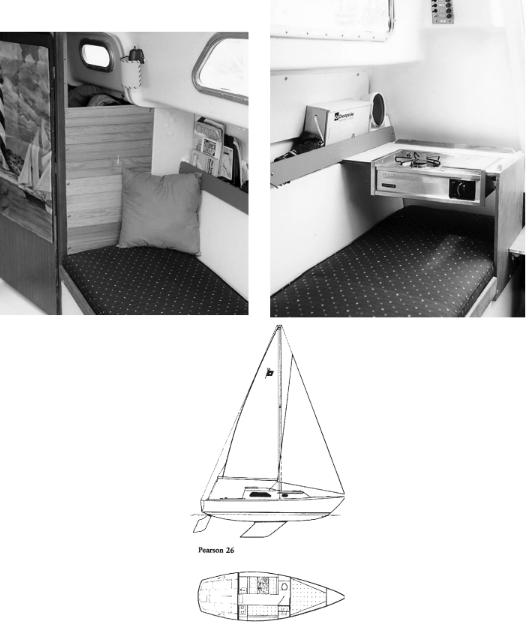
The main bulkhead panels, like the rest of the wood in the boat, are marine plywood with a dark fake-wood veneer. I replaced the bulkhead panels with tongue-and-groove ceiling fir strips at 30 cents a foot. After purchasing $40 worth of lumber, I found a local woodsmith to cut the strips to length using the old panels as a guide. Woody (his real name) had owned boats before and knew what I was up to. While he was at it, I had him make a new hatch from a dry, pressure-treated piece of plywood he had lying around. Finally, I had him install a single-burner propane stove in the existing galley table. The total cost for his services was about $600.
Slate blue
One weekend at home in my dining room, I painted the finished wood with polyurethane. Now the bulkhead was done, but the rest of the wood panels and trim needed something. I painted over the side trim panels in a slate blue my wife picked out. The rest of the wood I cleaned up, and decided to live with.
During the winter of working odd weekends I also:
- removed and recaulked the main ports
- installed a depth sounder
- ran a charging line from my Honda 8-hp outboard to the battery
- replaced all the running lights
- installed new electrical terminals on the leads running to the switch panel
- installed a cigarette lighter adapter and small fan in the main cabin, and
- installed a Porta Potti in the head.
When spring finally came, I was excited to get the cushions redone and the gear back in the boat. After taking the cushions to a few upholstery shops, and getting quotes from $800 to $1,000, I managed to talk one shop in recovering the existing foam cushions for $380. The existing V-berth cushions were covered with a BOAT/U.S. fleece V-berth sleeping set which fits perfectly.
Holy cow! The interior looked great! The white walls really brightened up the cabin, and the change from green to various shades of blue was a welcome relief.
New halyard
Topsides, everything was still vintage 1972 as well. I replaced the fairlead blocks and the genoa block at the top of the mast. All that was needed then was a new halyard with a shackle, and she was ready to sail. After some harrowing experiences in a borrowed bosun’s chair, I broke down and got a mast ladder that used sail slugs to keep it secure. After a memorable morning, my boat was rigged and ready to sail.
With a purchase price of $5,800 for the boat, then the cost for the services and supplies for the refit, and after buying a handheld VHF and other safety gear, my new old boat cost about $8,500.
After I had tied her up following one of the first sails of the season, a friend who is docked two boats down from mine, passed by. “She really looks nice, you did a great job,” he offered.
“Thanks, what do you think of the green deck?” I asked.
“Looks a lot better than when she came in here,” he admitted with a grin, “It’s kinda growing on me.”
“Me, too,” I said with a smile, thankful I wasn’t the only one.
Dave has sailed his vintage Pearson Randi, named after his wife, on the Potomac River in Washington, D.C., for two seasons. This year the boat and his family have moved out to Maryland’s eastern shore, where they are looking forward to sailing the Chesapeake Bay.
Thank you to Sailrite Enterprises, Inc., for providing free access to back issues of Good Old Boat through intellectual property rights. Sailrite.com