
Modify a trailer for your boat, and do your boatwork at home
Issue 14: Sept/Oct 2000
Lindsay Christine sits next to the carport, miles from the ocean, longing for a stiff breeze and an empty horizon. We are happy to have our trusty Mercator Offshore 30 sloop so close. She’s undergoing a refit, and having her here is wonderful.
Older boats eventually need substantial maintenance or a complete refit. A trailer makes it convenient to have your boat at home to do the work as well as for off-season storage.
There are several advantages to buying or modifying a trailer on which to transport your boat to a convenient location. Yard bills come monthly and don’t stop when you take time off from your project. After the initial expense of buying, building, or modifying a trailer, storage at your home is free. As you can see from the chart on below, a trailer can pay for itself in a year.
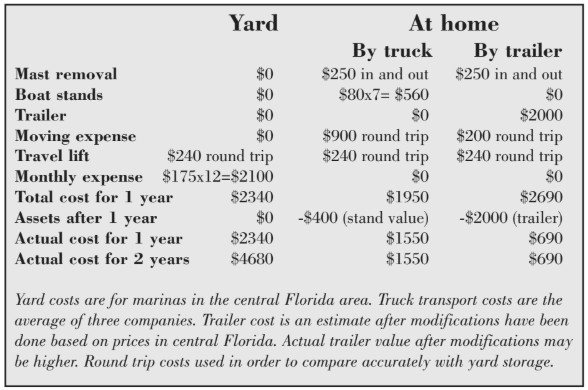
The convenience of having your boat at your house cannot be overestimated. Marinas are never as close as your backyard. Tools, power, water, and materials are all in the same place. Projects can be left where they are, rather than having to be put away every day. No time is wasted commuting to the yard, looking for power outlets, or returning home for a forgotten tool. More importantly, after work it is much easier to walk out the back door and get to work on the boat than it is to load up and drive to the yard. It’s also hard to ignore the boat waiting for your attention. Finally, your pride and joy is probably safer in your yard than the marina’s.
If your boat is not too large (more than 35 feet can get expensive and complicated), and a trailer is right for your situation, how do you go about getting one you can afford? If you’re lucky, you may know of someone with a suitable trailer for sale. Ask around at marinas and yacht clubs. Chances are you’ll have to modify it in some way to fit your baby. New sailboat trailers are typically semi-custom and very expensive, ranging from about $5,000 to $10,000 for a 30-foot boat. Unless you plan to transport your boat yourself over a long distance, this option is not an efficient way to spend your refit budget.
Do it yourself
When the time came for us to bring Lindsay Christine home, we researched the alternatives and, as you can see from the chart on above, the trailer option made sense in our case. In Florida, where we live, there are lots of boats and boat trailers. Surprisingly, after several weeks of searching, we could not find a purpose-built sailboat trailer at a reasonable price. However, Florida is home to a huge number of powerboats, so powerboat trailers are much more common and cheaper. We focused on altering one of these.
Having done it ourselves, we can say that modifying a powerboat trailer to fit a sailboat is not particularly difficult. We spent about $800 for the conversion, though it can be done for less if the trailer is not designed to be fully adjust-able for any sailboat. We were able to modify ours without any welding, though if welding is a skill you possess, it may be easier and cheaper than the bolt-on system we used. We chose to bolt ours together for three reasons, keeping in mind that we would eventually sell the trailer when we were finished with our refit. First, a bolt-on system is completely adjustable — the supports can be moved anywhere. That makes it easier to ensure a proper fit to your boat or any other boat and makes it more valuable for resale. Second, if necessary we could dismantle our modifications and resell it as a powerboat trailer if we could find no sailboat buyers. Third, welding would have damaged the galvanizing.
Where to find them
Besides local newspapers, check the local Boat Trader publication for your area. Local marinas and powerboat dealers may have used trailers for sale. We found our triple-axle trailer lying in the weeds at an Orlando Bayliner dealership.
How much to pay
In the Central Florida area, a used triple-axle powerboat trailer in reasonable condition with a 10,000- to 12,000-pound capacity averages about $1,500 . . . less than half that of a purpose-built sailboat trailer. The trailer we bought had no brakes but otherwise was in good condition. The dealer was happy to get $600 to be rid of it.
What to look for
Gross vehicle weight rating is the first criterion. If the trailer can’t handle the weight, the rest in unimportant. Trailers are supposed to have a GVWR tag attached so you can see what the manufacturer designed it for. A 30-foot boat will almost certainly need three axles. Typically, each axle can support 3,500 pounds (including the trailer) and is constrained by the tires’ capacities. Trailers with higher capacities usually have larger axles that support 5,000 pounds or more, though they may only have larger tires. For very short distances you may be able to simply increase the tire rating if your trailer’s capacity falls short.
Look at the crossbeams on the trailer. The more the better, and they should be fairly evenly spaced. Ideally, these beams should mount on the top of the sideframes, though this will raise the overall height of boat and trailer. Crossbeams that are welded flush to the sideframes are acceptable if the welds are good and rustfree. Open beams will prevent rust better than box-framed beams. Next, look at the axles and suspension. These are typically unpainted and the first parts to rust. Incidentally, some powerboat trailers have their axles too far back to make a good conversion. This is especially true for trailers for cigarette-type boats. Look for trailers designed for cabin cruiser-type boats.
For longevity, aluminum or galvanized trailers are a better choice than painted steel. Our galvanized trailer is nearly 20 years old and has no rust. Many larger powerboat trailers are never submerged; the boats are often transported to a marina, and a lift is used to launch them. In fact, many powerboat trailers are hardly used at all; owners find it difficult to transport a large boat.
Measure and sketch some candidates and compare them with a profile drawing of your boat. You’ll want the center of gravity just forward of the axles in order to have 8 to 10 percent of the total weight on the tongue. Some trailers have axles that allow adjustment fore and aft, making weight distribution easy. And, while the stern can extend several feet off the back of the trailer, you’ll want the bow to extend no farther than the point where the tongue and frame come together or the tow vehicle may interfere with the bow. Our trailer is 27 feet LOA, and Lindsay Christine’s stern hangs out 7 feet.
Most trailers are built 8 to 8.5 feet wide and no wider, in order to be road legal in most states. Your boat may be substantially wider than the trailer, but this poses no problems in fitting the trailer to the boat.
How to modify
Once you have your trailer and are ready to modify, get out your trailer sketch and profile drawings again. Your job will be easier if they are to the same scale. Superimpose the boat drawing on the trailer sketch to get an idea of the boat’s placement and where the supports will need to go. You’ll need the keel roughly centered fore and aft over the axles. You may need to put some stout timbers on the crossbeams for the keel to rest on. These should be firmly attached to the crossbeams and very strong; nearly the entire weight of your boat will be resting on them. We used two sets of double 2x6s bolted together.
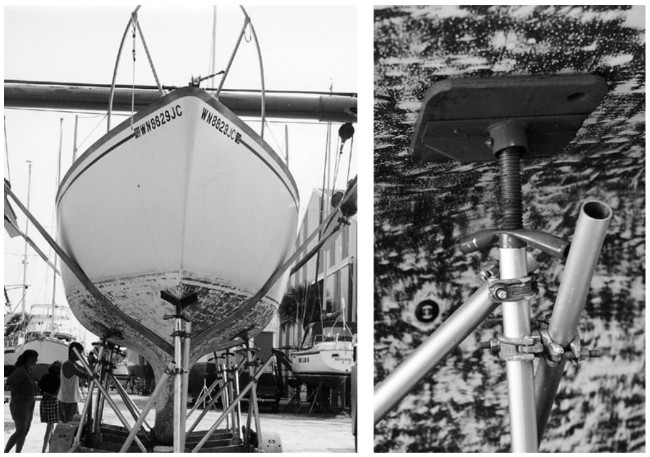
Next comes the transformation from a powerboat to a sailboat trailer: the supports. Ideally, these supports should be at the bulkheads. You’ll probably want three screw jack supports on each side plus one for the bow. With luck, you’ll be able to mount the supports along the sidebeam in order to get them as far outboard as possible. In our case, some of the supports had to be mounted on a cross beam which brought them in 4-5 inches.
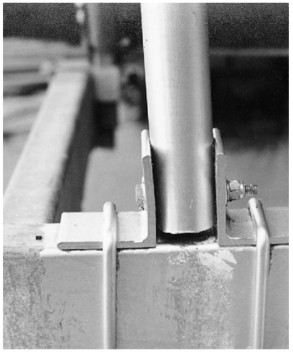
In order to make the supports adjustable fore and aft and in and out, we chose to mount them on hinges made from angle-iron strapped down by U-bolts. These can be customized inexpensively at a truck suspension service facility. We chose Grade 8 bolts for the support pivots, since they may take lot of force during transport. The supports can be made out of 1 1/2-inch (inside diameter) round steel tubing or black pipe available at about a dollar per foot. The screw jacks that slide inside the pipe are 1 7/16 inches in diameter and are specifically designed to fit 1 1/2-inch ID pipe. They are available from Brownell Boat Stands Inc., www.boatstands.com, 1-800-533-8433, and can be shipped by UPS.
These are the same heavy-duty screw jacks (minus the tripod supports) that marinas use and, with luck, you may be able to find used ones since the tripods usually rust out while the jacks remain sound. Cut the tubing supports short enough for a range of adjustment (the screw jacks have about 27 inches of adjustment) but not so short that the screw jack doesn’t have good support. When Lindsay Christine was loaded on the trailer, two of the black pipe supports proved to be slightly too long, which necessitated sawing off a couple of inches. If we or someone else ever loads a boat with a shallower draft on the trailer, cutting the pipe will enable the proper range of adjustment. Be sure to prime and paint your black pipe.
The item that made our project fully adjustable is a swivel scaffold mount by Safway Scaffold, www.safwayscaffold.com. This device, used for building scaffolds, allows the tripod support to move athwartships as a unit, allowing each support to be custom fitted to any shape. Somewhat expensive, these greatly simplify building and adjusting the supports. Take careful measurements of your boat and try to adjust the supports as close as you can in order to lessen the time needed to load.
Load ’em up
If you were accurate, loading will be smooth and considerably faster than setting up tripod supports in the marina yard, despite what the yard manager may say. We were warned of expensive lift time in the event extra time was need to load the boat, but it was loaded and adjusted in 20 minutes. Be sure you’re happy with the boat’s position on the trailer. Once the lift is gone, you won’t be able to move the boat.
How to transport
Unless you run a heavy equipment company, you’ll find it advantageous to hire a local company to transport your boat. While your boat/trailer combo may look intimidating to you, it’s just another job (albeit an interesting one) to a tow-truck service. During our last cruise, I worked a short stint as a tow-truck driver, and I can assure you that after pulling semis from rivers and working multicar pileups, pulling a trailer to your house is a breeze. Also, due to the assistance they provide at traffic accidents, tow-truck companies typically have good relation-ships with law enforcement officers. Pulling an oversize load a short distance with emergency beacons flashing is usually tolerated. If your boat has to travel on an interstate or other major highways, ask the company for advice.
Because tow trucks were designed to tow large uncooperative vehicles, trailer brakes are probably not necessary. The truck that towed our boat was rated to tow 50,000 pounds, and the driver remarked that he couldn’t tell the 12,000-pound load was behind him. Expect to pay $75 to $100 plus $1 to $2 per mile, though you may be able to negotiate a better price. Trucks with wheel lifts are able to mount the towing ball on the lift which is adjustable fore and aft as well as up and down, making custom height adjustment simple. Speaking of heights, make sure you measure the maximum height of the boat on the trailer (usually at the bow pulpit) and verify that there are no low bridges, power lines or trees along your route home. Our neighbors peered out of windows and shook their heads (again) as I walked down the street holding a 15-foot tall pole, checking for obstructions. Lindsay Christine’s height of 14 feet 3 inches was not a problem for the 5-mile trip home. (Interstate highway bridges are only required to have 13 feet 8 inches of clearance. -Ed.)
Once your baby is home, level and shore up the trailer with timbers. It’s a good idea to put a tarp down first if your boat will be on the grass. It’s tough to mow under a trailer, and the tarp will catch dropped tools and spills.
Bringing home baby on a trailer for an extended stay may be the most cost-effective way of doing that refit. She will stare you in the face after work every day, and you’ll also have the satisfaction of paying for a valuable trailer with the money you saved on yard bills.
The master contemplates his canvas. An escaped corporate executive, Chuck “sold out” to go cruising with his family. Now 10,000 miles and nine countries later, he is refitting their sloop for the next adventure. He holds a USCG Master License.
Thank you to Sailrite Enterprises, Inc., for providing free access to back issues of Good Old Boat through intellectual property rights. Sailrite.com