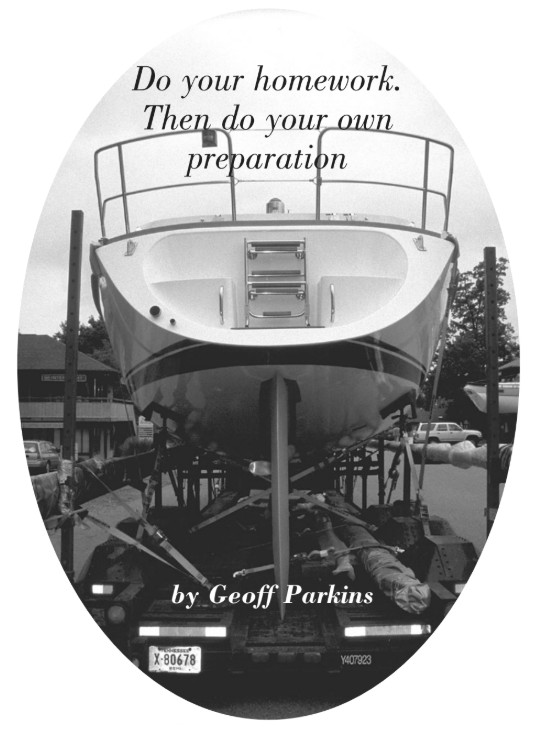
Do your homework. Then do your own preparation
Issue 14: Sept/Oct 2000
Some people spend their entire lives in one zip code. Others, through career pressures, family location, health concerns, or good old-fashioned wanderlust are moving from one place to another with varying frequency. Let’s assume that you don’t fit into the one-zip-code category, and the call to relocate comes in not long after you’ve either lovingly restored the floating apple of your eye or found your heart’s desire.
Maybe you live in New Bern, North Carolina, and your situation change puts you in a new office overlooking Puget Sound. For the purposes of this article, I’m going to assume that you don’t have time for a leisurely cruise through the ICW, the Caribbean, the Panama Canal, and the Pacific coast of Central and North America. If you’re moving and you already have a boat, you can sell it and buy a new one when you get to your new home, you can have it delivered by a professional crew, or you can take it down Route 66. Unless your boat is vastly different from most older boats or you’re moving because you just bought another boatyard, you will probably not recover the money you spent doing restoration work. A sea delivery from one coast to another is extremely expensive and not without risk. The over-the-road option might be the most cost-effective.
Selection
Your first step is selecting a trucking company. Find a company you’re comfortable with. You will entrust valuable property and a significant emotional investment to someone who is getting paid to get your boat to its destination as quickly as possible. If you feel that the main office of the company is abrupt and uncommunicative, try imagining what their drivers must be like. A good trucking company will know the difference between a hatch cover and a furler extrusion and will spend some time making sure you are comfortable with their level of expertise. Find a company that specializes in yacht hauling. Joe’s Storm Door and Trucking Company would no doubt love the contract, but can they take a look at a boat and see whether or not it will fly apart at 70 mph? A quick search of the Internet will return a handful of companies that specialize in yacht hauling (see list of resources).
A deeper look will show that cargo insurance coverage carried by trucking companies ranges from $100,000 to $1 million. You and your 1939 Popcorn 22 may not need gold-plated coverage, but if the company has such a good track record that they can get $1 million in coverage and not go broke paying premiums, they might be worth a longer look. Most yacht haulers get their business from referrals, so hang around a busy yard when you see a boat come in on a trailer, and ask the owner or yard manager what they’ve observed about the way XYZ Trucking handles their cargo. Chat up the travel lift operator; he’s seen it all . . . twice.
Chris Bunch of Deep Water Transport in Washington, N.C., has a particularly strong caveat for those looking to ship their boat over land: “Never pay a broker or boatyard in advance.” He feels there are some unscrupulous agents who will request a 50-percent deposit and then jack the rate up by a couple of thousand dollars when the truck shows up (usually due to an “unforeseen” additional cost associated with your particular boat). The agent then denies your request for a refund of deposit and a different carrier, claiming the expense already incurred in getting the truck to your boat’s location. It becomes a “put up and shut up” situation where your checkbook is the loser. Chris recommends that anyone considering hauling a boat on a truck should contract directly with the carrier, with no middleman. (Other satisfied clients recommend a broker to help eliminate an empty truck on the return trip. -Ed.) A reputable carrier will have a clear-cut contract, guidelines for preparing your boat, and a firm fixed price. Spend some time reading the fine print on the contract, as it will define which party is responsible for what damage. More on that later.
Pricing
I’ve deliberately left pricing until late in the selection game, as I feel it’s more important to find a carrier that has an excellent reputation and a good presentation during your initial contact. Costs will be all over the map, based on schedule, season, boat size, destination, and “backhaul” or “deadhead” miles involved. Typically, you will see prices in the $1.65 to $2.15 per mile range (for an average 30-foot sailboat, as of June 2000). Larger boats, obviously, will cost more. Most companies will want a certified check for the full amount, due when the boat arrives at its destination. Be leery of deposit requests.
You can save quite a bit of money by planning ahead and scheduling your delivery to coincide with another boat going in the opposite direction. The trucking company is more likely to be willing to discount the rates if he doesn’t have to drive cross-country with an empty trailer. Your biggest savings, however, will come from preparing the boat for shipment yourself.
As with just about everything related to work on boats, the more you do yourself, the more money you will have left at the end of a job to convince your chandler that you’re the next Rockefeller. Another benefit of doing the prep work yourself is that it cuts out a significant layer of finger-pointing if there’s damage at the end of the trip. You’re going to want to blame the trucking company for damage during transit, and they’re going to claim that the boat wasn’t prepared properly. A word of warning here: most damage occurs as a result of poor preparation. If you let your yard prepare the boat, you won’t know for sure whether the rig was prepared properly or not. That’s where the finger pointing begins, and you are usually the loser in that game. Consider these three areas for preparation: the rig, the outside, and the inside.
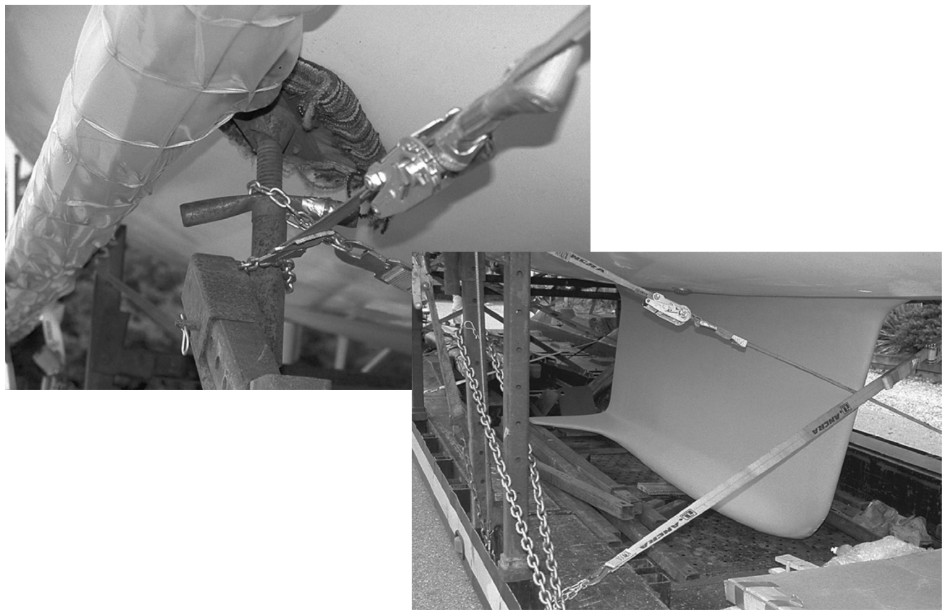
The rig– This is where the most damage occurs. Prepping the rig for shipment is, without a doubt, a pain in the neck at both ends of the journey. However, good prep work is cheaper than a new rig. Start by having your yard pull the rig and set it on sawhorses in a work area. Remove all shrouds and stays. Coil the wire rope and secure the coils with a combination of nylon wire ties and filament tape. Stow the toggles and clevis pins. Label them accordingly. Label each piece of wire as you take it off, to facilitate reassembly. Stow the standing rigging below, and make sure it won’t chafe anything when the boat moves.
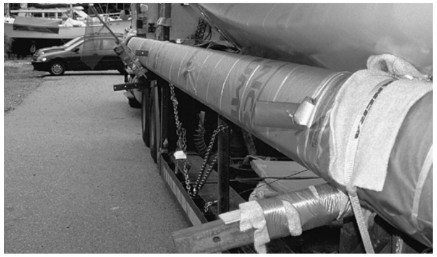
If you have roller furling, leave the drum and extrusion in place, but secure it to the mast on 18-inch intervals. Secure it twice as strongly as you think you’ll need, and then add 20 percent. Put a piece of 2×4 or 4×4 in the bottom of the mast to act as an extension that you can use to support the furling drum. Next, remove the spreaders, and stow them inside the boat.
If you have radar, remove the radome and either ship it to your new address or stow it carefully below. Remove and stow all antennas and navigation lights. Make sure you tag the wires in a way that makes it easy for you to reassemble at the distant end. Running rigging, winches, and cleats can be left on the rig. Running rigging should be secured as well as the furler extrusion. A driver will simply cut a piece of rope if it’s dragging on the ground. You might consider wrapping winches, rope clutches, and other gear with moving parts in plastic to protect the equipment from water and road grit.
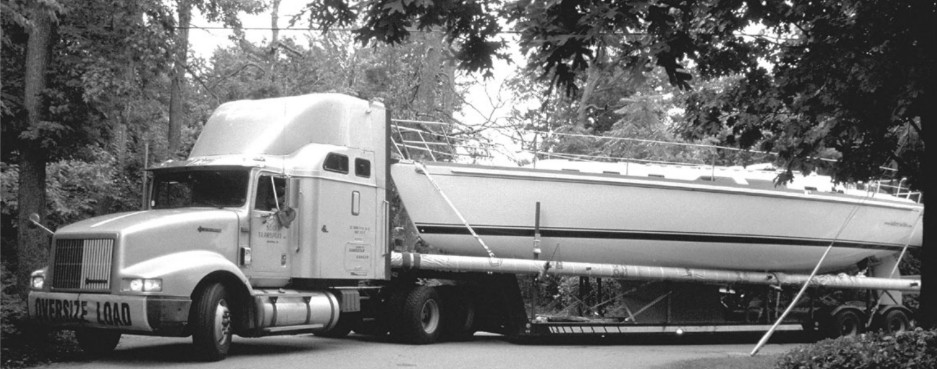
Although you might think about padding the mast with bubble wrap, it is not recommended, because the loaders cannot see what they’re resting the spar on, and it’s too easy to set the mast on the cradle with a rope or furler extrusion between the spar and the cradle. Three thousand miles of chafe will cause all manner of damage to the mast and the sandwiched part. Leave the mast open, and wash it thoroughly when the boat gets where it’s going. Similar treatment should be given to the boom. Depending on the size, the boom can be secured on deck, as long as the lashings are extra-strong and you have ample padding between the boom and the deck. More words of advice from Chris Bunch: “Boatowners should be aware that they will be subjecting their boat to hurricane-force winds for several days and should secure gear accordingly.” With that in mind, add another lashing here and there, just to make sure. The trucking company will supply padding to go between the mast and the cradle.
The outside– Moving to the deck of your boat, remove all loose gear. Stow or ship your anchor. Remove all exterior canvas, and stow it below. Take off the Bimini frame and stow or ship it. Take off instrument covers and stow them. If practical, remove cockpit-mounted electronics and ship them separately. Remove and stow genoa cars and other loose deck hardware. Stow your cockpit table. If you can, stow or ship dinghy davits. Make sure that your cockpit locker lids have sturdy hasps, and padlock them shut. Seal the gaps around the lids with tape to keep the wind from lifting them open. Use a strong tape, like filament or duct tape, to secure hatches, opening ports, and your companionway. After roller furling equipment, the most common damage occurs when an inside hatch lock fails, and the hatch cover is torn off at 70 mph. Use adhesive remover to clean off tape residue when you put your boat back together. Take another look around, and if you have any questions, remove the gear and ship or stow it.
The inside– Down below, take off anything of obvious value and ship it separately. Make sure everything below can stand several days of lurching and jerking around. Secure dishes, stemware, and drawers. Remove the television and the lovely brass kerosene lantern. Tie or tape lockers closed. Think hurricane. Another nugget from Chris: “Don’t count on drivers to spot problems with preparation. Often, they’re not thoroughly trained, and they rarely know about boats.” Use your seaman’s eye to spot potential problems. Keep in mind that any damage incurred as a result of improper preparation is the responsibility of the owner, not the trucking company.
Timing
The trucking company will be very happy (read: it’s cheaper for you) if they can simply drop the boat on the trailer and drive off into the sunset. Haul the boat several days before your ship date to give yourself plenty of time to secure everything and to get accurate measurements of your boat to the trucking company.
Schedule your ship date for a Monday or Tuesday, if possible. Three times this year at my home marina, I have seen drivers show up Thursday afternoon, expecting a quick load and an easy getaway. The boat gets loaded well enough, but then the measuring happens, and the boat is over the legal height. The stanchions have to come off, as does the boom gallows. The owner’s nowhere to be found, and the yard already has other work scheduled. The gallows doesn’t come off until Friday afternoon, and there’s no one available to remove the stanchions until Monday morning. Guess who pays for the driver to enjoy a nice three-day weekend in Annapolis?
Give yourself the extra time to make sure all the i’s are dotted and the t’s are crossed. Finally, take a hard look at your marina lot. Make sure there are no overhead obstructions like tree limbs or power lines to interfere with the truck. Look for at least 14 feet of vertical clearance. If you don’t have clearance, pick another marina to ship from. Do the same at the destination marina. Most trucking companies will not accept responsibility for damage incurred by vertical clearance obstructions at either marina. (Caution: While this is a good number for rough figuring, remember that Interstate highway bridges are only required to have 13 feet 8 inches of clearance. -Ed.)
Responsibilities
As noted, any damage resulting from failure to prepare the boat properly is the responsibility of the owner. If your yard does the prep work poorly, you will need to go after them for reimbursement. Any damage that occurs outside of either marina and is not caused by a failure to prepare the boat correctly is the responsibility of the trucking company. In any case, all of the responsibilities of both parties should be spelled out in the contract. Review it carefully and ask questions. If you’re unhappy about the wording of the contract, discuss it with the trucking company prior to contracting with them.
Finally, check with your own insurance company to see what coverage is extended to boat hauling. See if they have any caveats or exclusions that could leave your wallet exposed in the event that something goes wrong. I did some work on a boat that was trucked to Annapolis from Chicago. The driver ignored a low overpass warning and sheared off all of the stanchions and peeled off a goodly thickness of the coachroof. Make sure you understand liability and coverage before you sign anything.
That’s the scary stuff. I see boats coming and going via trailer every day: shiny new Clorox bottles from Beneteau and Hunter, salty-looking old Cape Dorys, and high-tech Grand Prix racers. Most of them arrive at their destination without a scratch. The guy who owns the trucking company wants to stay in business, and he wants you as a good reference.
Size restrictions for shipping a boat over the road
There are certain recommended “Do not exceed” sizes for trucking a boat. In some cases these limits can be exceeded, but only at horrendous expense, say $15,000 for a trip from Texas to San Diego.
The maximum legal height of a load without the need for special permits and routing is 13 feet 8 inches. The maximum load length without the need for special permits is 53 feet. The maximum width without the need for special permits is 8 feet 6 inches. And the maximum total weight of a hauling rig is 80,000 pounds. Most companies set weight limits for the boats they haul at 36,000 to 38,000 pounds. Check with your transport company about measurements and fees for exceeding maximum dimensions.
Maximum figures can be exceeded, but now you’re paying for a wide load and warning vehicles in front and behind the truck. That involves the cost of three drivers and state-by-state permits, fees, and routing requirements. These loads are not permitted to move at night, on Sundays and holidays, or during bad weather.
If you’re close to the height limit, think about removing stanchions, lifelines, and pulpits. You get a wonderful chance to rebed your deck hardware, and you won’t get billed for inadvertently removing graffiti from freeway overpasses.
Geoff is a good old boater based in Annapolis, Md. He runs a marine electronics business and lives aboard a 15-year-old Ted Brewer-designed pilothouse cutter named Ocean Tiger with his wife, Lori, and a menagerie of pets.
Thank you to Sailrite Enterprises, Inc., for providing free access to back issues of Good Old Boat through intellectual property rights. Sailrite.com