A little routine inspection can help prevent that sinking feeling
Issue 18: May/June 2001
The steering gear on your boat may not get a lot of attention unless the boat stops steering. Depending on the way the rudder system is designed, it might also need your attention if it starts flooding.
My son and daughter were sailing a Catalina 27 with a group of friends one fine fall day. As chance would have it, they all were either in the cockpit or farther aft, standing by the backstay. My daughter happened to go below and found the floorboards awash in seawater. There was no automatic bilge pump.
They called me on the radio to ask my opinion. I thought perhaps all the weight in the stern had sunk the hull lower than the open top of the rudder shaft tube, letting water in. I advised my son to distribute the weight of the crew more evenly and then pump the bilge and see if the water stayed out. That solved the problem, and they were able to sail home.
Such occurrences are rare, but they do happen. Even if you don’t intend to rebuild your steering gear, it is important to know how the rudder shaft enters your boat without allowing the water to enter with it. In many cases this involves a rudder tube.
Several rudder designs
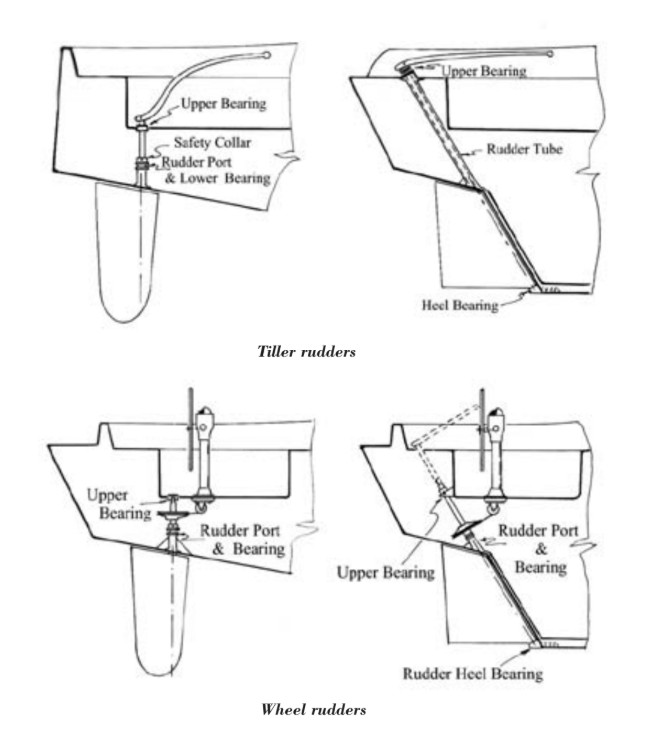
The exact location of rudders and the method of their attachment to hulls involves several compromises. The transom-hung rudder, attached with pintles and gudgeons, or even a pin, offers simplicity of construction and maintenance, but the rudder blade must be larger because it is less efficient. It can also ventilate and may be far enough aft to come out of the water when the hull pitches in heavy seas.
For these reasons, designers often choose the fully immersed rudder. If your boat has a fully immersed rudder, it will have a rudder tube and at least two bearings, and it may have a stuffing box or some other form of seal as well.
A more complicated system
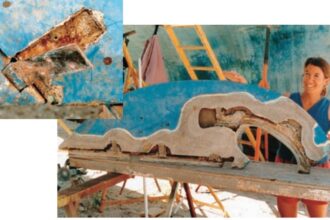
In the case of tiller steering, the common approach is to glass a heavy fiberglass tube into the hull that extends from the bottom of the boat to the cockpit floor or the afterdeck. Typically, this tube has a top bushing to keep the rudderstock centered in the tube. Since the tube extends well above the waterline, there is no attempt to make it watertight.
The bottom of the rudder on a full-keel boat with an attached rudder rests in a shoe attached to the aft end of the keel. This is the lower bushing which prevents undue side-to-side and fore-and-aft motion of the rudderstock. In a skeg-hung rudder, the lower pintles, gudgeons, and bushings are used to support and control the rudder. In the case of a spade rudder, there must be a collar that holds the rudder up in the rudder tube to keep it from falling out of the boat. This has happened more than once and, depending on how the rest of the system is configured, can lead to rapid flooding.
In the case of wheel steering, the quadrant that connects the wheel to the rudder makes it necessary to have a much shorter rudder tube. This usually terminates inside the hull below cockpit level. The height of the tube may prevent water from entering the hull. If it doesn’t, there must be some sort of sealing system. This can be a standard bronze stuffing box glassed to the top of the rudder tube or, if the tube is high enough, the top bushing with close tolerances is all that is required.
Over time, both the tiller and the wheel systems may need repair in the area of the rudder tube. My Pearson Ariel had a rudderpost and tube that terminated in the cockpit. There was supposed to be a top rudderpost bushing to keep the water out when under way. I noticed that at hull speed, when under power or sail, the boat would suck down, and the velocity pressure of the water would force it up the tube. The top rudderpost bushing had long since disintegrated, and all that was left was a hollow tube with the rudderpost inside. It was a pretty sloppy fit, at that. So water would exit the top of the tube and pool in the aft end of the cockpit when the boat was under way. (The cockpit drains were in the forward end.) This was not dangerous, but it was an annoying source of wet feet. Replacing the old bushing with a new one was not practical. Even when I called the Pearson Company, which was still in business at the time, representatives could not tell me what the bushing was made of or how it was fabricated.
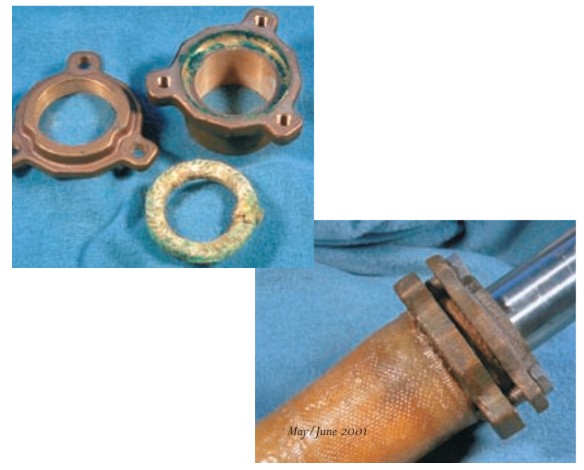
Edson to the rescue! It seems I was not the only one with this problem, and Edson International made a rudder stuffing box that combined a top rudder bearing with a stuffing box to keep water out. It is easily attached to the top of the rudder tube with fiberglass tape and epoxy and becomes a permanent addition to the structure.
The packing in the stuffing box can be renewed and removes the slop from the rudder shaft. The assembly is not very expensive, and Edson makes the rudder stuffing box in various sizes to fit most rudder shafts.
Inspection and repair
Your rudder tube should be included in a regular routine inspection of your steering system. Is there a top rudderpost bearing, or is the rudderpost free to wander around in the tube? Is there a grease fitting in the side of the tube? Is the rudder tube terminated below the waterline, and does it have a rudder stuffing box?
Your boat may simply have bushings at the top and bottom of the tube, or you may have some variation of the rudder tubes discussed. Regardless of what style rudder tube you have, time and use may cause enough wear to require repair.
Every rudderstock needs some sort of bushing or wear ring to keep it centered in the tube and turning smoothly. It is common for these bushings to break in half and slide down into the tube. Check the top bushing for wear. If it is worn, replace it. This usually involves removing the tiller head or steering quadrant to allow access to the top of the rudder tube. If you have a rudder stuffing box, check the packing. If it is worn, replace it with Teflon-impregnated packing for easier steering and better drip control.
When the boat is out of the water, check the bottom bearing. Grab hold of the bottom of the rudder and try to move it from side-to-side and fore-and-aft. A little play is OK, but anything over 1⁄8 inch is too much. If it moves beyond this, check all the bushings and, probably as a minimum, replace the lower one. Bronze pipe in the appropriate size can be cut and used as a good bushing.
The heelpiece on an attached full-keel rudder can be worn into an oval shape over time. This can be restored to round by reboring and inserting an oversize bushing or by using MarineTex to repair the damage. MarineTex will not last forever, but it will last several years.
Finally, do not ignore a wheel or tiller that feels loose. The rudder may be trying to tell you something. It pays to give your rudder tube and shaft a little attention each spring and fall for safe, carefree sailing during the summer months. An ounce of prevention can save you from that sinking feeling and give you the confidence that comes of knowing how your rudder system is built and what kind of condition it is in.
Bill is a marine surveyor/boatbuilder who’s been living, eating, and sleeping boats since he assisted at Pete Layton’s Boat Shop in the ’50s. He’s worked for Charlie Morgan (Heritage) and Don Arnow (Cigarette). And he’s owned a commercial fiberglass boatbuilding company.
Thank you to Sailrite Enterprises, Inc., for providing free access to back issues of Good Old Boat through intellectual property rights. Sailrite.com