Climbing the mast the slow but easy way
Issue 27: Nov/Dec 2002
FOR MOST OF US, GOING TO THE TOP OF the mast for any reason is an ordeal. Even if you are not afraid of heights, the logistics of getting there makes it easy to procrastinate. How- ever a periodic trip to the masthead is necessary for preventive maintenance. If these trips aloft are not made, Murphy will dictate that you will have to go up for repairs at the most inconvenient time and place.
The first time I went up the mast on our Valiant 32, Bluebonnet, it was an eye-opener. Our previous boats were trailerable, and any masthead work was done before the mast was raised and the boat launched. At launch time on Bluebonnet I had neglected to connect the ham radio antenna wire to the coaxial female connector at the masthead. I recruited a fellow sailor on our dock to crank me up the mast in my new bosun’s chair, using the main halyard through a rope clutch and a self-tailing halyard winch. When I got to the masthead I found, to my dismay, that when the bosun’s chair was raised to the halyard sheave, the top of my head was a foot below the top of the mast. This resulted in my working in a very awkward position mostly by feel. Also, the rocking of the boat by the wind or the wake from passing boats left me swinging and made the task even more difficult.
The solution to these and other difficulties of going up and working at the masthead came through trial and error. I realize there is no one best way to do a lot of things, and I only offer this as the best way I have found so far. There have been other articles in Good Old Boat on methods of going up the mast. I offer my method for working safely at the top of the mast because it works for me and does not require purchasing any special equipment.
Intolerable heights
My wife, who is my best friend and helper on most boat projects, has an inner ear condition that makes heights intolerable for her. Thus, I am the one elected to go up the mast. Unfortunately, she doesn’t have the upper-body strength to crank me up there.
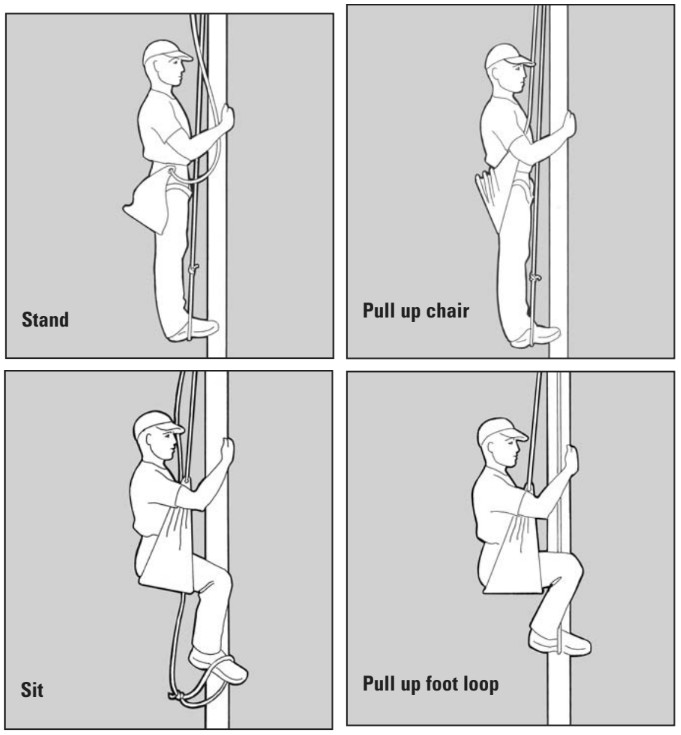
I attach the bosun’s chair to the main halyard and mouse the shackle with a nylon wire tie. I use a second halyard that also goes to the mast- head — a jib or spinnaker halyard — and tie a loop a couple of feet in diameter in the end of it that would attach to the head of the sail. The tail of each halyard goes to a separate winch. With my feet on the cabintop, I strap myself into the bosun’s chair. I use the type that has a belt that goes around my waist and a strap that passes through my crotch. My wife then cranks the other halyard up until the loop is about the height of the seat of the bosun’s chair. I then put one or both feet on the loop and stand up. My wife then cranks up the main halyard until the chair is again snug against me. Then we repeat this procedure. In this way, my wife never has to crank up any significant weight. We have to move the other halyard around the spreader and standing rigging from time to time.
The procedure may take time, but it’s not tiring work. Our other attempts to get me up the mast involved my wife cranking while I pulled myself up on the rigging or other halyards. Both of us were exhausted by the time I got to the top of the mast.
To solve the problem of how to work safely when I get to the top, I have done two things. First, I installed two fold-up mast steps near the top of the mast. These are mounted on opposite sides of the mast at a distance from the masthead that allows the masthead to be just below my armpits when I am standing. Any wind or rocking of the boat will have little effect while you are standing on the steps and strapped to the mast. You move with the mast and don’t gyrate wildly.
Safety strap
Second, I wear a safety belt around my waist (such as that offered by Mast Mate) and fasten the safety strap around the mast when standing on the steps. This is most important because the bosun’s chair slips down around your thighs when you’re standing. With the belt and the safety strap around the mast, you can lean back against the strap and work with both hands comfortably and safely. But don’t try to get out of the bosun’s chair while you’re working in this position. It’s there for your protection. With the chair strapped around your waist, you have access to the tools in its pouches. Also, if you get tired of standing on the steps, you can always sit down in the chair to rest.
Before descending, remember to fold the steps up again. Although you don’t need it for descending, remember to bring the second halyard down with you, feeding it back through any of the standing rigging so it will be in its proper place when you get back on deck.
We have found this to be a very satisfactory system. I can get up the mast with minimal effort and without any special equipment, and I can work comfortably and safely while aloft. I have found the mast steps to be so convenient that I am considering adding them down to the spreaders. It would speed up the process of reaching the top. I would, of course, continue to use the bosun’s chair and safety belt. Then there is the possibility of installing ratlines on the lower shrouds to reach the spreaders . . . but you have to draw the line somewhere.
Thank you to Sailrite Enterprises, Inc., for providing free access to back issues of Good Old Boat through intellectual property rights. Sailrite.com