While they may not save the day, they certainly help brighten it
Issue 19 : Jul/Aug 2001
Every place has its Cape Horn. At port Cardigan, on the west coast of Wales, where I am an auxiliary harbormaster, it is the estuary bar. The channel shifts in storms and is seldom buoyed. Admiralty charts are outdated as soon as they are printed. Now a sleepy little market town, back in the days of sail, Cardigan was a thriving seaport the tonnage of which competed keenly with Liverpool, Bristol, and Cardiff.
The bar was a dangerous place then, too, and it has left us its legacy of bones . . . the bones of ships and men under the mud and sand. At night when I stand outside my isolated cottage and hear the mournful sound of the seals calling to each other, it is easy to slip into thoughts of ghosts. The local church has only one bell. It should have had two, but the other was lost when the ship carrying it went down on the bar.
Few yachts visit, and those that do risk grounding. I recall a couple of years ago a little carvel-built cutter sailed in, cut a corner too fine, and touched on the bar. She was a centerboarder, and her crew quickly lifted her board. For a while it looked like they might make it, but they were hard on a lee shore, and with the board up they could not claw off. The Royal National Lifeboat Institution launched the inshore rescue boat, but it was too late. The yacht would be there until the next tide.
There was no harm done. Fortune had served up calm conditions, but her position was not to be envied. As the tide receded, she was surrounded by the better part of a mile of sand. Knowing her crew would be feeling vulnerable, perhaps shocked and cold, I bagged some cakes I had just baked, pulled on my boots, and trudged out to see what I might do. A young married couple and their baby were aboard. They were grateful for the warm cakes.
The yacht was likely to refloat during the night, but that place is notorious for rapidly changing conditions, so we made a plan. I helped them lay out some anchors and suggested the wife and baby stay with us at the cottage for the evening while a couple of young lifeboat crewmembers would help the skipper bring the yacht in to my mooring, with the RNLI boat standing by.
Happily, all went without incident and we still receive Christmas cards from that family. They learned two important things on that visit . . . to distrust the chart and to carry a griddle aboard to cook Welsh cakes.
First, the griddle
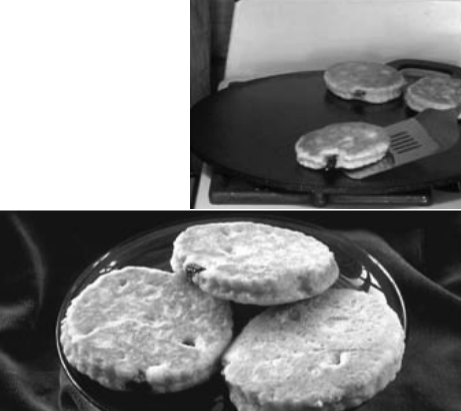
Welsh cakes are an economical and simple dish to prepare quickly and easily on a single flame, provided one has the tool for the job. In Welsh it is known as a maen (which should be pronounced “mine” but is, colloquially in some regions, pronounced “marn”). In the north it is called “planc” (pronounced “plank”). Maen is Welsh for “stone” and I would guess derives from the ancient use of a hot bakestone for cooking. I use my grandmother’s, which may well have been inherited by her and could easily date from the 19th century.
You can sometimes buy these griddles in country hardware shops, or one can be made in a metal workshop. It is a simple plate of steel or iron, a disk of up to about 12 inches in diameter, usually somewhat less, and 3⁄16 inch to 1⁄4 inch thick. Conventionally, it is shaped to include an integral handle guaranteed to burn the fingers or, rarely, a wooden handle like that of a frying pan, which is much better. Properly cared for, it will temper and improve with age with a polished surface; indeed, you can try these cakes in an old-fashioned iron frying pan, if you like.
Next, the recipe
Recipes for Welsh cakes vary, but mine is more or less as follows. I am vague because you can experiment with the ingredients; it is the method that is critical.
Sift 12 to 16 ounces (1 1⁄2 to 2 cups) of white self-rising flour into a mixing bowl. Add ground cinnamon to taste; I like it a lot and use a heaped teaspoon. Mix it in thoroughly, a job done well with a wire “balloon” whisk.
Add some light brown sugar. I use about 3 ounces and mix well. Traditional recipes would give half fat to flour but, with modern light margarines/spreads, that can be halved, so I use about 4 ounces and rub it well through the mix. This is not a job to undertake after handling the anchor chain. One well-known British chef back in the 1950s used to warn that hands should be meticulously scrubbed because, if they were not clean before mixing pastry, they would be spotless afterward!
Back to the galley. The mix will be very dry and crumbly. Beat up an egg and with it a vital ingredient that is recommended on good authority . . . I happened to be in a local hardware shop buying a maen for a friend, an ex-patriot Welshman living in London and pining for the old Welsh cakes back home. As I examined the device in question, an elderly lady of small but fearsome demeanor approached and bade me listen carefully.
“The secret,” said she, getting my attention by prodding me painfully in the chest with a bony finger, “is to add a spoonful of syrup and, you just listen carefully now, good boy,” (I have turned 50, by the way), “BEAT (prod) IT (prod) INTO (prod) the EGG! (superprod).” By this time, my back was against a wall, I could retreat no further, but I would clasp that expert advice to my bosom long after my shattered ribs came out of plaster.
Now, without fail, I beat in a good teaspoon of golden syrup until it is dissolved into the egg. This ensures the cakes will be as they should: moist and chewy. (Golden syrup is available in the U.S. We’ve also substituted maple syrup and Karo syrup. Either one will do. -ed.)
Add it to the cake mix — proper recipes would say fold it in — and add a little milk, if necessary, to make a firm, moist dough. Reconstituted dried milk is fine, and you will be unlikely to need more than a couple or three dessert-spoons (teaspoons), depending on the size of the egg.
At this point add some chopped mixed peel of the type used in fruit cakes, and some sultanas. Quantities vary with taste, but the received wisdom is not to be overly generous with the fruit . . . say a couple of dessertspoons of sultanas and one of mixed peel, or there will be too much fruit to permit cutting into individual cakes, which is what happens next. (Sultanas are a yellow seedless raisin. Any raisin will work. We’ve used grated orange peel for the chopped peel -ed.)
Skill plays a role
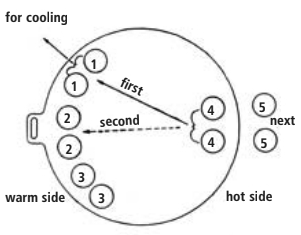
Roll out to about a quarter of an inch thick and cut (cookie-cutter style) into rounds 2 1⁄2 inches to 3 inches in diameter. Place to one side. Now the real test of skill begins: put the griddle on the flame and move it around to warm it uniformly at first. When the whole griddle is warm, draw it off to one side slightly so half of the griddle gets hot, while the other half remains warm. Put a drop of cooking oil on the hot part and use a kitchen towel to wipe the oil all over the surface in a very thin layer.
Drop a couple of rounds on the hot part. They should hiss just audibly as they go on. After about half a minute, flip them over to cook the other side, repeating if necessary until they are lightly browned. They are still not cooked through, so now transfer them to the other side of the griddle, the warm side. Drop another two onto the hot part and repeat the operation, working down the other side of the griddle like the figures on a clock. Drop on a third pair. As the fourth pair go on to the hot part, it will be time for the very first two you cooked to come off. They will have risen. Put them to cool on a sheet of paper, and let the fourth pair take their place. If they have developed a hard crust, you’ve left them on too long.
This process continues methodically, first browning the cakes on the hot side, then placing them on the warm side to finish cooking and rise. You get into a rhythm. The aroma is such that the temptation to eat the cakes hot is almost irresistible, but if you weaken you may pay with indigestion. (We admit to impatience: we ate them warm. -ed.)
When they are cool, store them in a tin. They can be eaten plain with preserves and are good with fresh fruit, particularly apples. They do not need to be buttered. They are excellent in heavy weather or on a long night watch.
The technology is simple, the tradition long, the results well worth the pleasant interlude cooking, perhaps helping to pass a stormy afternoon in harbor. The maen, as well as being a piece of Celtic folklore, is an easily stowed (well away from the compass) and highly practical tool in the galley, even more so if there is no oven. It is good for flapjacks and pancakes; there is even a traditional bread that can be cooked on it. So often, simple is good.
Geoffrey lives in a beach house near Cardigan on the west coast of Wales. He’s been involved with small craft for more than 40 years. A writer and journalist, he just finished his second novel.
Thank you to Sailrite Enterprises, Inc., for providing free access to back issues of Good Old Boat through intellectual property rights. Sailrite.com