Issue 20 : Sept/Oct 2001
In my writing about the search for shoal draft (July 2001), I covered centerboards, leeboards, and bilge fins but neglected shoal fins — an oversight on my part. It was, perhaps, a deliberate omission though, since I’ve never been convinced that shoal fins actually work. Indeed, I have found that if a particular type of shoal-draft fin does provide the desired performance, its disadvantages often outweigh its advantages.
During my years with Bill Luders, we designed many 5.5-Meter yachts. This class of 32-foot sloops had a minimum keel width of 4 inches and a draft of 4 feet 5 inches. Naturally, such a narrow keel forced the ballast higher than it would have been if we fitted a wider keel, but every time we tried a wider keel, the tank test showed that performance suffered. Lowering the vertical center of gravity to increase stability simply did not offset the increased resistance of the fatter keel.
Then, in the last years of our association, a well-known Texan 5.5 sailor commissioned Bill to investigate bulb keels, and we tested a variety of shapes. Same result. Obviously, if we’d shallowed the draft to 3 feet 9 inches, and used a bulb keel, things would have been even worse. I suppose that’s the reason I’ve never been a fan of bulb keels.
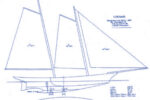
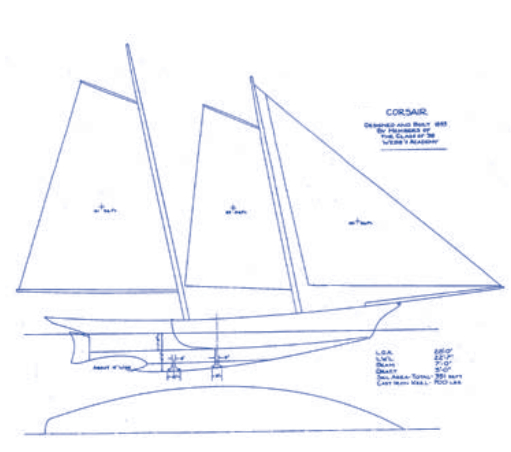
The Scheel keel, as used on the Tartan, is a form of bulb not unlike an inverted dumbbell. It’s a patented shape so I’m unaware of its actual refinements, but it appears very similar to the keel used on Corsair, designed in 1893 by a class of the Webb Institute, the well-known school of naval architecture. Bill Luders’ father was a member of that class, and I still have a print of the drawing of Corsair that Bill gave me. Indeed, when I pulled it out to look at it, I was surprised to see that Corsair also featured a “Brewer bite” between her rudder tip and the end of her keel. Perhaps that’s where I got the idea for the cutout I’ve used on many of my designs. I don’t know for certain, but it is definitely possible, as these things can stick in your mind long after you’ve forgotten seeing them.
The Corsair drawing was also printed in a yachting publication (I believe it was Skipper magazine) many years ago. It’s quite possible that Henry Scheel saw it there, forgot about it, and mentally resurrected it when the need and opportunity occurred. I knew Henry for many years, well enough to know that he would not have pirated anyone else’s work. So if he did get his keel idea from Corsair, it was unwittingly.
In any case, the only association I had with a Scheel keel was in the late 1970s when we were designing the Morgan 38. Morgan wanted to offer a relatively shoal-draft boat for Florida and the Bahamas and insisted on a maximum draft of 5 feet. We designed a NACA fin, fatter than I preferred in order to fit adequate ballast low inside it. Then Morgan hired Scheel to design one of his fins for the boat, and the result was a saving of a mere 2 inches in draft, 4 feet 10 inches. A tank model was built with interchangeable Scheel and NACA fins and tested at Stevens Institute under the watchful eye of Pete De Saix. The fat NACA fin was easily the winner, and hundreds of Morgan 38s appear to be doing well with it, some for more than 20 years now.
Winged fins are another story. They do appear to add to performance as, when heeled, the wing increases the effective draft compared to a wingless fin. The wing also reduces cross flow from the leeward to the windward side of the fin and, in turn, this helps eliminate vortices and resultant drag. My concern about a winged fin, though, is that it could act as an anchor when the boat goes aground, making it difficult to tow the boat off into deeper water. I’m sure I’m not the only one who has heard tales of winged fins being badly damaged or even torn off in a minor grounding that would not have been a problem with a more conventional fin. In my opinion, a good winged fin is effective but fragile.
In any case, I’m convinced there is no perfect solution to shoal draft. Keel-centerboards, leeboards, bulbs, Scheel fins, shoal fins, winged fins — all seem to have their good and their bad points. At the moment I favor asymmetrical bilge fins for the cruising skipper who must have shoal draft, but only until something better comes along.
Thank you to Sailrite Enterprises, Inc., for providing free access to back issues of Good Old Boat through intellectual property rights. Sailrite.com