Bristol Fashion
Issue 20 : Sept/Oct 2001
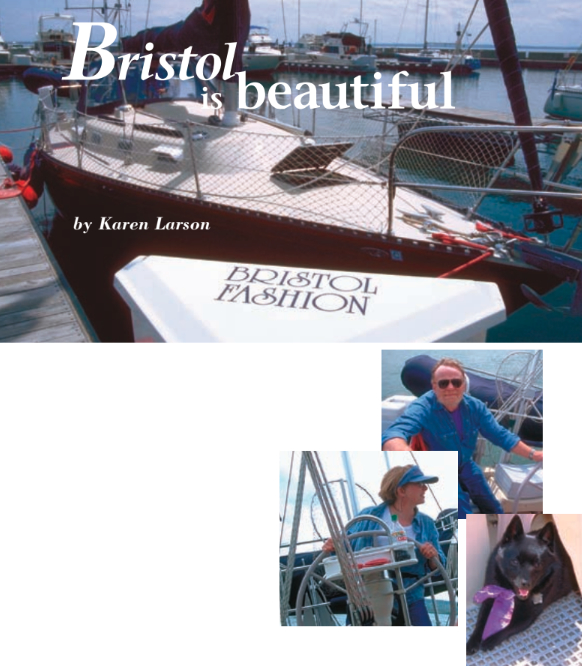
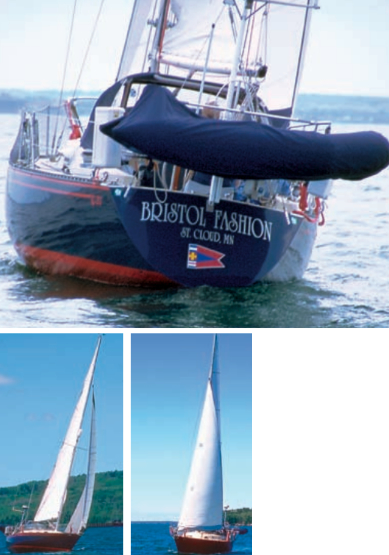
Bristol Fashion. A Tartan 33. Gleaming navy topsides with red trim. She was on our list of dream boats before we bought Mystic.
But she wasn’t for sale. Bristol Fashion was, and still is, owned and loved by Russ and Joanne Clepper, who sail Lake Superior from their home port of Washburn, Wisconsin. This 1980 Tartan wasn’t Bristol when Russ and Joanne bought her in 1987. She’d spent seven hard years in the charter fleet and was showing the effects of the “learning experiences” that had trained many a vacationing sailor. But the Cleppers had been looking for an affordable freshwater sailboat in every marina between Duluth and Detroit. When they found this Tartan they’d already paid for a survey of another boat and backed away from that deal.
Then the Tartan went on the market, ironically the very boat they’d chartered some years before. Still named Deliverance, she was trucked to their home in St. Cloud, Minnesota. She would be named Bristol Fashion, like the Cleppers’ former pet schipperke. Russ and Joanne weren’t intimidated by this boat’s survey, which noted some blistering on the hull and minor delamination of the rudder. They’d repaired boats before. This one would be redone from stem to stern and, when finished, she would live up to her new name.
As a couple, the Cleppers’ sailing days began with a Christmas holiday in 1976. Russ remembered enjoying sails on small lakes as a child. He suggested that they attend Steve and Doris Colgate’s Offshore Sailing School on Captiva Island, on Florida’s west coast. They spent the mornings sailing Solings and the afternoons exploring the area as tourists.
A Santana for starters
The summer of 1979 they found a Santana 21 at a rock-bottom price when a broker was forced to sell his business. “It was a repossession sale,” Russ says. “You put in your bid and bought it ‘as is, where is.’ There was no survey.”
They named the boat, appropriately, Liquidation. As it turns out, there were parts and pieces missing — rigging in particular — but they worked out the details and sailed Liquidation for three years. They could trailer this boat and attended a few regattas, although Joanne points out, “We went for the fun. We’re not racers, but I like a good party.” She notes with a laugh that the first boat was one that Russ (who is 6 feet tall) could kneel in. The second was one he had to bow his head in, and by the time they got to the Tartan, he had standing headroom.
Timely training
Each boat trains its owners for the next one, and the Cleppers were soon ready for another project. The boat with “bowing headroom” was a Columbia 7.6 (25 feet) named Sparkle. “But,” Russ says dryly, “she didn’t.” Sparkle was already five years old in 1983 when she was brought home to the Cleppers’ garage for remedial work. “We spent a lot of time on that one,” Russ says.
Joanne adds, “We painted the deck, added cedar closets, built stowage spaces.” Sparkle was reborn as Prelude. They sailed her on Minnesota’s Mille Lacs Lake, a large shallow lake close enough to home to make it possible for Joanne, an elementary school teacher, to get there and spend time sailing alone when Russ, who owns a photo shop, had fewer summertime hours to spare.
Fast forward another six or seven years, and the Cleppers were walking docks and getting familiar with marinas from Minnesota to Michigan in search of the boat with standing headroom. The Tartan 33 won the honors partly because of the interior layout and the warmth of the interior teak woodwork.
First they trucked her home to the garage, which they admit will not allow for any further project boats — if the trend is to get larger, at any rate. (Even then, we marvel at the size of this garage. Could there be such a thing as a garage that holds a 33-foot sailboat?) They can’t squeeze in a boat even one foot larger, they agree. But having her at home made the refit much more convenient.
Stripper award
“There is not a system, part, or piece of this boat (except the engine — a 24-hp Universal diesel was standard) that we have not overhauled, rebuilt, replaced, or modified to fit our needs,” Russ says. “We stripped the topsides and prepared her for Awlgripping.” Everything, Joanne notes, was stripped, earning her an honorary “stripper award” among her co-workers, who no doubt heard many tales of the project in the garage.
“We’ve stripped her from deck rail to the keel,” Russ says. “The next big project will be the deck in preparation for Awlgripping.” He notes that if you get into a project, “you might as well spend the money and do it right.”
Blistering on the bottom? They did a full barrier-coat and bottom-paint job. They replaced a well-worn teak-and-holly sole. They had a new cabinet built for a microwave, installed new Lewmar ports, installed Alpenglow lights, replaced the alcohol stove with a propane version, added a Dutchman system, replaced the head and holding tank, replaced most of the wiring, added roller furling and a full-batten main, put in a bow anchor roller, added an inverter and smart battery charger, and so on.
They revised, restored, polished. When she truly was Bristol, Bristol Fashion was trucked back to Lake Superior where her former charterers would never recognize the gleaming red and blue version of the former bamboo-colored sailboat.
Well laid out
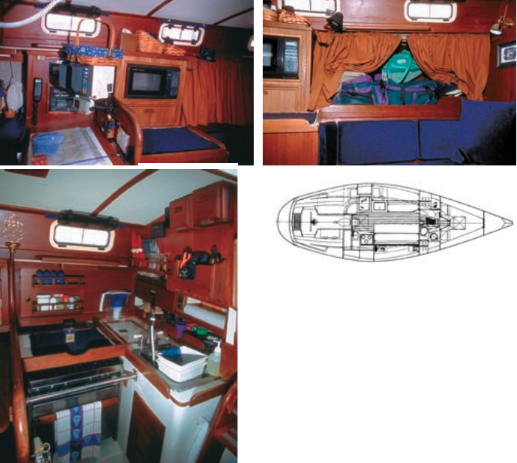
As a sailing twosome, the Cleppers particularly like the boat’s interior layout. For starters, it has a V-berth big enough for two and a head that runs the width of the boat just aft of the V-berth, making a larger shower space. Abaft the head in the main cabin there is a long settee to starboard and a short one to port with the icebox taking up the missing space to port. The starboard settee converts to a large double berth or a single with a padded leeboard. The remainder of the galley is in the usual place on the starboard side beside the companionway. A chart table and access to a quarter berth are squeezed into the corresponding space to port.
A fold-down table on the forward bulkhead makes the belowdecks area seem spacious. But once a folding table is down it often blocks access to the head, which is typically located forward. It’s just about essential, therefore, for boats with a table of this sort to have a permanent navigation table, which the Tartan 33 does nicely. Otherwise, navigation and access to the head will be in competition on passages.
Unusual features
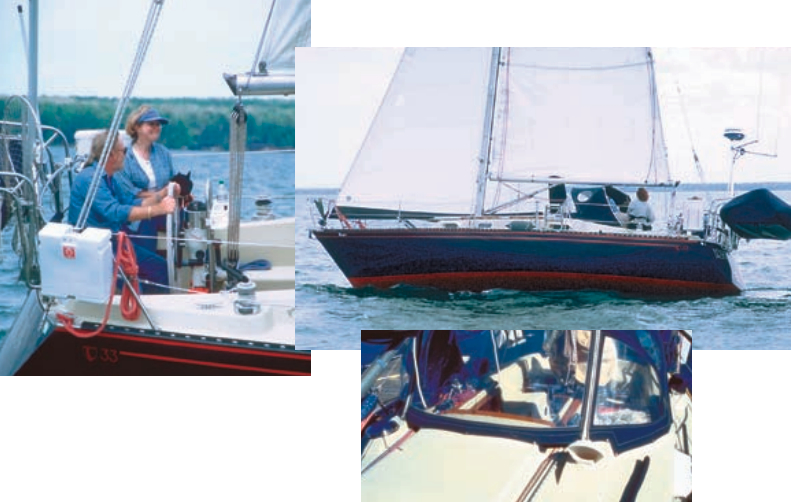
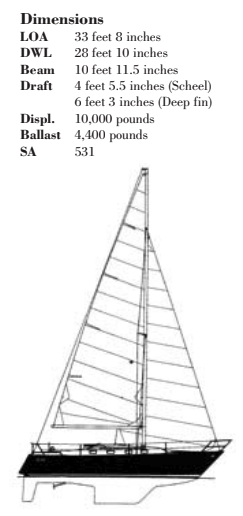
The Tartan 33 was designed by Sparkman & Stephens and introduced in 1979 for a run of approximately 220 boats that ended in 1984. Among its unusual features are a 3⁄4 fractional rig and a Scheel keel. The Tartan 33 was introduced as a replacement for Tartan’s earlier and very popular 34, which the company felt had become dated. The Tartan Ten, another 33-footer, preceded the 33 by one year. But this was a flat-decked racer with practically no interior furnishings and lacking standing headroom.
Some of the racing qualities of the Tartan Ten were incorporated into the 33: the fractional rig, the slotted aluminum toerail, a flattish sheer, and a wide stern. The 33 was one of the first production boats to incorporate a Scheel keel. This keel, which widens noticeably at the bottom, reduces draft to 4 feet 5 inches. The fin keel which replaced it with the introduction of a newer Tartan 34 is 6 feet 3 inches deep. This newer 34 was nothing more than a modified 33 with a new keel, a masthead rig, and 9 inches added to the stern.
The Tartan 33 uses swept-back upper shrouds. It also has what Practical Sailor described as a “vestigial skeg” supporting a rudder that the Practical Sailor reviewer called “a high-aspect-ratio appendage practically parallel-sided in profile, rather than the more efficient elliptical shape” common at the time.
Practical Sailor also mentioned a noteworthy Sparkman & Stephens design element: a molded dodger breakwater, saying, “other builders should take note of the simple, functional breakwater in the Tartan 33, which has openings molded in to allow halyards to be led aft.”
Bristol Fashion’s namesake schipperke (a Belgian barge dog, by the way) has been replaced by Mariah, another schipperke who has her own bed in the V-shaped place in the footwell beneath the V-berth, and her own tiny life jacket for use when sailing. She’s been “adopted” by other sailors at the Washburn Marina, who bring doggie treats and sometimes colored neck scarves from their travels. These scarves have become part of Mariah’s dockside persona. She has to live up to a certain image as the boat dog on Bristol Fashion. Nothing less will do.
Thank you to Sailrite Enterprises, Inc., for providing free access to back issues of Good Old Boat through intellectual property rights. Sailrite.com