A great cruiser by any name … including Panda and Tashiba
Issue 20 : Sept/Oct 2001
An invasion of boats constructed in Asia began landing on the Pacific shores during the mid-70s, when the American sailboat market still included sailors with a soft spot in their hearts for traditionally designed boats. Many will fondly remember this spirited period in the history of the fiberglass boatbuilding industry. New brands seemed to appear monthly, bearing labels like Hans Christian, Tayana, Ta-Shing, Union, and Lord Nelson.
The invasion was fueled by several factors: a combination of cheap labor and raw materials; the builders’ ability to fabricate metal components; and favorable currency-exchange rates.
At the time, American boatbuilders were operating at full capacity and dealers were rolling in clover. Boats were becoming more durable as builders seemingly had a handle on fiberglass construction techniques. Sporty designs produced by Cal Boats, Hunter, Ericson, and Catalina appealed to a market of sailors seeking combinations of good looks, comfortable accommodations, and a turn of speed.
However, the introduction of boats constructed in Taiwan launched a period during which traditionally designed double-enders enjoyed a renaissance. Following the aesthetic proclivities of Colin Archer and his ilk, the drafting tables of American designers began spawning drawings for boats that looked right at home in a wooden boat festival. Not surprisingly, the blend of traditional designs and modern construction methods produced stylish boats constructed of fiberglass. Laminated hulls sported a deceptive, wood-straked appearance. Bulwarks, cabintops, decks, and cockpits were defined by prodigious amounts of glistening teak joinery. Belowdecks, combinations of gelcoat and teak produced warm interiors with the feel of a staid men’s club. Standing headroom, large galleys and saloons, and oversized sleeping quarters were the norm.
Knockoffs were king
One idiosyncrasy of the Asian building system at the time was the introduction, usually at the expiration of a royalty agreement or some other financial arrangement, of a knock-off, a twin to an existing yacht given a different label. One dealer’s boat left Taiwan as a Hans Christian 34 and arrived in Los Angeles six weeks later as a Union 34. These developments often occurred to the chagrin of designers who, in many cases, were not paid royalties.
The bad news is that many of the boats had the performance characteristics of a bathtub. Designed for bluewater passages, they were on the heavy end of the displacement scale. Some were undercanvassed. Many underbodies sported a full keel that, while producing excellent tracking, inhibited performance and handling; a boat that tacked through 90 degrees was considered the exception. The ability to back up in a straight line under power, even when outfitted with a three-bladed propeller, was cause for celebration.
Their lack of performance often was exacerbated by owners overloading them, causing waterlines to disappear below the surface. One owner remembers designer Bob Perry telling him that one way to keep a boat on her lines was to paint a new line higher on the hull.
Some sail better than others
However, at least three of the boats were generally considered to have better sailing characteristics than their contemporaries. The Tayana 37, Baba 30, and Baba 40, all Perry designs, pointed higher and sailed faster. These boats still command high prices on the used-boat market, when you can find them.
One of these, the Baba 40, was introduced in 1978. This boat was conceived by Bob Berg, a Seattle yachtbroker who, with two business associates, formed Flying Dutchman International Ltd. Their plan was to import traditionally styled cruising boats from Taiwan.
The boats were built in the Ta Shing yard, which still enjoys an excellent reputation in the industry. Because the yardworkers were unable to pronounce Berg’s name, he was nicknamed “Baba” and so was his boat.
“Our objective was to produce a boat that was faster and less expensive than the Westsail 32 and Valiant 32,” he recalls. Berg commissioned Bob Perry to design the Flying Dutchman 35 and the Babas. Berg’s primary input was in the design of the interiors.
Perry says, “When Bob left his dealership, there was a legal fight over the name Baba, and Bob lost the right to his own nickname. He continued to market the Baba 40 under the Panda name. Then the yard took over the marketing, and the name was changed to Tashiba. The boats are essentially all the same. There was a deck-mold change, which reduced sidedeck width and increased headroom, that occurred fairly early in the project. I had nothing to do with that change, and I still consider it a stupid modification. There was also a steady progression in building details to help reduce the price of the boat. If you put an early Baba 40 next to a later Tashiba 40, you will find the newer boat has less teak trim, fewer hatches, and fewer portlights. There were also some interior changes to help reduce the price.”
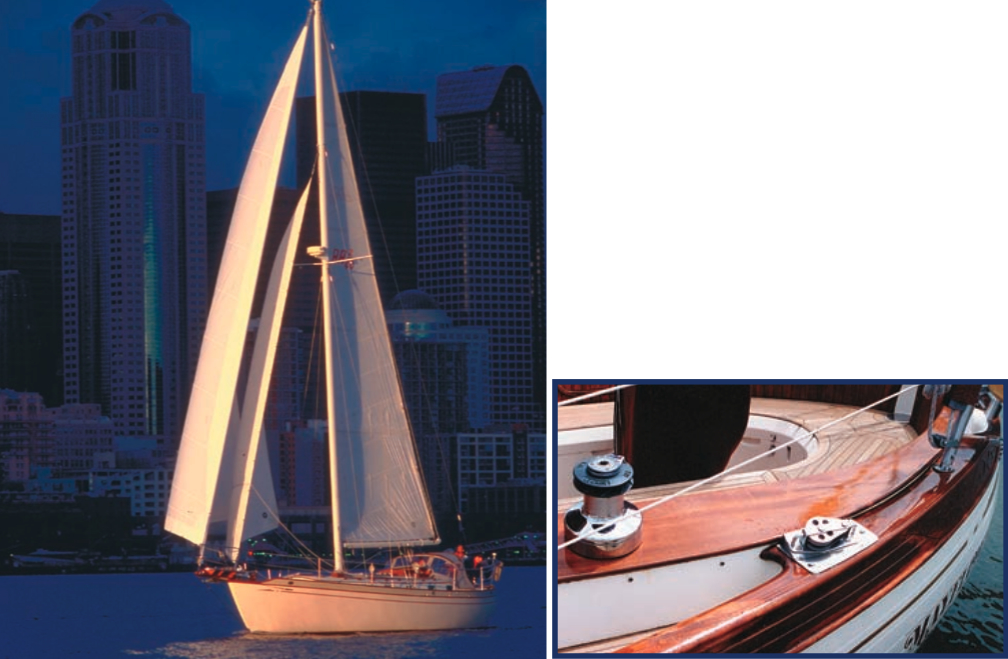
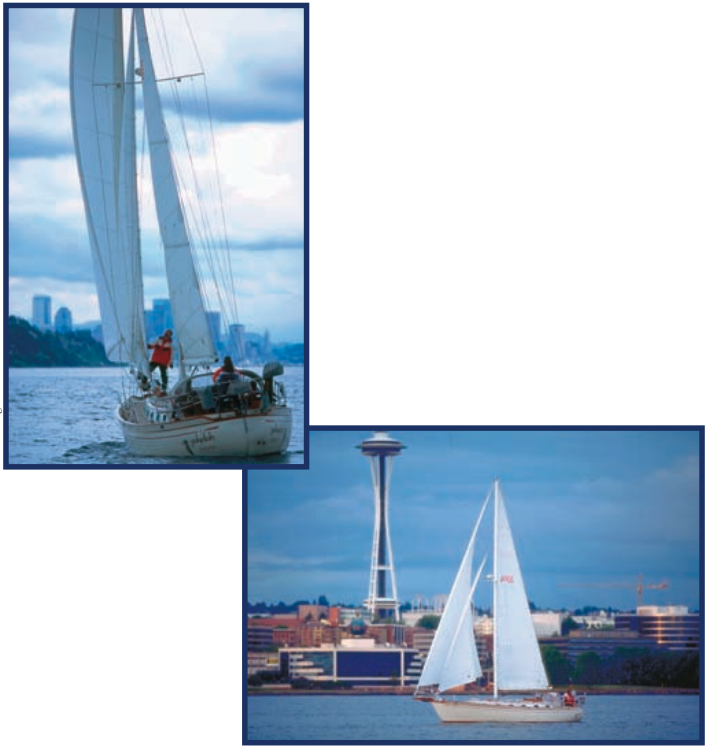
Production of the 40-footer began in 1978, and more than 150 were built. One of these, Yohelah, is owned by Rob and Teresa Sicade (Sigh-cayd), who live aboard and sail on Puget Sound while working through the middle months of a two-year plan to point the bow at the horizon. Viewed from abeam, Yohelah’s profile reflects her intent to cross large patches of water. Her bowsprit adds an almost jaunty look while increasing her length by five feet and the sailplan by yards. Her sheerline is near level, accented by a teak caprail sitting atop high gunwales that keep water off the deck and passengers. Bronze portlights span the length of the cabin, as do teak handrails that, when properly maintained, reflect sunlight. Aside from the aesthetics, those handrails also provide a degree of safety often appreciated while sailing offshore under dark, moonless skies.
The Baba 40s rolled off the production line with butterfly hatches under the boom that add to the appearance but have a tendency to leak. Bob and Teresa’s boat, however, has a large, flush deck hatch that adds light and ventilation and prevents water from intruding below deck. This custom change was built in by the yard at the request of Yohelah’s first owner, who made several trips to the Ta Shing operation while the boat was under construction. He also had the boat fitted with a forward-facing nav station.
Deck layout
Since the newest of these boats is at least 20 years old, it is unlikely that two boats will have the same deck hardware and configuration. Common denominators were aluminum masts supported by heavy wire standing rigging. Many of the competing brands at the time were equipped with wooden masts, booms, and spreaders that, though sturdy and attractive, required yearly varnishing. I’ve missed more than one day’s sailing while aloft with varnish brush and bucket.
“My boat is still equipped with original wire,” one owner told us, “and passed a recent survey. However, I’d re-rig the boat before heading offshore.”
Another replaced running rigging with lighter lines and says that, combined with lighter sails, “it has reduced heeling significantly.”
High on my list of modifications would be moving winches aft, where there is adequate space to mount them under a dodger, installing sheetstoppers and, if possible, internalizing halyards.
The bow and spaces below the boom provide space for the storage of an inflatable dinghy and life raft. The oval cockpit is large enough for four adults, but, like the Baba 30, smallish compared to the floating condominiums marketed by modern production builders. However, the cockpit is comfortable, and the boat won’t be swamped by water coming over the stern in heavy seas.
Belowdecks
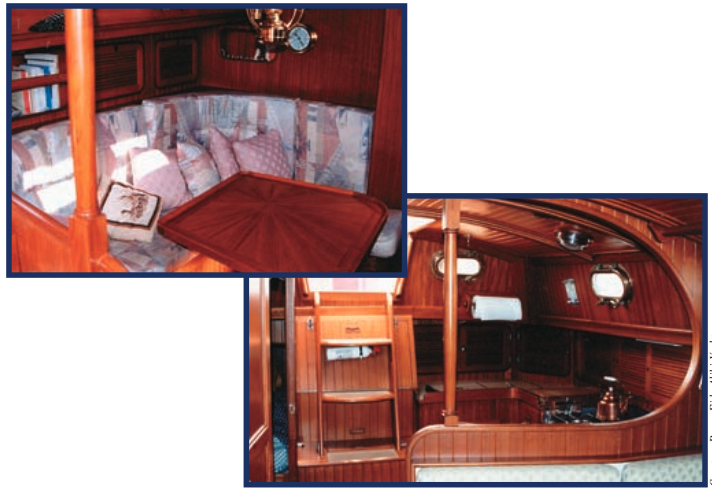
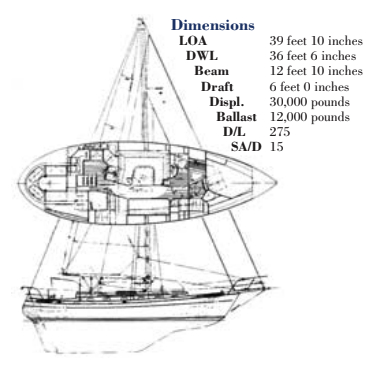
Spaces belowdecks are so spacious and well laid out that when the weather’s too stinky for sailing, at least the crew can suffer in comfort. The configuration includes an enclosed stateroom with a double berth aft to starboard, galley to port opposite the nav station, C-shaped settee to port, a second to starboard, and head and V-berth forward. The main saloon measures 10 feet 10 inches on the centerline.
Among the variations between boats was the layout of the C-shaped galley. Sinks may be located aft, at the foot of the companionway steps, or on a counter located athwartships. Either way, there’s generous counter space; Yohelah’s measures 54 inches long and 22 inches wide, large enough for the preparation of a feast during a Fourth of July celebration or the Christmas goose. The chef will appreciate three shelves dividing the refrigerator that convert the space from a disorganized cavern to a well-organized storage area.
Considering that nav stations on many new boats are shrinking in size in direct proportion to the number of new electronic gadgets that can be mounted on bulkheads, I like the 32-inch by 21-inch chart table. There’s room to spread a chart and plot a course without banging an elbow on a wood surface.
The C-shaped settee provides seating for 6 to 10 people, depending upon how well acquainted they are. Add the 64-inch-long settee to starboard, and there’s additional seating for three. The settee doubles as a berth, extended by 12 inches of room in a footwell under the chart table. When underway on a port tack, that may be the most comfortable place to sleep.
The forward stateroom boasts an 80-inch-long berth, the equivalent of a queen-sized bed. The compartment also has a built-in hanging locker and shelves to port. The head is a spacious two-compartment affair. Are accommodations large enough for extended cruising? You bet. “We have lived aboard for three years and been comfortable,” the Sicades say.
Construction
Though many of the Taiwanese boats were cored with balsa, Baba hulls were constructed of alternating layers of handlaid 1.5-ounce mat and 24-ounce roving. “Most boats had six layers in most places,” Bob Berg recalls.
The interiors of the first boats in the production run were sprayed with gel-coat and covered with quilted vinyl; they later were produced with sound-deadening foam and teak battens in the main saloon and forepeak.
“The boats were substantially built and have held up well,” a veteran surveyor who once marketed the boats noted. “The electrical systems are excellent. The company used high-quality wire that was tagged and bundled. The plumbing system is good.”
The final product typically reflected a loose approximation of the designer’s construction specifications. The good news is that they were, if anything, overbuilt.
However, if the boat has an Achilles heel, it is the fuel tank. Fuel is stored in a 110-gallon tank, located on the centerline, that runs the length of the main saloon. That’s the perfect spot for that weight: low and amidships. However, the tanks were constructed of steel and are prone to leaks.
In the words of one owner, “Our tank looked good when we purchased the boat, even passed the survey. However, it ruptured three months later . . . not a weep or small leak — a rupture. If your boat has the original
tank, replace it.” Two other owners echoed his sentiment.
Performance
It’s a sad reality in the liveaboard community that some boats become magnets for household items that inhibit performance or cause permanent attachments to a slip. Not so with Rob and Teresa.
“The basic rule is that she must be ready to head to sea in 10 minutes,” Teresa says. I considered that to be a stiff challenge until the Sicades executed their pre-launch routine and cast off the docklines in as little time as baseball teams have between innings.
Yohelah was built in 1984, was fastidiously maintained by her original owner, and sails with a standard sailplan of mainsail, 100-percent jib, and staysail. A light drifter or asymmetric spinnaker is on the Sicades’ wish list.
Since most double-enders will sail to within 40 to 50 degrees of the apparent wind when windspeed exceeds 10 knots, the real test of sailability is in light air. As a consequence, I was not disappointed at having only 8 to 10 knots pushing us across Puget Sound. Initially flying only the main and staysail, we put her through her paces sailing in a 1- to 3- foot chop. Sailing closehauled, she registered between 4.1 and 4.3. knots of boatspeed.
When Teresa hoisted the jib, Yohelah squirted forward, and boatspeed increased to 5.5 knots. Heeled comfortably at 12 to 15 degrees, she buried her shoulder and forged ahead. Considering that we were dragging a three-bladed prop, I think she performed well.
Then, since a gentleman never goes to weather, we footed off to 60 degrees and sailed in great comfort as boatspeed increased to between 6.1 and 6.3 knots. Continuing off the breeze, I saw little change in boatspeed until we attempted to sail below 120 degrees. Then the main, staysail, and jib began misbehaving like teenagers, and she slowed measurably.
The bottom line: the Baba 40 is a boat that looks seaworthy and performs as you’d expect. She is faster than most of her contemporaries, is stable, and tracks well. She’s warm and comfortable belowdecks. If you only used her on weekends or short trips, you might enjoy spending warm summer evenings messing with the brightwork that makes her so appealing. However, if you were heading to the South Pacific, you might want to consider covering the teak with a coat of white paint.
Ed writes about boats and off-beat subjects for several national magazines from his home base in Montana. Between boats right now, he’s in the market for a trailerable 28-30 footer.
Thank you to Sailrite Enterprises, Inc., for providing free access to back issues of Good Old Boat through intellectual property rights. Sailrite.com