Issue 21 : Nov/Dec 2001
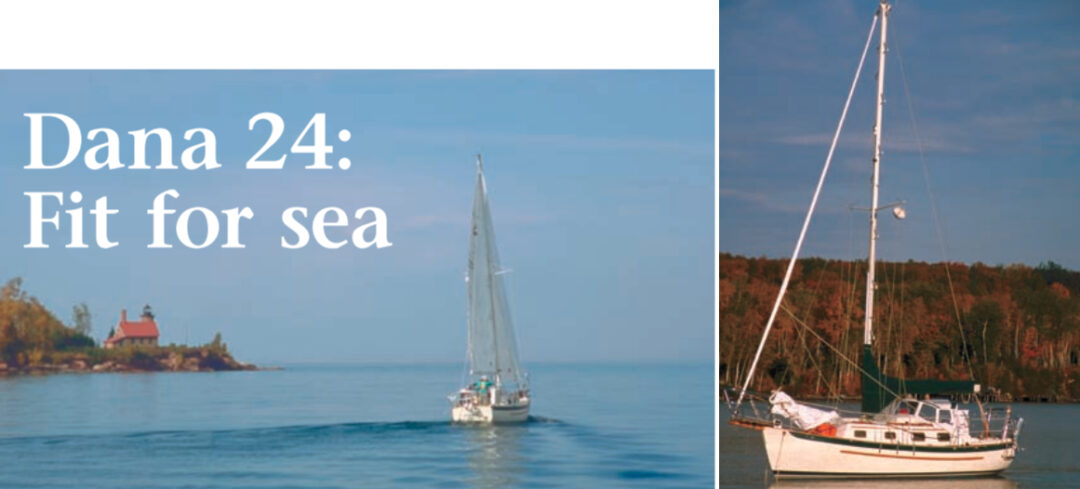
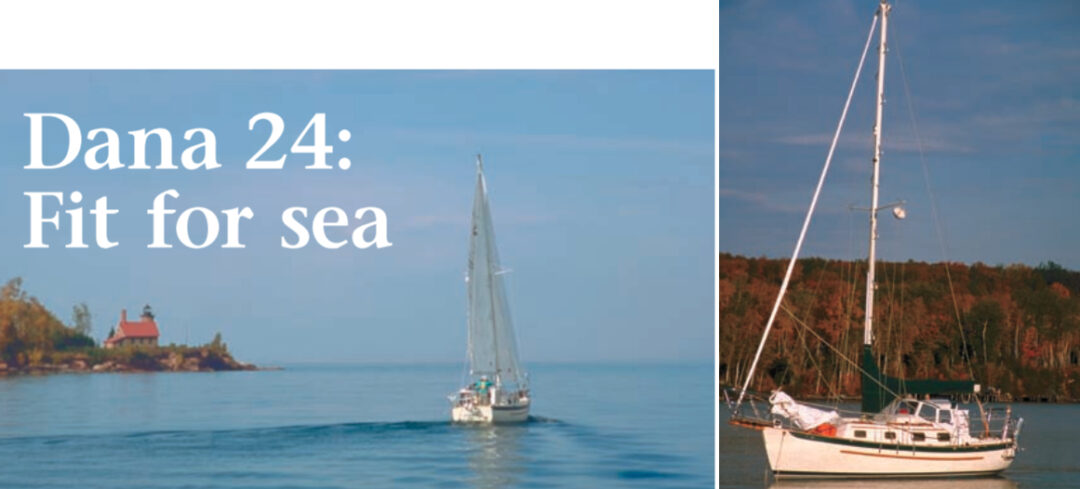
The Dana 24 is the second-smallest boat in the series of production boats manufactured by the Pacific Seacraft Corporation (PS) in California. PS has earned a nationwide reputation for quality boatbuilding, and the Dana 24 is a tough, rugged ocean cruiser built to very high specifications. There’s nothing you have to do to a Dana to make her fit for sea. She comes that way.
She’s an out-and-out cruiser, designed for safety and comfort without any concern for racing rules, though that doesn’t necessarily make her slow, as her designer, William Crealock, will tell you.
Bill Crealock is thorough and cautious, a conservative member of the old school who was trained the proper way. He began his career in Scotland, where one of his first jobs was to design a single ship’s bulkhead. It took him a week.
The Dana is the synthesis of his knowledge of, and respect for, the sea and PS’s commitment to the best materials and building methods. And she has proved to be a winner. She has also proved to be expensive. A brand-new one, hot off the press, will cost you $99,400 before tax. (Pacific Seacraft has dropped the price of the Dana since this book was written. A new Dana is currently selling for $69,000. -Ed.) No small amount for a 24-footer. But for quite a lot of people the price just doesn’t matter. After all, if you’re madly in love with a boat, what option do you have?
Basic design
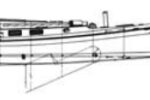
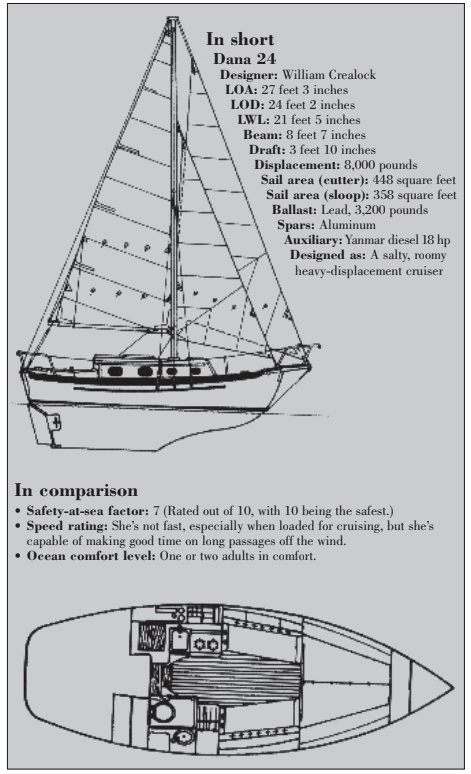
The Dana is 24 feet on deck, 27 feet overall, and 21 feet on the waterline. Her nose is snub and nearly plumb, and her topsides are high for her length. Her stern is a stubby, no-nonsense transom, and under water she carries a full keel vigorously cut away up forward for almost half the length of the boat. And sitting on top of everything there is that lofty box of a cabin.
Her squared-off rudder pivots from the end of the keel, which ends a little way forward of the transom, and the after end of the rudder projects past the transom under water. The cutout for the propeller is taken entirely from the deadwood of the keel, so she is assured of efficient steering.
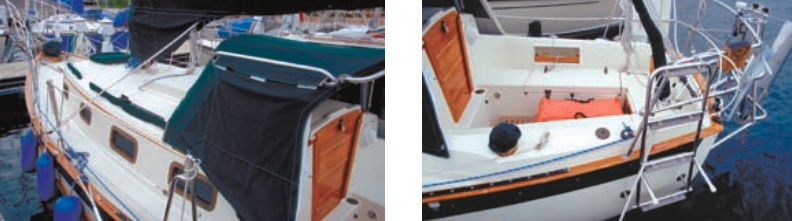
A glance at her decks is all that’s needed to tell you what this boat is designed for. She has a true bluewater cruiser’s bulwarks edging her decks all around, a full 5 inches deep in places.
Her bowsprit is short, less than 3 feet long in fact, but it helps make a cutter of her and gives her a salty air of jauntiness. It has a bronze eyeband. In fact, everywhere you look on deck you’ll find fittings of solid bronze, including winches, cleats, and chocks.
To the untrained eye, the cockpit looks small, but the seats are long enough to lie down on — 6 feet 3 inches long, to be precise. The seatbacks are contoured for comfort, and high coamings provide a welcome feeling of security as well as protection from bad weather. With a solid bridge deck and two 1 1⁄2-inch drains for fast self-bailing, this is a proper seagoing cockpit.
A 10-pound propane tank lives in a cockpit storage locker with its own hatch, and a manual bilge pump is mounted through the cockpit seat riser so you can reach it from the helm.
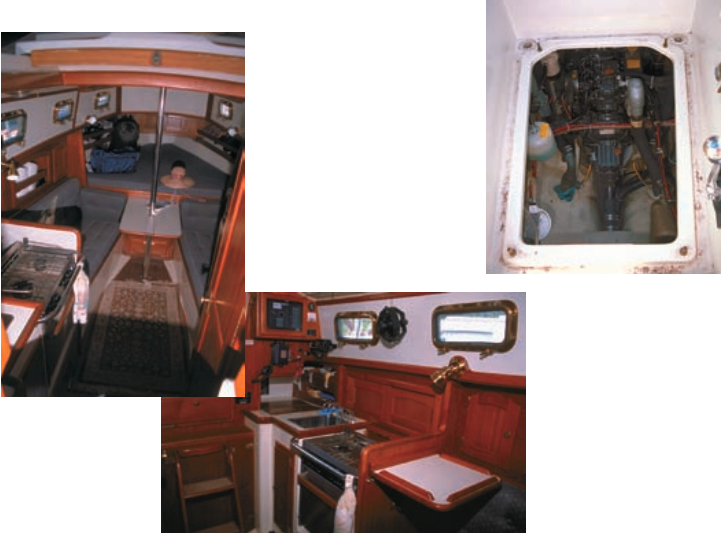
As a final touch, PS has built a watertight access hatch into the cockpit sole so you can easily get to those parts of the engine that need regular attention (See photo on Page 6).
The engine itself is the twin-cylinder Yanmar 2GM20F, which develops 18 horsepower — enough to keep the Dana charging along at her full hull speed of a little over 6 knots in most conditions.
Accommodations
When you step down below on a Dana 24, you step into another world. She’s palatial for a boat only 21 feet on the waterline. Her open-plan design melds the forepeak and the main saloon into one cabin whose length, breadth, and depth make you wonder if you’ve lost all sense of proportion.
The vinyl cabin headliner is 6 feet above the teak-and-holly sole for a start — now you know why the coachroof sticks up so much — and the forward V-berth is 6 feet 8 inches long and 6 feet 9 inches wide. That headliner, incidentally, is fastened in place by zippers, so you can easily remove it to get at electrical wiring and the inside end of fastenings for deck fittings.
Most of the interior is a fiberglass molding firmly bonded to the hull, but it’s smothered in bright, hand-rubbed, oiled teak so well crafted that it wouldn’t be out of place in a Victorian gentlemen’s club if it were darker and more tobacco-stained.
Everywhere you look you get the feeling that opulence is being held in check only by practical seamanship. The gleaming portlight surrounds, the meticulously finished cabinetwork, the cleverly contrived sliding/hiding table — everything gives the impression that it is not only highly pedigreed, but also on its best behavior.
There is no bulkhead between the large V-berth up forward and the main cabin, which boasts two 6-foot 6-inch settee berths. Aft of the settees there is a full-sized enclosed head to starboard and a surprisingly large galley to port, complete with a 4.5 cubic-foot icebox, a stainless-steel sink, and a four-burner propane stove with oven. Overhead, two teak grabrails run the length of the cabin. You’ll bless them in heavy weather at sea. The standard water tank holds 40 gallons, a lot for this size of boat, but you can also have another 30-gallon tank built in at additional cost. The fuel tank holds 18 gallons of diesel, and the head holding tank has a capacity of 15 gallons.
The rig
Pacific Seacraft offers all of its sailboats as cutters or sloops, and although you might regard the Dana 24 as being a little small for a cutter rig, it does divide the sail area into small units for easier handling. The sail area of the sloop is nominally 358 square feet, while the cutter’s area is 448 square feet. The mainsail on this efficient, high-aspect-ratio rig has an area of just over 140 square feet.
The sloop rig will be the better performer to windward, with its single headsail and only one stay and one set of running rigging to create windage, but the cutter might be more convenient if you’re short-handed. It also has the advantage that you can mount the jib on a roller furler and simply make it disappear when the wind pipes up, without ever being forced to reef it. That leaves the sturdy little staysail to do the heavy work and means you’ll never be shamed in public by a baggy, badly setting, inefficient, 150-percent genoa reefed down to the size of a storm jib. Both rigs run to the masthead, and the inner forestay of the cutter, running almost parallel to the jibstay, terminates at the stemhead. Incidentally, the standard hank-on jib supplied with the boat has a built-in row of reef points — something you won’t find on your namby-pamby garden-variety coastal cruiser.
The aluminum mast is stepped on deck in a stainless steel tabernacle and, because there is no bulkhead in the cabin below it, a sturdy stainless steel compression post delivers the downward thrust to the keel. The mast and boom are painted with a linear polyurethane finish.
It’s a bit of a stretch aft from the end of the boom to the mainsheet track on the afterdeck, which results in some slight inefficiency of angle and extra torture for the boom on the beat, but it’s a worthwhile compromise to keep the sheet clear of the cockpit.
All in all, it’s a simple, sturdy rig eminently fit for sea work.
Performance
William Crealock is a designer who knows how to coax good performance out of cruising boats, and by cruising boats we mean small boats with a lot of accommodations and the ability to carry a heavy load of water and stores.
His designs might not be the nippiest around the buoys in a Saturday afternoon club race, because they do not have the swift acceleration of a lightweight racer, but he has learned to refine the underwater lines so his boats are able to reach their maximum hull speeds with the minimum of fuss and power. This means they are easily driven and quickly reach and maintain respectable cruising speeds. It’s what all cruising boat designers strive for, of course, but not all find the magic formula.
The Dana 24 is a heavy displacement boat, but heavy displacement in itself is no barrier to good performance if the rig that drives it is powerful and efficient enough. On the Dana it is both.
Her long keel gives her excellent directional stability, and that cutaway forefoot might have been deliberately designed with those rolling trade wind swells in mind. She’ll romp down their faces as if she were on tracks. But her moderate draft also enables her to gunkhole and explore the thin waters of the world — the fascinating reefs and shallows — that are so often the best reward for crossing an ocean.
Known weaknesses
She is a shameless seductress. Beware. You could find yourself falling in love with this boat without warning and running away to foreign places with her.
Owner’s opinion
Bill and Lola Hotard sail their Dana 24, Lola, out of Mariner’s Cove, on Whidbey Island, Washington. One summer they headed north to Alaska, cruising 1,700 miles in 11 weeks to Wrangel and back with their dog, Magruder, a cocker spaniel/poodle cross.
Bill has a deep knowledge of sailboat cruising and believes in conservative sailing.
At the time of this writing, Lola was rigged as a sloop, with a 130-percent genoa on a roller furler. But Bill wanted to change that.
“When we’re going to windward I start reefing the genoa first, at about 10 or 12 knots. But the reefed genoa doesn’t perform well in heavy winds. The shape is wrong, and she won’t point.”
So Bill is planning to install a staysail and change Lola to a cutter.
“She starts to get weather helm as the wind comes up,” he says, “but it’s curable by reefing. With the cutter rig, I’ll take the first reef in the mainsail at about 12 knots. Then, if the wind is still rising, I’ll furl the genoa completely, leaving just the staysail forward of the mast. At about 18 to 20 knots I’ll take in the second reef in the mainsail.”
Bill has had a third set of reef points built into the main to reduce its area to about 60 square feet. The staysail, with an area of 90 square feet, also can be reefed down to 60 square feet.
Under motor, Lola gets 5 1⁄2 knots from her Yanmar 2GM20 18-hp diesel engine at about 75 percent power. “She runs for about 3 hours on a gallon of fuel at that speed,” Bill says, “but if you reduce speed to 5 knots or a bit less she’ll give you 21 miles to the gallon in calm water.”
The Hotards found the Dana 24’s accommodation comfortable for two and a dog. “I’m 6 feet 5 inches tall, so I have to bend my head a bit unless I’m under the hatch,” Bill said, “but to tell the truth I don’t find myself standing up much when I’m down below anyway.” Lola, a gourmet cook, has plenty of headroom in the galley.
Bill feels the size of the cockpit might, with benefit, be reduced for an ocean crossing, in case it got filled with water. “I’d keep the rolled-up inflatable dinghy in the cockpit to reduce its capacity,” he says.
He’d augment the boat’s 40-gallon freshwater supply with a 12-volt watermaker that could also be operated manually if necessary, and he’d probably tuck away a couple of 5-gallon collapsible plastic jugs of drinking water as insurance.
He is a staunch advocate of jacklines, safety harnesses, and tethers. He runs flat nylon straps from padeyes up forward back to the cockpit and hooks his tether to them when he’s moving about on deck. He has two tethers on his harness, one of 6 feet and one of 3 feet, for close-up work. Inside the cockpit he has run lines fore and aft on either side. He clips his short tether to these in bad weather.
“Another item you’d need for offshore work would be a windvane self-steering gear,” he says. “I’d probably choose a Monitor because it doesn’t have dissimilar metals to cause electrolytic corrosion problems.”
Finally, he recommends that light-weather sails be given serious consideration for an ocean crossing. “She’s slow in light weather under her working sails. I’d definitely want an asymmetrical spinnaker and maybe a nylon ghoster for close reaching.”
Conclusion
Let’s face it, there are cheaper ways to cross an ocean. The Dana 24 represents a considerable financial outlay. On the other hand, she comes complete with an extraordinary amount of equipment of the highest quality. You could compare her, perhaps, to the smaller models of the Mercedes-Benz automobile, the Mercedes being the Dana 24 of cars. After all, what other 24-footers deliver such standard features as a ballbearing mainsheet traveler, two bow anchor rollers, a swim ladder with teak treads, and a stern chain locker (with roller and deck pipe) to match the one in the bow?
John has sailed for more than 40 years and logged some 15,000 miles of ocean voyaging. In 1987 he and his wife, June, and their 17-year-old-son sailed their 31-foot sloop from South Africa to the U.S. This series of boat reviews is based on articles from John’s book: Twenty Small Sailboats to Take You Anywhere, which is available from The Good Old Bookshelf (see Page 64 for more information).
Thank you to Sailrite Enterprises, Inc., for providing free access to back issues of Good Old Boat through intellectual property rights. Sailrite.com