A designer’s view of the compromises involved
Issue 23 : Mar/Apr 2002
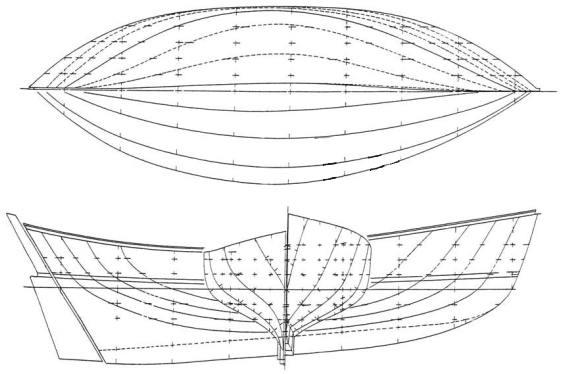
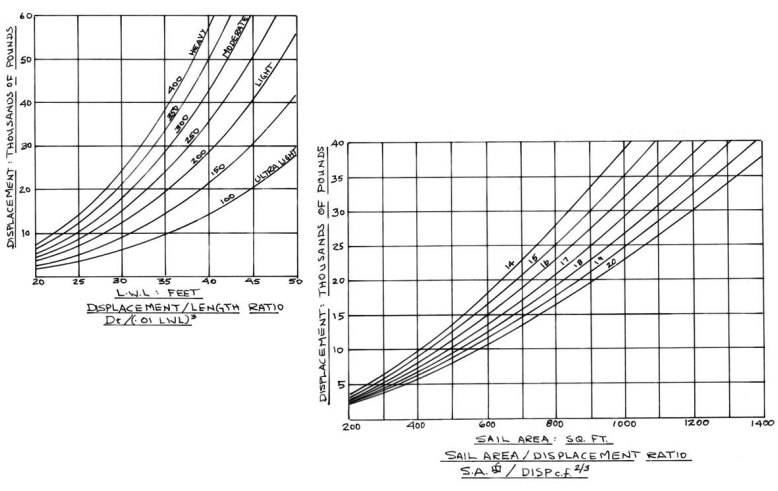
The displacement/length (D/L) ratio is a non-dimensional figure by which we can compare boats of different lengths. It’s obtained by dividing the displacement in tons (1 long ton equals 2,240 pounds) by the cube of 0.01 times the waterline length, or Dt/.01WL3. In general, for sailing yachts, a figure of under 100 is considered super-light, 101 to 200 is light, 201 to 300 is moderate, 301 to 400 is heavy, and over 400 is ultra-heavy.
For example, my 1971 Black Velvet design, with 24,800 pounds displacement on a 35.33 foot waterline has a displacement/length ratio of 251, so she would be considered to be of moderate displacement for her waterline length today, although on the light side when she first came out.
Displacement/length ratios have been dropping over the years due, in part, to the elimination of the Cruising Club of America rule for rating cruiser-racing yachts. The CCA rule was in use up until 1970 or so and took the actual displacement of the vessel into account, giving a rating credit for heavy displacement and penalizing light displacement.
In addition, the rule penalized long waterline length so it was common to see yachts with as much as one third of their length in overhangs. For example, Clarion of Wight, a cruiser/racer designed by Olin Stephens in the early 1960s, was 43.5 feet in length overall (LOA) and 30.0 feet in length on the waterline (LWL). Her overhangs amounted to 31 percent of her length, yet she had a very successful racing career and was, as well, quite a handsome yacht to my eyes.
High ratios
The result of the heavy displacement and short waterline of these yachts was, of course, very high displacement/length ratios. Clarion displaced 22,200 pounds and had a D/L ratio of 367. Bill Luders’ 39-foot sloop, Storm, with 17,500 pounds displacement on 27- foot waterline, had an even higher D/L ratio of 397!
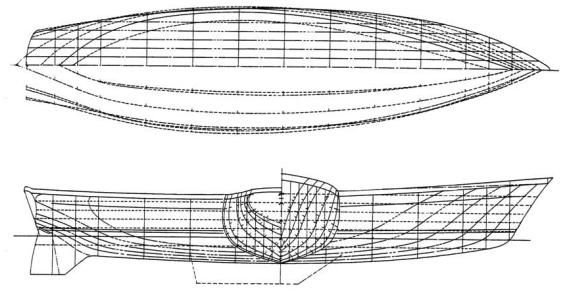
Generally, cruising yachts are successful cruiser/racers so the cruisers, the good old boats of the 1950s and ’60s and even the early ’70s, had the long ends, short waterlines, and husky displacement of their ocean-racing sisters. Conversely, today the trend is all to shorter ends and longer waterlines both in cruisers and racing yachts, so lower D/L ratios naturally result. An example in point is the mid-1960s Luders design, Duchess of Devonshire, 44.5 feet LOA, 30.5 feet LWL, 12.0 foot beam and 24,000 pounds displacement, for a D/L ratio of 378. Compare her with a handsome and moderate new cruising yacht by Mark Ellis, Alize III, 46 feet LOA, 35.67 feet LWL, 13.25 foot beam, displaces 25,000 pounds and has a D/L ratio of 246, substantially lower than the 1960s-era Duchess.
The differences may not be quite that great actually. A long-ended yacht will pick up more waterline length as she heels, and Duchess, with her substantially narrower beam, will undoubtedly heel to a greater degree in any given wind to pick up even more waterline than the stiffer Alize. If she gains four feet of waterline length in a good breeze, Duchess’ D/L ratio drops to 261. Assuming the shorter ended Alize picks up about two feet of waterline in the same breeze, her D/L ratio drops to 209. Thus the difference in the D/L of the two boats underway may be less than half what it was in the at-rest condition — but Alize still has the edge by far. Of course, Alize is a very moderate design by today’s standards, and there are many new cruising yachts being built with D/L ratios in the 150 to 160 range, thanks to modern construction materials, extra-generous beam, and other features.
Finer lines
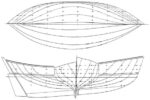
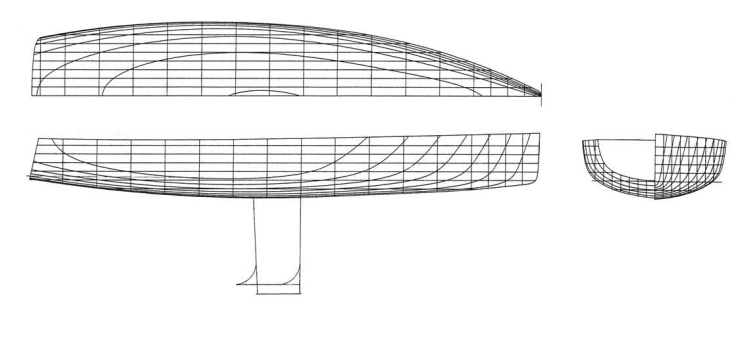
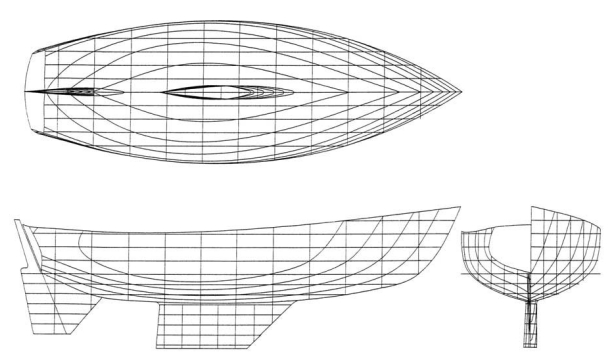
The big difference in the newer yachts is not just the lighter displacement, but the fact that they are carrying that displacement on longer waterlines. This means their lines are finer with less rocker to the canoe-hull profile and a much flatter buttock angle aft. This reduces separation of flow while, at the same time, the lighter displacement also reduces wave-making resistance, further enhancing overall performance and increasing potential top speed in a good breeze.
Despite what many believe, the older heavy-displacement boat is not necessarily a poor performer in light air. Her wetted surface may be little, if any, more than that of her longer-waterline, beamier, and lighter-displacement cousin. Thus, if she is given the sail area appropriate to her displacement, she should have no problem keeping up with the rest of the fleet. The problem with many older boats is that they were undercanvassed by today’s standards, due to the influence of the CCA rule, which encouraged low-aspect-ratio rigs and permitted 150-percent genoas to be carried without penalty. Very few cruising yachts carry genoas that large today and many older boats could substantially improve performance if they were given a taller rig and set a smaller 130- to 135-percent genoa. They’d be a lot easier for a short-handed cruising crew to handle, as well.
On the other hand, when conditions really get squirrelly no yacht can be driven to high speeds with safety, so the light-displacement cruiser may well have to slow to a speed that the heavier boat is handling with stately aplomb. Heavy displacement does assure motion comfort, as the heavier craft will scend more slowly in any given sea condition than a lighter yacht of equal size. Duchess’ comfort ratio works out to 38.76 while the larger Alize III comes in at 31.64, a fairly significant difference. However, Alize is very definitely a moderate-displacement design and a fine sea boat compared to many of today’s very-light-displacement crop. Indeed, I just ran the figures on two new cruisers, a 56-footer with a D/L ratio of 123.3 and a comfort ratio of 23.8 and a 68-footer with a D/L ratio of 88 and a comfort ratio of 23.1. These are, undoubtedly, very fast cruisers in moderate air but I, for one, would not want to be aboard either of those yachts in a real storm at sea.
More form stability
Adding to the heavier boat’s advantage in severe weather is the fact that the modern, beamy, light-displacement hull has much greater form stability than the older, narrower hulls of the 1950s to 1970s. The boat with great form stability wants to be perpendicular to the surface of the water at all times. In heavy beam seas she will tend to react quickly to the angle of the wave and have a snap roll that can be very upchucking. The heavier, narrower yacht will roll more slowly and to a lesser degree as she will not fight as hard to remain perpendicular to the wave’s surface. This can make a great difference in crew comfort.
In truly extreme conditions, beam and displacement can be critical factors. This was recognized by a USYRU committee on capsizing when they came up with the Capsize Screening Formula (CSF). This is simply the maximum beam divided by the cube root of the displacement in cubic feet (B/3√Displ cf). The higher the number, the greater the chance of capsize and remaining inverted when capsized. The lower the number, the less chance of being capsized or remaining inverted for long periods of time. The divisor between coastal and offshore cruisers was considered to be 2.0. Of course, this formula is rather simplistic since it ignores hull shape, the amount of ballast, and the location (depth) of the ballast, all vital considerations in a complete stability assessment. However, the CSF number is an indicator.
As examples, the CSF number of the Duchess is a very conservative 1.67 and Alize works out to a safe 1.82. However, the two lightweights I mentioned come in at 2.05 and 1.96 respectively, definitely not yachts I’d want to be aboard in any of the rougher waters of this globe. I’ve heard the argument that these new high-speed cruisers, given the advantage of weather-fax and modern communications, can stay out of a storm’s path or even outrun it. (Sure they can!)
Extremely heavy
Of course, things can be overdone, and there is a limit to the benefits of heavy displacement as well. I know of one extremely heavy ketch that displaced some 90,000 pounds on about a 46-foot waterline, a D/L ratio of 413. She had short ends and so gained little reserve buoyancy from them. She certainly must have had an easy motion, but her owner declared she would scend so slowly that she was swept like a half-tide rock in any heavy sea. He had me design a replacement for her, slightly larger and with a D/L ratio of 240, thanks to light aluminum construction. This vessel was very successful.
Heavy displacement does allow a yacht to carry substantial supplies of stores, water, fuel, spares, and equipment for extended cruises, and there may still be ample displacement left for all the amenities that make life aboard more pleasant, such as gen sets, air conditioners, heating systems, washer/dryers, pianos, and you name it. The heavy displacement yacht will simply be less affected by the weight of stores and gear required for a long voyage than will a vessel of similar size and lighter displacement.
Four people setting out on a long voyage could easily add two tons of weight to their yacht. Consider: their own weights (600 pounds); clothing and personal gear (300 pounds); food for a month, plus a week’s spare food (500 pounds); 25 gallons extra water (200 pounds); beer, wine, and other medicinal supplies (150 pounds); portable generator (50 pounds); extra propane; outboard gas, lamp oil, and so on (100 pounds); spare parts, oil, lubricants, engine belts, tools, and so on (200 pounds); life raft and emergency supplies (200 pounds); and now we’re up to 2,300 pounds plus. Add on the bedding, heavier ground tackle, fishing gear, books, charts, spare sails, spare rigging wire, spare lines, bosun’s stores, cleaning supplies, tools, portable radio, spare battery, folding bikes, barbecue, extra fenders, and all the other essentials and non-essentials that cruising couples simply have to take along, and you can see why it can readily add up to two tons, or even more.
Interesting comparison
Consider two 35-foot-waterline yachts setting out for a long voyage, each with a crew of four. One, a light displacement cruiser, with a D/L ratio of 150 and the other a moderate displacement cruiser with a D/L ratio of 270. If we add a modest 3,000 pounds of cruising gear to each, then the D/L ratios jump to 181 and 301 respectively, a 20.7 percent increase for the lighter boat and only a 11.5 percent increase for the heavier. If both yachts started out with a sail area/displacement (SA/D) ratio of 17.0, the SA/D ratio of the boats, ready to cruise away, will drop to 14.98 for the lighter yacht and 15.79 for the heavier. Obviously the lighter displacement yacht will be more affected by the additional weight and will suffer the greater loss in performance.
As you may have discerned, I am not fond of very-light-displacement yachts, despite their enhanced performance, nor am I fond of ultra-heavy yachts; even my husky 70-foot Tree of Life schooner only had a D/L ratio of 297. There is a happy medium and, for the average cruising yacht, I feel that yachts designed with D/L ratios of between 240 and 300 can provide their owners and crews with comfortable accommodations, reasonable storage capacity, adequate tankage, all around good performance, motion comfort, and seakeeping ability in heavy weather. Skippers wanting the added performance of lighter displacement should consider how much comfort — and safety — they’re willing to sacrifice. And if they insist on heavier displacement to obtain even greater comfort and amenities, they’ll have to decide how much performance they are willing to give up.
Yacht design is full of compromises and there’s no free lunch!
Ted is one of North America’s best-known yacht designers, having worked on America’s Cup boats and on boats that won the Olympics, the Gold Cup, and dozens of other celebrated ocean races.
Thank you to Sailrite Enterprises, Inc., for providing free access to back issues of Good Old Boat through intellectual property rights. Sailrite.com