Choosing and installing a roller furling system . . . options and opinions
Issue 23 : Mar/Apr 2002
Back in the late 1980s, when my wife, Andra, and I were cruising aboard our 1965 Pearson Vanguard, all our headsails were hank-ons. One of the most annoying jobs was stuffing a genoa into its bag, made more difficult because we left all the hanks on the forestay except the bottom one. To get the bag off the deck, we’d clip the jib halyard to the webbing on the bottom of the bag and hoist it. It didn’t help that the bags always seemed too small.
Some years later, after Fred Cook and I had installed a new Schaefer furler on our C&C 33, I took Andra for an inaugural sail. As we returned to the harbor she said, “Don’t you think you ought to drop the genoa?” I pulled the control line, which rolled the sail up like a window blind.
Andra watched in amazement, asking, “How come we didn’t have one of these when we were cruising?”
Good question.
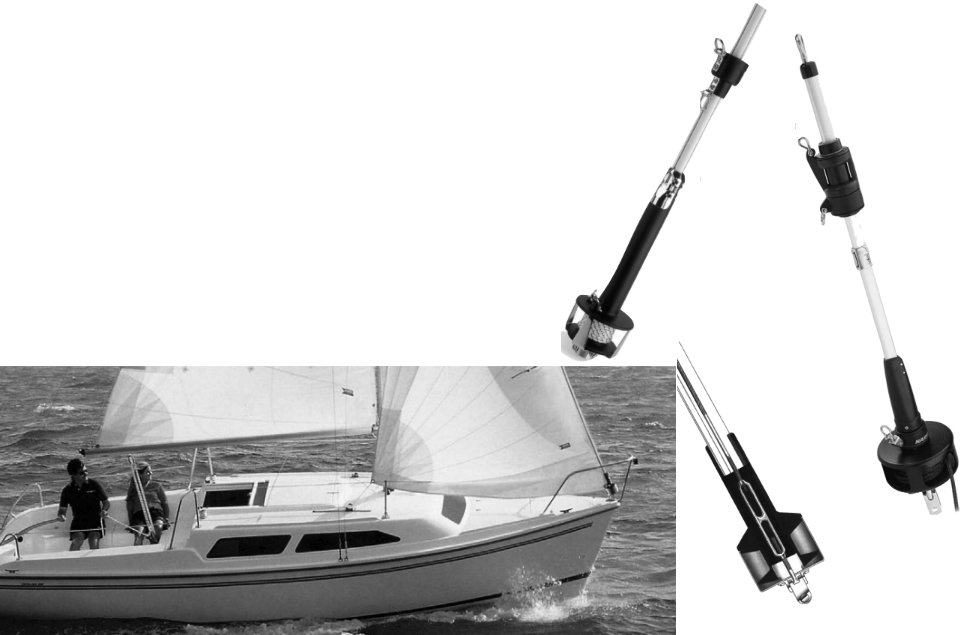
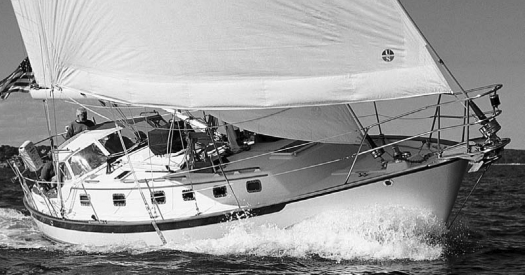
Roller headsail furling is one of the most significant recent advances in sailboat technology. Along with electric and self-tailing winches and windlasses, roller furling more than any other device has enabled short-handed crews to manage larger boats. Indeed, where 15 to 20 years ago most cruising couples felt that 35 to 38 feet was the maximum size boat they could handle, today older couples are routinely circumnavigating in 50- and 60-footers — thanks largely to headsail furling.
And it’s not just cruisers. Single-handed ocean racers depend on roller headsail furling. You couldn’t do the Around Alone or Vendee without it. The open-class 60s typically are rigged as double-headsail sloops with headstays and inner forestays, each fitted with roller furling. Where 20 years ago failure of these mechanisms was not uncommon (remember watching the battered crew of some boat enter harbor with the tattered remains of its headsail flogging in the gale?) today they are remarkably reliable. Failures are surprisingly few. An override on the drum of the control line is probably the most common problem and that can be avoided by keeping a little tension on the line as the sail is let out . . . rather than letting the sail unfurl with a bang.
Headsail furling isn’t just for big boats. While it is true that the smaller the sail the easier it is to trim, drop, and bag, nothing is simpler than making the sail disappear by simply pulling on a line.
History
While various and simple means of reducing headsail areas have been around as long as the sails themselves, the first mechanical systems did not appear until the twentieth century along the English Channel. The British Wykeham-Martin furling gear is mentioned in the book, Single-Handed
Cruising, by F. B. Cooke, published in 1924, and in the 1940s Merriman introduced its wire luff system which gave small boat owners an alternative to hanked-on sails. Swivels top and bottom permitted the sail to be furled around the sewn-in luff wire, which was independent of the headstay. Sag, however, increased terribly as the wind built, and sail shape suffered proportionally.
In the 1970s, three systems using solid aluminum extrusions in place of headstays represented a marked improvement to the Merriman-type: the Hood Sea Furl, the Hyde Stream Stay, and the Stearn Dyna Furl. While durable, the small diameter of the rod was a drawback in terms of reefing ability and sail shape.
What might be termed the modern era began with Hood’s introduction of the Sea Furl II in 1978. Like most furlers today, the Sea Furl II utilized sections of hollow extruded aluminum that fit over the boat’s existing headstay. Of course, there have been many refinements since, such as split furling drums for quick removal, feeders to facilitate changing sails, and a tack swivel (originated and patented by Hood Yacht Systems but now used by others) that allows the middle of the sail to make one full turn before the tack, thereby keeping the middle of the sail from bellying out. The basic idea, however, remains the same.
The same technology also has been applied to mainsails, though these systems are found almost exclusively on large boats because most require custom masts, which are very expensive. Recent improvements to in-boom mainsail furling gears make them viable alternatives to in-mast mainsail furling.
Choosing a system
If you’re in the market for a headsail-furling system, and especially if this is to be your first, there are, naturally, decisions to be made.
Roller furling vs. roller reefing. Though most systems are called “furlers,” most do more than just roll up the sail for storage. When the sail is partially furled it is said to be “reefed.” Being able to “dial in” the amount of sail area you want is a tremendous convenience. Generally, most genoas can be reefed about one-third of their area before sail shape becomes so sloppy that it’s unwise to continue. If a reduction of one-third isn’t enough, then it’s best to drop the sail and hoist a smaller jib or storm sail. This means that though a roller furling genoa might work 95 percent of the time, it shouldn’t be your only headsail.
Not all systems, however, are designed to be reefed. Some, such as Harken’s and Schaefer’s Small Boat Furling Kits, which consist of drums and swivels but not luff extrusions, are for completely furling the sail only, so be sure you know what you’re buying. These are best suited to daysailers with small jibs that you wouldn’t be likely to reef anyway.
PVC flexible foils vs. aluminum extrusions. Cruising Design Inc. pioneered the use of flexible, one-piece, PVC foils in place of extruded aluminum sections. These flexible furlers are ideally suited to trailersailers because they are much less likely to be damaged during frequent steppings and unsteppings on the launch ramp. They are not, however, as rigid as aluminum foils, so headsail sag will be somewhat more pronounced. CDI customers, however, have very few complaints.
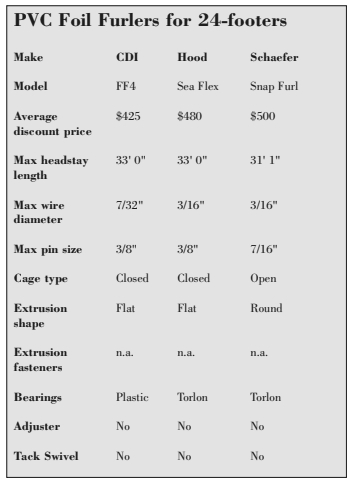
In the past few years, Hood, Harken, and Schaefer each tried to grab a piece of CDI’s trailersailer market share by introducing lower-cost furling systems with one-piece foils. Harken’s Heli Coil used PVC with a polypropylene interior and braided stainless steel for more torsional rigidity, but Harken’s supplier went out of business, forcing the Heli Coil off the market. Schaefer’s Snap Furl has a round, single-groove PVC foil. The foil for Hood’s Sea Flex is flat PVC, like CDI’s Flexible Furler.
Flexible foil systems are generally targeted at owners of boats up to about 25 feet, though CDI has models for boats up to about 30 feet. Limiting factors are headstay length (for example, 33 feet for CDI’s FF4 model), headstay diameter (3⁄16 inch diameter) and turnbuckle pin size (3⁄8 inch diameter).
Aluminum foils are the way to go for larger boats, especially those that don’t have their masts frequently unstepped, and for those owners who want premium sailing performance.
Not all systems with aluminum luff foils, however, are created equal. A few companies, most notably Hood, offer several levels of quality — the SL model is a sort of economy version of the main line Sea Furl 5. (The Hood LD or line-drive model with continuous control line has been discontinued, but parts are still available.) If you don’t plan on sailing your boat long or hard, one of these systems can save you some money.
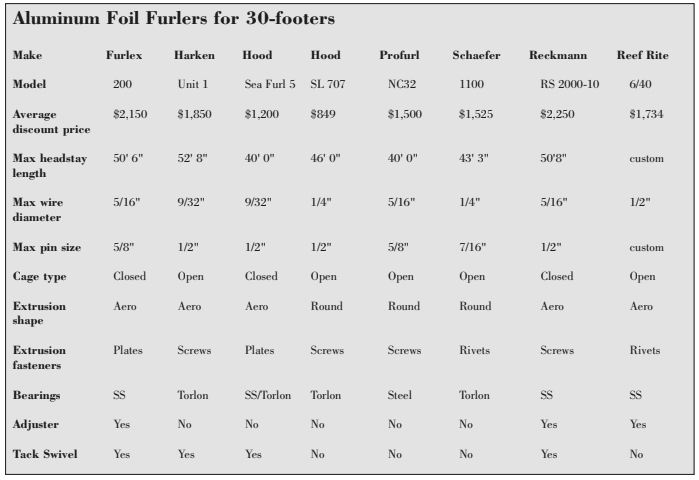
Most other major companies — Furlex, Harken, Schaefer, Profurl, Reckmann, and Reef Rite — incorporate the same essential features in all sizes and models.
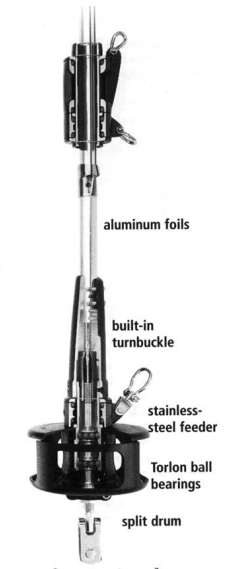
Plastic bearings vs. steel bearings. A major reason for the improvement in modern furling systems lies in how loads are handled. Today’s furlers incorporate multiple races of low-friction ball bearings, both in the bottom drum bearing and top swivel (see cross-section drawing on Page 14). Engineers have experimented with various ways of orienting the races so the ball bearings aren’t unduly stressed when loads come from unexpected directions. Harken says its bearing system is “omni-directional,” and Furlex says its bearings “float” on pivot points to handle the “offset” loads of tack and halyard. Schaefer says its races have “angular contact” surfaces. Theoretically, such features should translate into easier furling, which is about all the average owner cares about. Unfortunately, most owners don’t get to try three or four systems for ease of furling before buying one.
Bearings may be plastic or steel or a combination of both. Most plastic bearings are actually Torlon, much tougher than nylon or Delrin, but not as hard as steel, so they can compress under severe loads. That’s one good reason to buy a furler properly sized to your boat. Torlon bearings won’t corrode but, because they generally run in open races which can collect salt deposits and dirt, they should be periodically flushed with fresh water.
Steel bearings are, of course, harder. Furlex uses stainless-steel bearings in open races. Profurl’s carbon steel bearings run in sealed, grease-packed races that should last many years before water intrudes, thereby requiring replacement and repair. In a rather odd concession to what it perceives as a consumer fondness for Torlon, Hood’s Sea Furl 5 has both stainless steel and Torlon ball bearings, though the steel bearings do all the work — the Torlon bearings carry no load. Hood’s bearings run in open races and require freshwater flushing.
There isn’t a wrong choice here, but in my experience steel bearings make for somewhat easier furling.
Method of connecting extrusions. Especially if you’re going to install your own furler, you’ll be interested in how the foil extrusions connect. The methods are as varied as the number of manufacturers, each of which seems to think it has developed a better mousetrap.
Set screws, such as used by Profurl and Harken, have the advantage of being removable, but must be set in a thread-locking compound to keep them from falling out.
Rivets are strong and secure, but if you ever have to disassemble the extrusions, you’ll have to grind off their heads as you may have to also on Hood’s old button locks.
Others, like Furlex, use ingenious snap-together extrusions that are assembled without fasteners and can be taken apart without destroying anything.
Extrusion shape: round vs. elliptical. Here’s the dilemma: the larger and rounder the foil, the tighter the sail wraps around it. But there’s also more wind resistance just where you don’t want it, at the leading edge of the sail. So in the name of performance, some makers, like Harken and Furlex, compromise by offering elliptical foils, which are more aerodynamically efficient. Hood’s Sea Flex and CDI’s Flexible Furler PVC foils are nearly flat. Some companies, like Profurl, offer both shapes — cruising and racing. Unfortunately, you can’t have both, flipping back and forth according to your whim.
Cage type: closed vs. open. Cages are the drum enclosures that hide the coiled-up furling line. There’s not a lot to choose from between the closed and open styles. In closed types, the line and bearings are somewhat better protected from the weather, but overrides are more difficult to clear. A polished stainless-steel cage, like the one on the Sea Furl 5, is stylish, and cages provide a place for the manufacturer to stick its logo. Profurl, Schaefer, and Harken use open drums; the legs that connect the top and bottom drum parts help retain the control line yet allow access to line overrides in between.
Headstay tension method: original turnbuckle vs. screw. A few furlers, notably Furlex, provide a headstay-tension adjuster. The others use your existing headstay turnbuckle. An advantage of the integral adjuster is the elimination of the bulky torque tube that has to fit over the existing turnbuckle. Fat torque tubes connecting to skinny foils tend to make the sail wrap up unevenly.
Tack swivel. Years ago Hood patented a tack swivel that allowed the middle of the sail to make one furl turn before the foot. This made for a tighter furl without as much bag in the middle. Some other companies, like Furlex and Harken, paid Hood a royalty for its use. That patent has since expired, but not all companies have adopted its use.
Split drums for racing. If you like to race occasionally (if you race a lot, you don’t want roller furling) but still like the convenience of roller furling the rest of the time, you’ll want to consider a split drum. This feature makes it quick and easy to remove the furling drum, allowing you to hoist the largest headsail possible, that is with its tack closer to the deck than would be allowed with a drum high off the deck. If you’re not a club racer, a removable split drum probably won’t be a feature worth paying extra for.
Single- or double-luff grooves. Most foil extrusions have double grooves. In race mode, with the drum removed, they allow inside-out sail changes in which you hoist a second headsail before dropping the first. In cruise mode, they enable you to fly twin downwind sails. A few furlers have just one groove, and while most owners probably will never miss the second groove, it hardly adds to the cost of the system. Two grooves are recommended.
Can you install it yourself?
With a good manual, any reasonably handy owner can install a furling system. The most important requirement is patience. Read the instructions from beginning to end — at least once — before starting the job. Call the company with any questions; most have good customer service staffs.
Most headstays have to be shortened, and probably the worst mistake you can make is cutting it too short. The manual will tell you how to determine the correct length, but more than one overanxious owner has gotten confused and cut in the wrong place. Measure twice (or thrice!), cut once. The same goes for cutting the foil sections to the correct length. Furlex and Reef Rite offer the most complete kits, which include a new headstay as well as furling line, blocks, and more. This explains why these companies have prices which are somewhat higher than the rest.
Most installation directions ask that you fit a mechanical terminal to the cut end of the wire headstay — Sta-Lok or Norseman. These may or may not be supplied by the manufacturer. Installing a mechanical terminal isn’t rocket science, but if you haven’t assembled one before, you might feel more confident asking a professional rigger for assistance; after all, the entire rig depends on this fitting.
Installation is nearly always easier with the mast down, laid across several sawhorses or other supports, but it can be done with the stick up. You’ll need to rig a temporary headstay, like a halyard to a foredeck fitting, because the permanent headstay has to be unfastened at the stem for shortening and sliding over it the upper swivel, foil extrusions, and torque tube/lower bearing/drum assembly. Be sure your boat won’t roll a lot; choose a dock where you won’t be subjected to large waves or wakes from passing boats, and choose a calm day. Remember that most systems require you to go up the mast.
Tools required are few and ordinary — hacksaw, screwdrivers, pliers, and so on. If the extrusions fasten by means of rivets, you’ll need a rivet gun, of course. Those extrusions that use screws generally must be set in Loctite or other threadlocking compound, often supplied by the manufacturer.
If you don’t feel comfortable installing your new furler, a professional rigger can do the job for you. If you bought the furler from a dealer, he can give you a quote. If you bought the furler from a discount catalog, you’ll have to find a rigger experienced with furler installations . . . and you may have to pay a bit more because he didn’t get a commission on the sale of the furler. To be fair, and for better future service, if I planned to have a rigger do the installation, I’d buy from him, even if it cost me an extra hundred bucks.
Sails
Many sailors insist they can use an existing headsail with the new furler. Sometimes you can, but if the sail is old, chances are you’ll be much better off investing in a new sail. And let’s face it, one of the worst mistakes made by sailors is keeping sails far too long. Yes, they are expensive, but they are the engine that powers your boat, and good sails make a huge difference in speed, pointing ability and, therefore, safety. If your sailmaker says your old genoa is too stretched out to be satisfactorily cut down, take his advice and bite the bullet for a new sail.
If your sailmaker is willing to cut down an old sail, it still will cost you his labor and some materials. New reinforcements must be sewn in as well as a luff tape that slides up inside the luff grooves in the furler’s foil. You also should consider adding UV protection in the form of a sacrificial piece of sailcloth.
An option well worth having is a foam pad sewn into the luff. One brand name is Aeroluff. A padded luff helps fill the belly of the sail so it doesn’t bag out as much when partially furled. This is another approach to solving the same problem addressed by the tack swivel.
Using furling gear
A common criticism of sailors is that they have baggy sails and don’t know how to trim them. Well, when you get roller furling, the onus is on you even more. At times, you’ll likely be sailing with the headsail partially furled and not always the same amount. The more you roll in the headsail, the farther forward your sheet leads need to be in order to maintain proper trim. Therefore, adjustable sheet leads are important.
If your boat doesn’t have genoa tracks, consider adding them. The simplest type of adjustable sheet lead is to have cars with pin stops. To move them forward or aft, you must leave the cockpit, move to the sidedeck, lift the pin stop, and slide the car to its new position.
A more sophisticated system is to have the car slide freely on the track, with a shock cord to pull it aft and a control line and set of blocks to manually pull it forward. With this set-up you don’t have to leave the cockpit to adjust the sheet leads. Considering that the usual reason for adjusting sheet leads is high winds (which necessitated furling the headsail in the first place), it’s a time when you don’t really want to leave the cockpit anyway.
It’s not quite a maxim, but it may as well be: roller-furling headsails shouldn’t be furled more than about one-third. Furling them more than that results in unacceptable sail shape. So a 200-square-foot headsail can be reduced to about 134 square feet and still retain a reasonable shape. Of course, you’ll notice this much more going upwind than off the wind where just about any shape works. If, with the jib open to two-thirds of the headsail area, the boat still isn’t behaving the way you want, you’re probably better off dropping the furling headsail altogether and proceeding with either a smaller headsail (preferable) or no headsail at all (dubious, because it’s hard to balance the boat even with a double- or triple-reefed mainsail).
On smaller boats, you should be able to furl the sail without putting the control line on a winch, assuming the system has minimal friction and the wind isn’t blowing a gale. Still, it’s helpful to have a winch handy. Control lines are usually of a smaller diameter, say 5⁄16 inch, which can be hard on the hands. If you don’t have a winch available, keep a pair of gloves ready.
Maintenance and care
Modern roller-furling gear is relatively maintenance-free. The most obvious chore is flushing bearings in open races with fresh water. Without a periodic rinse, salt incrustations will cause more friction and more difficult furling.
When at the dock, I like to hose down as much of the system as I can reach, including the furled sail and, if exposed (as at the end of the season because I’ve already removed the sail), the foils, too. Salt isn’t good for much of anything. Read your instruction manual and perform whatever other maintenance is prescribed.
If you take the mast down for winter layup, be extra careful handling the headstay foil — the sections are aluminum and easily kinked. For transport across the yard, tie or tape the foil to the mast every so many feet. Most foil sections come in 6-foot-plus lengths, and they can be replaced, but it will be a pain that’s easily avoided with a little care.
Limitations of roller furling
So does roller furling seem like the be-all and end-all? Well, it ain’t. It does have its disadvantages.
First, with roller furling you tend to make do with the one headsail, whatever size that may be. Usually, it won’t be bigger than about 135 percent of the foretriangle. In light air, you may wish for a 150 percent or larger headsail. In strong winds, you can only furl it to about a 100 percent headsail, which may be too big. With hanked-on sails, you could drop, say, the #2 genoa and hoist in its place a small storm jib. With furling, dropping the sail is a bit more difficult because of the friction of the luff tape in the luff groove — you’ll probably have to pull it down with some force. Then hoisting the storm jib will be more difficult if only because you have to feed the luff tape into the luff groove. A prefeeder helps, but it still can be arduous. It helps to have two sets of hands, one to feed the sail and the other to hoist the halyard. Also, you can’t gather the sail at the bottom of the stay like you can with hanks; as the luff tape is fed into the luff groove, the sail has to go up, thereby catching the wind and often flapping violently and making the boat accelerate.
An alternative to dropping the regular genoa and hoisting a storm jib is to leave the regular genoa furled and hoist something like the ATN Gale Sail that has a big sort of hem that wraps around the furled headsail and is attached back to itself by means of a hook-and-loop closure.
So how do you choose?
Ah, so many details, so many decisions! Let’s see if we can’t simplify this a bit.
If I owned a trailersailer, I’d buy a furler with a flexible PVC foil. CDI is the pioneer here but not the only choice. Too bad Harken’s elegant unit is no longer available, but the Schaefer Snap Furl is well engineered, too.
The tables on Pages 12 and 13 may help you make comparisons. If you’re an occasional racer, you’ll want a split drum (all models shown have them) and an aerodynamic elliptical foil. If you don’t race, a round foil gives a bit more leverage furling and does a somewhat neater job.
Torlon plastic bearings won’t rust but can crush more readily under extreme loads than steel bearings.
Having owned or sailed on boats with all of the major brands of furlers, I can honestly say that as a class they’ve evolved into highly reliable and very comparable devices. There doesn’t seem to be a bad choice among them.
When price shopping, check to see what’s included in the standard package. Furlex and Reef Rite include everything. Others may not give you the furling line and lead blocks, prefeeder, and so forth.
Once you’ve worked your way through the decision tree and actually got one installed on your boat, you’ll wonder how you got along without one.
Dan was editor of Practical Sailor for 11 years. He and his family recently moved to Montana where he continues to write books and articles for marine publications.
Thank you to Sailrite Enterprises, Inc., for providing free access to back issues of Good Old Boat through intellectual property rights. Sailrite.com