Issue 25 : Jul/Aug 2002
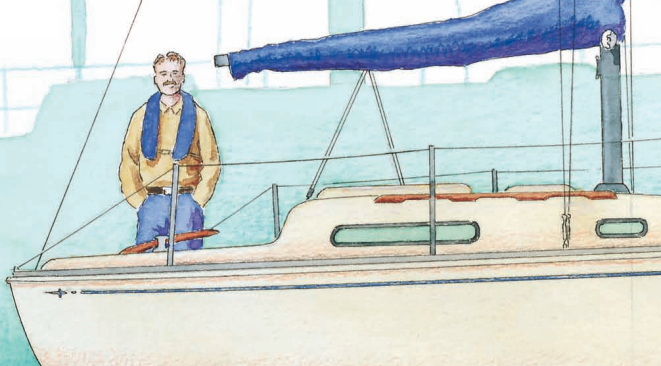
I sometimes feel that I have been swimming and sailing upstream all my life. I am one of the few sailors who has, over the years, moved down, rather than up, in boat size. But ah, the pleasures of owning and sailing small boats.
As with most things having to do with boats, “small” is, of course, all in the eye of the beholder. A few years ago, while doing spring maintenance on my own small boat, I got into a conversation with the fellow who had a boat on the hard near mine. His boat was a nice looking but well-worn Hunter 25. This new owner was happily undertaking a number of upgrades of his “new” boat and wanted my opinion on a few things, which I offered with my usual disclaimer that we all have our own way of doing things, particularly when it comes to our beloved tubs.
What really intrigued me was his comment that the Hunter was his “first big boat.” Now Hunter 25s are really quite nice boats if you like that particular style, but I wondered to myself how many people would consider them to be “big boats,” as this proud sailor did. Ah, the beholder’s eye.
I currently own and sail (quite frequently) a C&C Niagara. This modest little boat has an overall length just short of 25 feet. Over the past 30 years of sailing, I have owned some boats smaller than the C&C and some larger. This is definitely not a big boat as I behold it.
As always happens, a number of my sailing friends and companions have gotten the itch to “move up.” A brand-new Beneteau 331 and a nicely maintained Pearson 28 have entered the fleet of boats I now sail on regularly. And for a while this past spring, I even noticed that some of the “move up affliction” had afflicted me. I began looking at ads and kicking rudders of boats in the 30-plus foot range.
But while these bigger boats, with luxurious interiors, hot and cold pressure water systems, furling everything, and the displacement needed to stand up to some nasty weather have a charm all their own, I keep coming back to my little C&C and loving it more than ever. And the reasons are clear: small boats are easier to buy, easier to sail, and easier to maintain.
Since the primary purpose of owning a sailboat is sailing, I’ll start there. It is a simple matter for me to get my boat in and out of its slip, even while alone. Although a small boat without much displacement can be difficult at times to back up under control in a crosswind when you have little way on, the boat’s light weight can actually be an advantage in that it is quite easy to pull or push it in the direction you want it to go. That’s not so easily done with a boat that displaces more than 10,000 pounds. I keep a separate line on the aft piling nearest the shore for the sole purpose of pulling the boat’s stern to windward when the wind is blowing offshore and I must back into it. Works perfectly.
And speaking of pushing your boat, the previous owner of my boat recently wrote me a note indicating that he occasionally jumped into the water and pushed the boat off when it ran aground in our beloved Chesapeake Bay mud. Try that with a 30-plus-foot Island Packet or Pacific Seacraft.
My simple little boat has no furling anything. I have a huge inventory of very useful hank-on sails that, together with one-line slab reefing, allow me to sail in just about any condition one could find on the bay. Now I do have to admit that roller furling headsails and in-mast and in-boom furling mains are fun to use and quite easy to operate, but that comment changes radically when something goes wrong with those systems. Anyone who has struggled to bring down a huge flapping genoa on a fouled furling system will know how much easier it is at those times to bring down a hanked-on sail. Simple is better for me.
But the real difference between “big” versus “small” boats comes when sailing. My little tiller-steered C&C displaces less than two tons and draws less than four feet. While not a boat I would consider excessively tender, it will heel readily to 20 or 25 degrees when the wind gets to 15 knots or so. This can really be fun and exciting sailing, as the tiller allows you to feel everything the boat is doing. Wheel-steered boats, displacing four or more tons, will merely loaf along like stately old ladies in such conditions. An added benefit of a small boat heeling into the breeze is that you can actually brace your feet against the opposite side of the cockpit. That’s not so easy in a boat with a 10- or 12-foot beam!
Maintenance is also a snap on a small boat as you can do most things yourself. At spring maintenance time, the advantages of small boats really shine. Sanding, prepping, and bottom painting a boat with a 20-foot waterline is a matter of a few hours of work and a gallon of paint. The amount of work and cost required by a bigger boat rises in geometric proportion to its waterline length.
The absence of hot and cold pressure water systems might seem like a penalty to some big boat owners, but to me it is a blessing. As a matter of fact, I took out the 15-gallon hand-pumped water tank and replaced it with disposable water jugs to eliminate the problems associated with the nasty things that like to grow in water tanks. Electricity comes from a single 12-volt battery charged off the outboard’s alternator or occasionally from a Battery Pal trickle charger. And speaking of engines, what could be simpler than a rope-started 8-hp outboard? Each spring this wonderful invention requires nothing more than new plugs. I change the oil in the lower unit and add a few spritzes of WD-40 now and then. There are no multiple filters to deal with, antifreeze to change, complex (and often clogged) cooling systems, fuel lines to bleed, packing glands to repack, Cutlass bearings to replace, shafts to align, or props to balance.
The right boat for you, of course, is a function of how you will use and maintain it. If you are a serious passagemaker who cruises to distant ports, you’ll need the displacement and interior volume of a “big boat.” But, if you are like many bay and lake sailors, who mostly daysail and spend an occasional night or two aboard, the next time you get the itch to “move up,” give some careful thought to doing just the opposite: think small. You won’t regret it.
Thank you to Sailrite Enterprises, Inc., for providing free access to back issues of Good Old Boat through intellectual property rights. Sailrite.com