Tackling a makeover with more enthusiasm and elbow grease than money
Issue 25 : Jul/Aug 2002
Affordable boats are out there — neglected or little-used boats that a little elbow grease can transform into a sharp cruiser. You want one that needs some weekend work, not cash, to restore to fighting trim. Finding one is not always easy; some luck and a little perseverance is required. Luck was the factor in our case.
Upon moving to eastern Tennessee from Kansas, where I sailed a West Wight Potter 15, I met a fellow Potter owner, named Max. He also owned a 1974 Bayfield 25, kept at the local yacht club. My wife, Gretchen, and I were soon friends with Max and were fortunate enough to be invited along to sail the Bayfield on many occasions.
We learned to short-tack up to a mooring and to push off the mud when we ran aground. Most of all, we learned how much we enjoyed having a boat large enough to carry some amenities along. She was equipped with a head, a built-in icebox, an alcohol stove, a dinette, and best of all, standing headroom. One day, Max (one of those guys who is always trading boats and usually owns three or four at any one time) mentioned that he might be interested in moving up to a 30-footer if he could sell the Bayfield.
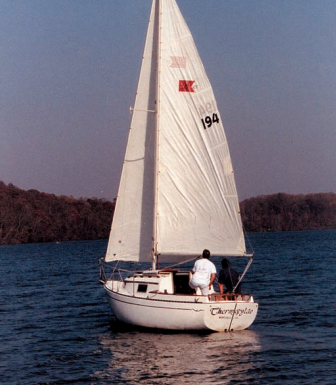
Gretchen and I locked eyes, and the deal was born. Our budget is limited, as we are putting aside a cruising kitty and hope to take a couple of years off for cruising. However, we wanted the experience of a bigger boat and figured we could recover our costs if we didn’t go overboard with refurbishing. We became the proud owners of Thermopylae, named after the Greek battle that was made famous in part by this quote:
“When Persian envoys came to demand surrender of Leonidas, the Spartan king who led the death stand at Thermopylae, they said, ‘You are fools to resist, the Persian archers alone are so numerous that their arrows will darken the sun.’ ‘So much the better,’ said Leonidas, ‘we will then fight in the shade.’ ”
You’ve gotta be impressed with an attitude like that.
Serious polishing
The boat was in good shape but needed several upgrades and some serious polishing and cleaning. The first job was merely to clean and upgrade the interior. We stripped it out and attacked with Clorox and Simple Green. The bilge was a slimy oil pit, not full of oil but rather the result of years of neglect. Gretchen did not like the smell. Many, many new oil absorbers and much Simple Green later, the air quality was much improved. We found wasp nests in every corner and inside the stereo speakers, which in any case had been destroyed by humidity. There were holes cut into the wood paneling for old radios, the original electrical panel, and who-knows-what. The original cabin lights were cracked and discolored from the heat of the lightbulbs. The alcohol stove only worked on one burner and leaked when pressurized. The depth finder was rolled up in wiring in a storage locker, and the cabin sole, a nice piece of teak and holly, was in need of refinishing. The cooler drain was non-functional, and the cooler had been used for storage. The teak was bare, and the hatch slides were worn down to the screw heads.
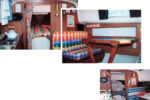
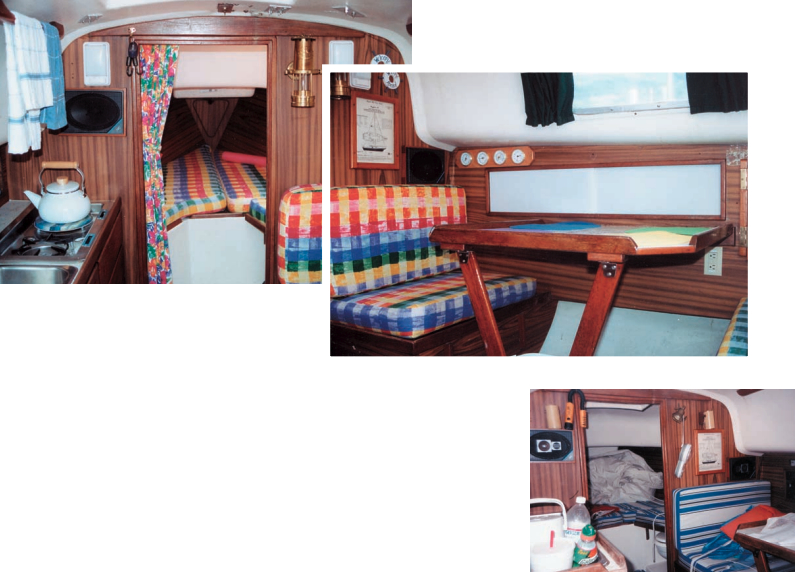
After a good cleaning, we started fixing. My father built a nice piece holding a new clock, hygrometer, thermometer, and barometer for us. It was cleverly designed to cover up the old radio hole cut into the paneling. A framed postcard map of the Bahamas covered another small hole. A Weems & Plath oil lantern covered the last holes and gave us a salty look, while a colorful sliding curtain sewn by Gretchen was hung to separate the V-berth and head from the cabin. Modern cabin lights with low-output lightbulbs replaced the 1970s-vintage originals. We replaced the alcohol stove with a propane camping stove using the original stovetop.
Replaced linoleum
We stripped and polyurethaned the cabin sole, refinished most of the varnish on the interior woodwork, and replaced the linoleum in the dinette with inexpensive bathroom floor linoleum. The drain in the cooler was fixed. Then I sanded and painted the inside of the cooler with white refrigerator enamel for a brand-new look. Thanks to a mother-in-law who is a great seamstress, we were able to recover the old cushions for the cost of the material, which we got at a 50-percent-off sale. The new cushions made a dramatic difference, brightening the interior and giving it a tropical feel.
On the outside, after several attempts with different products, Gretchen, master of the woodrefinishing chores, decided to stick with teak oil for the brightwork. The teak glows golden when she has finished a piece. That job is taking a lot of sweat, but not too much money. A local carpenter had a scrap piece of teak leaning against the wall of his shop that he used to create the new hatch slides. A bit of candlewax lubricant, and now the hatch flies open at a touch. (I also cut a piece of candle and put it in the mast track between the top two slides; it lubricates the mast track each time we raise the main.) Gretchen found a window polish for the plastic windows that actually worked (Maguires Mirror Glaze Plastic Cleaner) and removed much of the effect of years of UV exposure.
Mechanically the boat needed some elbow grease but not too many expensive parts. The electrical system was in pretty good shape; someone had overhauled it and installed a new control panel prior to Max’s ownership. One new battery was needed, along with a new alternator, new belts, and some cleaning of several grounds. I installed a voltmeter to keep an eye on things. The impeller and hoses were replaced, a leaking water tank repaired, new water hoses installed, and a new Jabsco head and hoses installed.
Gobs of corrosion
The through-hulls had gate valves on them, most of which were little more than gobs of green corrosion. These were replaced with new ball valves. The cockpit drains in a B-25 go to a through-hull that is below the waterline and completely inaccessible unless you’re a double-jointed elf. Because of my nightmares of a cockpit drain hose developing a leak and sinking the boat while we were absent, I capped them off (eventually I’ll glass them over) and re-routed the cockpit drains to a new throughhull in the transom just above the waterline. Now when we leave the boat and close the ball valves, the hull integrity is sound. We installed swim-ladder mounts on the starboard side; the ladder is stored in a cockpit locker. I installed a Racor fuel filter/water separator and new fuel hoses. I also installed an inline free-flow electric fuel pump with an on/off switch. Not used during normal running, it’s only there to help bleed the fuel system (NAPA Part #6101050 made by Balkamp.
We didn’t like fumes in the cockpit when we motored in light wind, but two simple fixes eliminated the diesel stink. These old Yanmars (YSE-8) had no positive crankcase ventilation systems, so the valve cover breather is vented directly into the engine compartment — one reason the bilge was so oily. I replumbed the vent directly into the intake pipe so the fumes are burned in the engine and exhausted through the transom. We also tried some SoyFuel, a soybean-based bio-fuel diesel substitute. It can be mixed in any ratio, although 50/50 is recommended. It has a higher octane rating than diesel, so the engine starts and runs better, but more importantly the exhaust odor is almost undetectable, and what there is smells like popcorn! A search on the Internet will turn up several suppliers of biodiesel. (Be sure your engine can use this. –Ed.)
No rot or sagging
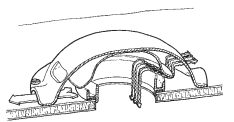
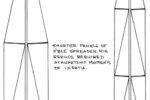
The rigging was in good shape and needed no repairs. The deck-stepped mast base was sound, no rot or sagging in the cabinroof had occurred. Bayfields are built heavy enough to last many years when sailing on a lake. A new sailbag for the jib allows us to leave it hanked on for quick getaways. With practice, we can have both sails up a few boatlengths out of our slip. We use a 130- percent genoa most of the time in the light air of Tennessee. This moves the boat very well. There is also a 100-percent jib and an unused storm jib stored below. With the help of Sailrite’s book, The Sail Repair Manual, and some of their thread, we learned how to sew sails on a home machine. We did some repairs and added a double layer where the spreaders rub when tacking, something we do all day. The book, at $11.95, was well worth it. The double layer turned out great.
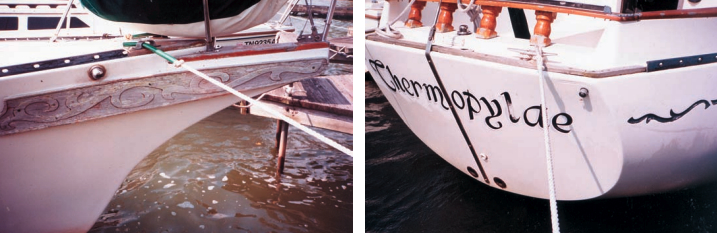
Next up is finishing the exterior brightwork and perhaps replacing the trailboards (or we might let the next owner have that privilege).
We’ve enjoyed our time on the water, whether sailing or applying elbow grease. Our investment has already paid off in terms of many wonderful evening sails and weekends out with the scenic Smoky Mountains in view, multiplied by the experience we’ve gained sailing and working together. With an investment that fit our budget, we didn’t change our cruising plans. And with the liberal application of sweat equity, we’ve turned a serviceable, but neglected, boat into a trim cruiser that is reliable, has a good-looking interior, and is very comfortable to spend weekends on.
Now — if we can just find a 38 footer like her . . .
Thank you to Sailrite Enterprises, Inc., for providing free access to back issues of Good Old Boat through intellectual property rights. Sailrite.com