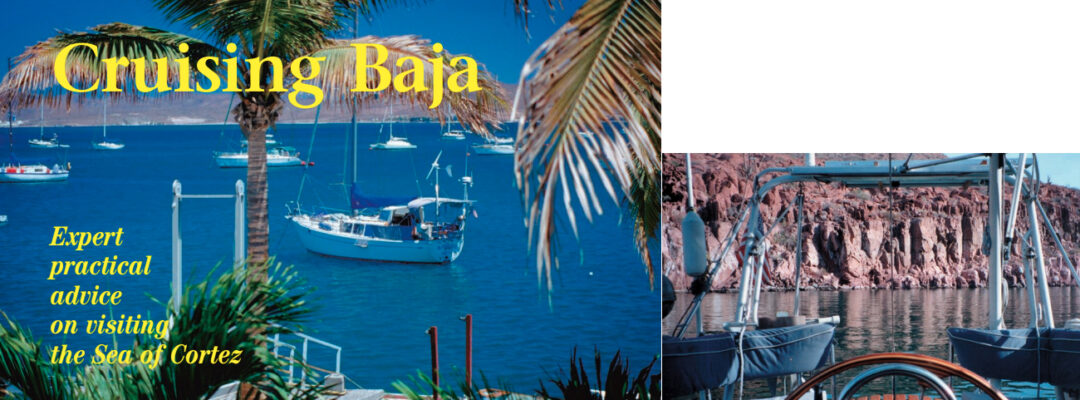
Expert practical advice on visiting the Sea of Cortez
Issue 25 : Jul/Aug 2002
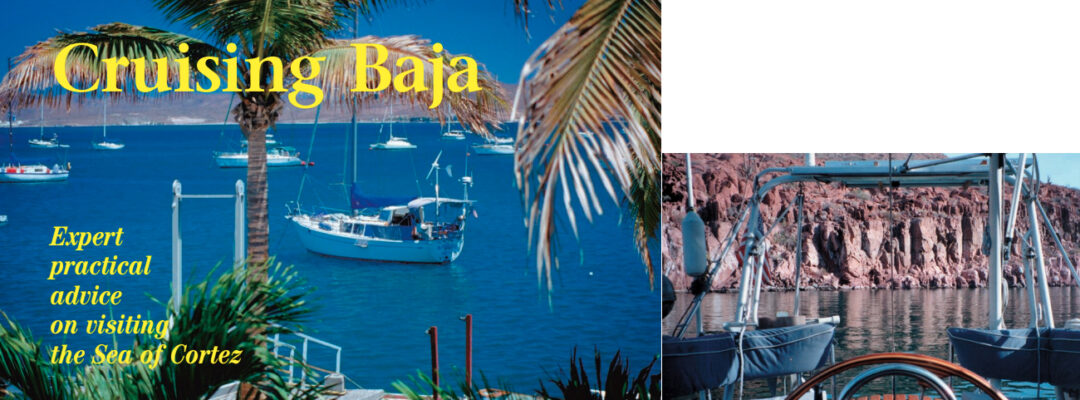
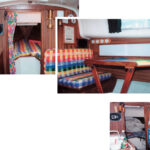
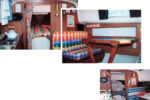
At right, the cockpit seats and helmseat which were added for storage and comfort.
My wife, Bette, and I lived on our 1974 Cal Cruising 35 for seven years and cruised an estimated 14,000 miles up and down the Pacific coast, venturing into Canada and Mexico. We decided from the start not to be casual boaters or weekend cruisers. This would be a new way of life for us, and we would put everything into it. When we left the Northwest, Maho Blues and her cargo were all that we owned — no jobs, no cars, and nothing in storage — we were committed to cruising.
There were fascinating characters to meet and beautiful new anchorages to explore, but there was something especially unique and wonderful about the Sea of Cortez, in Mexico. We appreciated the sun, warm water, and solitude of Baja California. Our first visit lasted a year. We survived the intense mid-summer heat and welcomed the cool of the fall. When we ran out of money, we sailed back to San Diego to make a few boat improvements and to earn the funds to do it all over again. Within a year we returned to the friendly people and spectacular anchorages of the Baja. By the time we made our second visit we felt that our boat was truly prepared for cruising Mexico. We had put our all into Maho Blues, and she was giving it back to us by making life easier and more enjoyable.
In essence, we created a comfortable, self-contained home that allowed us to spend up to six weeks off by ourselves in picturesque, remote Baja anchorages. Cruising boats around the world face many of the same challenges, so ideas for dealing with energy needs, secure storage, and seaworthiness are universal in their appeal.
But there are differences, too. The cockpit enclosures on boats in Canada, for example, are designed to keep out the rain and keep in the heat, while awnings in Baja need to allow for good airflow (clear plastic is often traded for Textilene screening in Mexico). Much of our equipment was valuable anywhere we cruised, but we traded crab pots for spearfishing equipment and had more need for snorkel gear than foulies in the Sea of Cortez.
It may surprise you that we did well without a watermaker in this desert land, that the diesel fuel in Baja was clean, and that our extensive awning system which nearly shaded the entire boat from the scorching sun could be removed in two minutes flat if necessary.
SSB radio
Soon after you sail south of San Diego, your VHF radio will no longer receive U.S. weather channels. You will be in a country that has no coast guard, only the Mexican navy. The port captains and fishing boats exchange important weather information in rapid-fire Spanish. The VHF radio can keep you in contact with other cruisers in the area, but getting regular weather broadcasts is critical to safe cruising.
So the SSB/ham radio becomes important in Mexico. There are daily cruiser nets that share information on the SSB radio, but we found the morning ham Chubasco Net (7.294 MHz at 15:30 Zulu) to be the best source of maritime weather information. The complete installation of a used SSB/ham radio can be done for under $1,000, and one of these powerful radios might someday enable you to send out a call for help that can be heard for thousands of miles.
We had several friends who tried receive-only radios to listen for weather information, but they were not able to pull in signals on a reliable basis. I can think of nothing more important to the survival and enjoyment of cruising than continually paying attention to the weather. We survived two hurricane seasons (approximately June 1 to November 1) in the Sea of Cortez. It takes several days for these storms to form and move north. Staying on top of weather information will usually give you time to head for a hurricane hole, and there are several of these protected areas in the Sea of Cortez. Hurricanes in the northern Sea of Cortez are extremely rare.
The arch
I laugh to myself when I recall how our complex radar arch and dinghy davit system on the transom of our boat developed over the years. Most of the aluminum and stainless parts came from scrap yards in Seattle, and I worried at times that I was building an ugly structure that might not work at all. Friends on the dock gave me plenty of comments and incredulous looks that did little to boost my confidence. The system towering over our transom eventually included the radar mounting and dinghy davit system, the wind generator mast, the outboard motor lift, the Bimini, the permanent solar panel mounts, the attachment for the SSB antenna, the wind anemometer unit, a strobe light, and even a low-amperage anchor light.
I affectionately joked that we had a bit of an “oil derrick look,” and I’m sure it was true that all this windage did nothing to help our performance when going to weather. However, it works for coastal cruising, and in the Sea of Cortez, off-wind performance is fine. Our boat was a great motorsailer when we need her to be, with enough fuel to cover more than 1,000 miles. We found that it was necessary to tie off the wind generator when sailing to weather. Over the years that we cruised I saw more and more boats with similar systems incorporating many of the same features. Because it is a completely functional system, over time I got used to the look of all that stuff above our transom. In fact, I was proud of it because I built it myself, and it worked.
The arch was created to form dinghy davits, and I love them, but I also appreciate their limitations. I believe davits are only appropriate for boats 35 to 40 feet and longer, due to weight and balance issues. Without davits, cruisers risk towing their dinghies behind them or must go through the hassle of removing the outboard motor and mounting it to the rail while the dinghy is hoisted to the foredeck and secured in the upside-down position.
Dinghy on davits
In mild weather we could carry the dinghy on the strong davits with the outboard still mounted on the transom. It had to be lashed down well and cross-tied in case conditions got rolly, but our dinghy could be launched and the engine started just a minute after we anchored. The outboard motor could even be transferred back and forth from the dinghy to the rail mount while the dinghy was hoisted on the davits. Several times we have been in wind conditions so strong that other cruisers’ inflatables flipped over and submerged their outboards. Of course, the occasional thief is more tempted by a dinghy sitting quietly in the water behind your boat on a dark night. We hoisted our dinghy out of the water and cross-tied it every night.
A dinghy on davits for ocean passages? Probably not. There are too many sad stories of dinghies being destroyed or lost at sea. I could stand in our dinghy while it was hoisted on the davits and jump up and down with no resulting damage. Our dinghy could also be hoisted high enough to be above the swells from following seas. Even so, I would not consider crossing an ocean with our dinghy on the davits. The ocean is more powerful than most of us can imagine.
Inflatable dinghy
Before we left Seattle to go cruising, we were given a beautiful eight-foot rowing dinghy. But we made the difficult choice to sell it. Maho Blues was too small for two dinghies, and an inflatable made more sense for cruising. There were many times in our travels when a small rowing dinghy or a hard dinghy with an outboard would have been swamped. The hauling capacity and speed of the inflatable are superior, and it is a more stable platform to climb into when snorkeling. Our inflatable was an older nine-foot Avon RIB, and the outboard was a Nissan 5-hp two-stroke. A rigid bottom lent itself well to use with davits because it could be lifted directly from attachments to the fiberglass floor rather than from the air-filled tubes. I am amazed at how long Avon dinghies last, and there are good deals to be found on used ones.
While the 35-foot sailboat was our home, a great deal of our fun and entertainment centered on the dinghy. We used it for sunrise and sunset fishing, snorkeling and spear-fishing trips, and for hours of exploring secluded lagoons and miles of shoreline. At slow speeds the outboard used very little fuel and could run for most of a day on less than a half gallon. Full throttle would bring fuel consumption up to about a half gallon per hour. Over our years of cruising, it carried tons (literally) of water, food, and supplies out to Maho Blues.
What about the downsides of inflatables? First of all what can be inflated can be deflated. Avons are strong, but ours was old, and we did have to repair a leak or two. It was difficult or impossible to row into wind and waves when two people were on board if the outboard quit. With this in mind, we carried spare fuel, a dry box containing a spare spark plug, drinking water, snack food, and a handheld VHF radio. We also carried a mushroom anchor with a few feet of chain and 30 feet of line. We were frequently off by ourselves with no one to help us, so we did not go exploring in the dinghy when wind conditions could blow us out to sea if something went wrong.
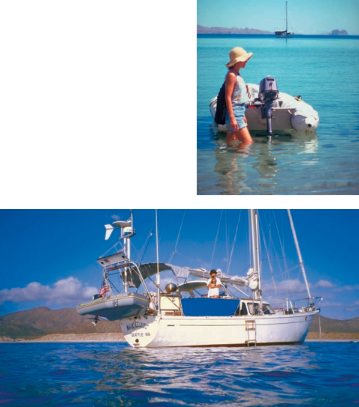
At left, Maho Blues shows off the dinghy davits that bemused friends at the dock in the U.S. but were valuable in Baja.
Clean drinking water
We often drank a gallon or more of water a day to keep from becoming dehydrated in the middle of summer. (No, you can’t substitute beer — it’s a diuretic.) We were surrounded by the arid, rocky, cactus-covered land of Baja and the Sea of Cortez islands, yet there are significant mountain ranges and natural aquifers that supply clean, fresh water to several towns and villages on the peninsula. Our water tanks (110 gallons in two tanks) were sometimes filled with a hose during a temporary stop at a dock, but more often we transported our water in jugs to the boat using the dinghy. We had several six-gallon jugs, but discovered that three-gallon versions were easier to handle and store.
We added chlorine to the water in our tanks, and I installed a water filter under the sink. This arrangement allowed the chlorine to kill organisms in the tanks, and the filter removed any excess chlorine from the water before we drank it. Our boat came with a pressure water system, and we always left the breaker to the electric pump in the off position when we left the boat. A water-pump motor can burn itself out due to a small leak, and it can also pump a precious water supply down the drain or into the bilge. I also installed manual pumps at the galley and in the head.
We added a manual saltwater pump in the galley for washing dishes, and early on we had a few laughs when it clogged on a regular basis with little fish called Blennies. Pumping and pumping would produce no water until a sudden gush would come after a seriously distorted little Blenny popped out into the sink. After the novelty of this wore off, I added a strainer by the seacock.
The amount of water we could carry was often the limiting factor during extended trips into remote areas. All fresh water on our boat was considered drinking water, and we developed disciplined habits to conserve it. We used no more than 1.5 gallons per person per day, even in extreme heat. Salt water was used for bathing and for doing laundry in a bucket. A Baja summer cruising wardrobe can consist of nothing more than a few T-shirts, shorts, and a pair of sandals. Things washed in salt water dry well in the Mexican sun, and the lines that run around a boat are certainly used more for drying clothes than for saving lives, but I guess boaters should still call them lifelines.
A note on watermakers: modern units are wonderful but expensive. Many cruisers we met had them and loved them. Even though they consume a great deal of power, the high output units were more popular. Several cruisers had upgraded from smaller units that required them to run their engines for long hours to higher-output units that could completely replenish their water tanks as they motored from one anchorage to another. We would have enjoyed having more fresh water to wash the boat and ourselves, but we could live for a year in the Sea of Cortez for the price of a good watermaker.
Power sources
Our alternator was a Balmar 100-amp unit. We also carried a complete extra 75-amp alternator which could be bolted into place quickly if needed (it wasn’t) and a couple of spare regulators (we needed one). The high-output alternator could recharge the battery system without running the engine for long hours. I have only good things to say about Balmar. With help from the solar panels and wind generator, we seldom needed to run the engine more than once a week.
The voltage regulator output could be adjusted up occasionally to equalize (or overcharge) the battery system. Battery equalization could also be accomplished to a lesser degree with our unregulated solar panels and the wind generator.
Solar panels are like magic; they quietly do their jobs year after year without failure. We had two Siemens panels that regularly put out a combined total of 8 amps. They were unregulated but could be switched off, if necessary (to check battery voltage, for example). I detected no deterioration of output in three years of using the Siemens panels. I did learn a few lessons about solar panels. First, it is much easier to permanently mount them in a horizontal position. Trying to track the sun and adjust panels for perfect orientation on a boat takes more time than it’s worth with the sun continually moving and the boat swinging at anchor. Second, placing 10 percent of a solar panel in the shade does not reduce the output by 10 percent. Instead, the output may be reduced by 50 percent. It is important to keep panels completely out of shadows to maximize output. The best place for this on our boat was high and as far aft as possible, off the back of the Bimini.
Wind generators involve a lot of tradeoffs; they’re not for everyone. Years ago I found a high quality Wind Baron unit at a swap meet in Seattle for less than $300. I mounted it high and out of the way using a $20 second-hand small sailboat boom for the pole and set this on a rubber transmission mount at the transom coaming to reduce noise and vibration. The unit produced power for years, and the only maintenance ever performed was a $6 bearing replacement. It produced power (more than 20 amps in high winds) through the night and even while we were sailing.
Tradeoffs? There is always some noise. It is dangerous if you get close to a prop that can have a tip velocity of several hundred miles per hour. The system adds to the amount of above-deck braces, weight, and windage. Finally, it produces power, on one hand, but can rob the same power from the solar panels when they are in its shadow. With the abundant sun in Mexico, I might consider trading in the wind generator for more solar panels next time. But for cruising other areas with more wind than sun, I’d certainly keep it. There is something pure about producing electric power from the wind that I find appealing. Maybe it’s part of the same intrigue I have with sailboats.
Why didn’t we add regulators to the solar and wind generator systems? Because we lived on our boat and were there to monitor voltage. Overcharging was seldom a problem with the large battery bank to absorb the amps and the constant demands of the refrigeration system and other onboard draws to consume power. All three charging sources were fused, were capable of being turned off, and had ammeters to register their individual output. A loose wire on the alternator or a problem anywhere in the charging systems was soon detected.
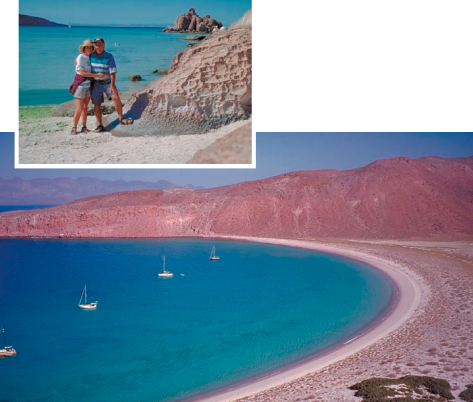
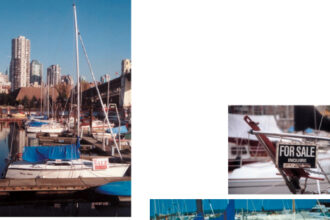
Below, Maho Blues anchored at Isla San Francisco, a day’s sail north of La Paz.
Power storage
More than once, we lived for an entire year without plugging into shorepower, yet our boat had the golf-cart batteries I installed years before we left to go cruising. These deep-cycle 6-volt batteries (used in pairs for 12-volt systems) provide the cruiser with an excellent value. I realize there are newer, high-tech, even bulletproof batteries available on the market, and they may be appropriate for people who have the money but don’t have the time to check things like the level of water in their batteries. I always paid careful attention to the batteries that were the heart of our power system. The water levels were checked weekly, and their voltage level was monitored several times a day.
Maho Blues had six golf-cart batteries (one pair in bank #1 and two pairs in bank #2) that could store approximately 800 amp-hours of energy. These were lead-acid or flooded batteries, as opposed to gelcells which require no service but have a shorter life. The battery selector switch was generally kept in the “both” position. My strategy, which worked well for us, was to prolong battery life by using a large bank that was seldom deeply discharged. There was no separate starting battery for the diesel, no isolators, no battery combiner, no $300 digital monitoring gauge, and no battery temperature sensing system to feed back information to the voltage regulator.
Battery charge level was simply monitored on the high-quality analog meter that came with the boat and double-checked when needed with a handheld digital multimeter. The trick is in knowing that all loads must be removed for several minutes before a battery bank will give a true voltage reading (the battery will register lower under load) and that by the time a so-called 12-volt battery gets down to 12 volts, it is nearly dead. On the other hand, batteries that are being charged by the alternator, the solar panels, or the wind generator may appear to be nearly up to 14 volts until the charging source is turned off and the batteries are allowed to rest for 10 or 15 minutes. The entire range for a battery from full charge to nearly dead is only in the one-volt range between 12 and 13 volts, and batteries that are seldom discharged below a level of 12.4 volts will have a long life. Only distilled water was added to our batteries, and the specific gravity was checked with a hydrometer if a bad cell was suspected.
Fuels
In an ideal world I would use one fuel for everything on a boat: diesel. But while excellent for the main engine, this fuel is not appropriate for small outboard engines or for efficient cooking stoves. Along with the fuel in our tanks, we carried a small container of diesel for fuel filter changes and a couple of designated jerry jugs (usually empty) in case we needed to transport diesel from some remote location to the boat using the dinghy.
We carried 10 gallons of gasoline including a gallon mixed with oil and ready for use in the dinghy and another gallon mixed with oil ready to go on the boat. Our Nissan outboard had an integral tank that held a half gallon. Gasoline was stored out of the sun in a vented locker that also functioned as a cockpit seat.
Our third fuel was propane. Quality propane stoves are fantastic, and an outside propane barbecue is a must in Baja. It gets too hot in the summer to cook down below. We lived with kerosene for years out of fear of propane and because it was expensive to convert. But eventually we did change over. I did everything by the book with a remote solenoid shut-off valve in a vented cockpit locker (under a second cockpit seat), and we carried an extra propane tank under the helm seat. We purchased a Force-10 stove with a thermocouple to shut off the gas flow if the flame is blown out by the wind. Less expensive propane stoves, such as those designed for use in RVs, do not have this shut-off safety feature.
(More tips from Roger and Bette will appear in the September 2002 issue of Good Old Boat.)
Thank you to Sailrite Enterprises, Inc., for providing free access to back issues of Good Old Boat through intellectual property rights. Sailrite.com