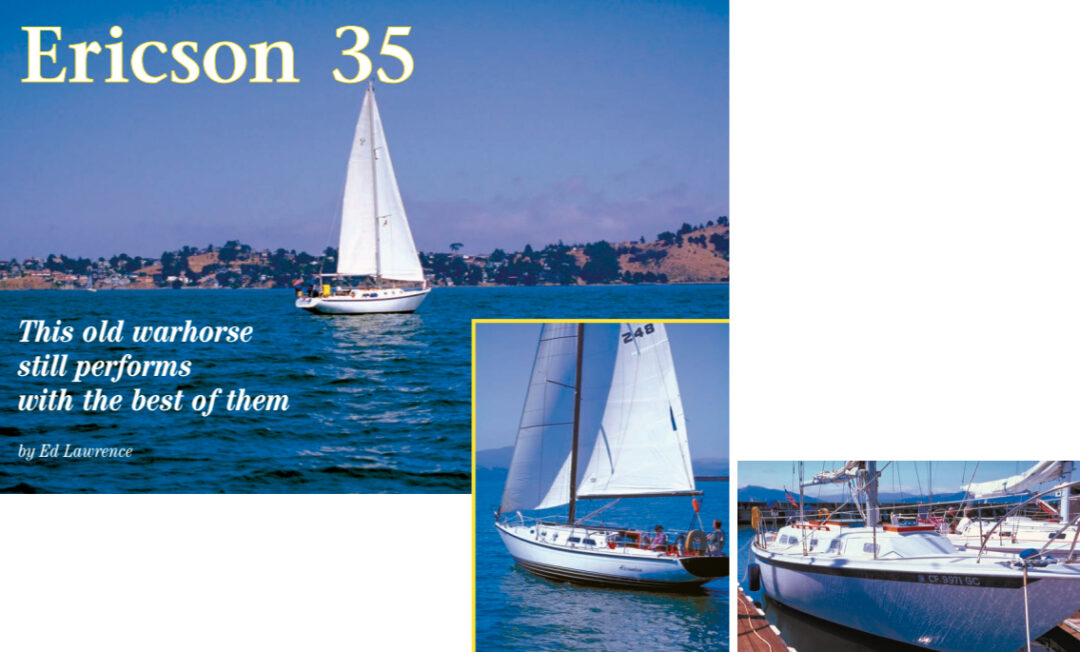
This old warhorse still performs with the best of them
Issue 25 : Jul/Aug 2002
Take a seat in a yacht club late on a Saturday or Sunday afternoon, and you’ll hear racers recounting the highlights of their day: “I was coming into the mark on starboard when this turkey tried to get an inside overlap and blew the jibe. His bow pulpit clipped my stern and took a chunk of glass the size of a pie tin out of my transom. What a jerk!”
Or: “How about if I write a check to you? I’ll tell Judy it’s for a new computer, you pay for the repair to the spinnaker, and she’ll never know the difference.” Those conversations do take place. Trust me.
Turn 180 degrees in your chair, and you may hear the words of sailors who have outgrown the racing urge. Now content to spend their days in one-boat fleets, they sail effortlessly on starboard tack from Point A to Point B on San Francisco Bay, the Chesapeake, one of the Great Lakes, or in whichever direction their bow points when they leave their home base.
Regardless of your sailing proclivities, when you’re aboard an Ericson 35, odds are that you will be traveling almost as quickly and comfortably as crews aboard the newest, similarly sized sloops. I’ve been in the middle of a gaggle of 35s rounding a mark in front of the Golden Gate and escaped unscathed because she responds to a touch of the tiller. And I’ve cruised offshore under a chute for hours without touching a sheet.
So, when asked for my feelings about these old warhorses, my take is usually, “change one digit on her birth certificate, and you may think you’re sailing something that’s fresh out of the box.” Creature comforts are certainly large and well laid out. However, from a cosmetic standpoint, there is no ignoring the fact that she may have lost her youthful bloom. Here’s why.
Good looks
Employment counselors say “you get just one chance to make a first impression.” With that as a yardstick, the 35 Mark II is eminently employable.
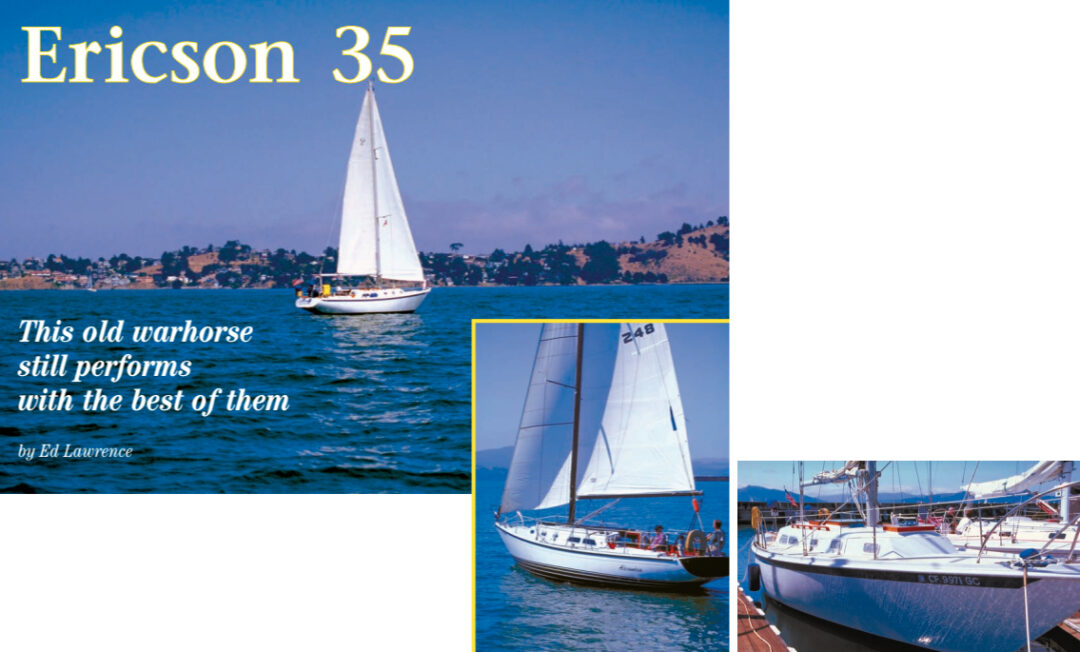
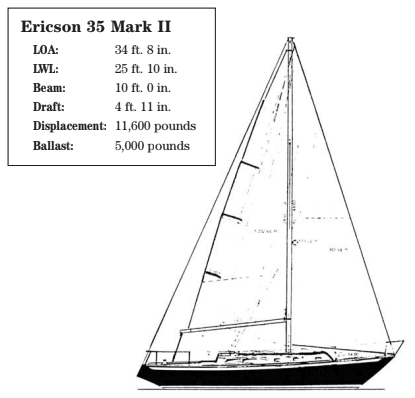
Viewed from abeam, she has a traditional look that’s far from clunky or jaunty. Her masthead rig and boom are proportionate to her deck length. Designed long before today’s plumb bow/wide stern models, she sports long overhangs and a reverse transom that is pleasing to the eye. The bow entry angle is more rounded, and her 10-foot beam is narrower than many of today’s boats. Higher at the ends, she has a soft sheer that flows downward to reveal five ports, a real plus when swinging on the hook in a bouncy anchorage.
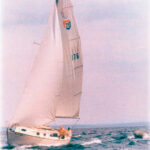
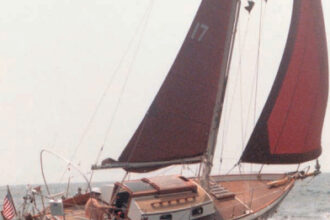
However, it is her attitude when she’s under way off the breeze that causes my heart to go pitty-pat. Viewed from the stern quarter while heeled 10 to 15 degrees with her starboard bow buried, she shows a rounded underbody as provocatively as a dance-hall girl raising her skirt. Whew!
Her good looks reflect the talent of Bruce King, a prominent American yacht designer from whose board her lines evolved, along with those of 21 other Ericson originals and eight he redesigned. Among other designs bearing Bruce’s name are the Islander 37 and 55 and custom boats ranging in size from 90 to 124 feet. His big-boat fleet includes Whitefin, a 90-foot fractional-rigged sloop that closely resembles L. Francis Herreshoff’s Ticonderoga.
The Ericson 35 had its origins at a waste disposal site. When Pearson Yachts decided to close a small West Coast manufacturing facility, the hull molds for an Alberg 35 were left in a scrap heap. The enterprising manager of the site sold the hull molds to Mark Pittman, an entrepreneur who formed Ericson Yachts in 1965.
Blustery winds
An archetypal production builder with a West Coast heritage, Mark made his name building fast cruisers designed to sail comfortably in the typically blustery winds encountered in San Francisco Bay and on the Pacific coast. His major competitors were Pearson and Cal Boats.
During the company’s infancy, Mark avoided architectural fees by copying or altering existing boats. According to Don Kohlmann, who joined the company in the 1980s, the Alberg 35 deck was redesigned by Bruce King and introduced as the Ericson 35 in 1965. Speaking of this boat, Bruce says “maybe two dozen were built.” A Columbia 5.5-Meter hull was copied and became the platform for another Ericson model sold with a different deck layout.
The first Ericson design attributed entirely to Bruce King was a 23-footer. That was followed by the Ericson 27, one of the most popular boats produced in the 1970s. A performance cruiser with user-friendly accommodations, it was a consistent winner in Midget Ocean Racing Club events. The company was eventually purchased in 1975 by the CML group, which also owned Boston Whaler and a group of clothing businesses. Gene Kohlmann, who owned an Ericson dealership in San Francisco at the time, joined the company in 1975 as vice president. He was eventually joined in top management by brother Don, a professional sailor with America’s Cup credentials.
In 1984, during the period when corporations were acquired and sold as quickly as stolen diamonds, CML made a public stock offering closely followed by the divestiture of many of its non-clothing businesses. Ericson was sold to Gene Kohlmann and a group of investors. Then, during the economic downturn that ravaged most of the small, independent boat builders, Ericson became a statistic when it shut its doors in 1990.
These days, Don is general manager of Pacific Seacraft, and Gene is the company’s operations manager. Coincidentally, Pacific Seacraft purchased the molds for the Ericson 38 and 34, both of which enjoyed successful production runs as Pacific Seacraft boats in the 1990s.
The Mark II
Bruce King redesigned the original 35-footer as the Mark II, which was introduced in 1969. An instant hit among cruisers and racers, more than 600 were produced, a tremendous accomplishment considering the vagaries of the industry at the time.
He reflects that “the boat is a blend of traditional and modern design elements. The overhangs, strong sheerline, low tapering cabin trunk, and reasonably proportioned transom make for an appearance that is easily recognized in the sailing community. Rounded sections, a fin keel, and balanced spade rudder aid her spirited performance. We also raised the deck level to make her drier.
“This particular, perhaps friendlier, look is preferred by many to the more aggressive appearance of many of today’s vertically ended freeboard designs.
“The boat was built primarily to the CCA racing rule, with an eye toward the newer IOR rule, and was initially successful. The underbody has less wetted area than its predecessor,” he continues.
“It is an attractive, well-proportioned boat with mannerly sailing characteristics,” he adds. “The boat will sail itself with the helm locked off anytime the wind is forward of the beam because the center of lateral resistance (CLR) shift is avoided by certain design geometry. The ends of the hull are fairly symmetrical. If a stern is too full, CLR shift is unavoidable. If the juncture of the keel trailing edge and the hull is located too far forward, CLR shift is unavoidable. If present, it must be compensated for by an increase in helm angle, or the boat will head up.
“Her moderate displacement with overhangs results in an easier motion with less pounding in head seas. This greatly enhances comfort. This avoidance of CLR shift with varying heel angles, combined with an easy motion, has always been one of the primary reasons experienced sailors prefer the Ericson to other boats,” he says.
Not stiff
Three decades after her introduction, a sail-area-to-displacement ratio (SA/D) of 17.3 equates to a moderate performer, and a displacement-to-length ratio (D/L) of 241 places her on the high end of the average scale for moderate-displacement cruisers. Though her ballast ratio is 43 percent, she’s not considered stiff by owners.
The Mark II eventually was replaced on the IOR circuit by boats with more pinched sterns specifically designed as rule-beaters. She continues, however, as a popular PHRF racer.
A faster model, the Mark III, was introduced in 1982. She featured a rounder hull shape and more conventional stern and was rated 30 seconds faster under PHRF rules than her predecessor. Bruce describes the Mark III as having many of the same characteristics as the Ericson 38, which was introduced prior to the makeover of the Mark II.
Disturbed by pressure in the racing community for performance at any cost, Bruce eventually opted to specialize in the design of large custom boats. “The trend was to build lighter boats on the edge of structural inadequacies that would be more competitive. I didn’t want any widows knocking on my door.”
Ericson boats enjoy a reputation of being well constructed. With only one notable exception, all three models followed a similar lamination schedule.
Hulls are solid fiberglass laminated with alternating layers of mat and woven roving. The hull was built in a split mold and bonded together with 11 layers of mat and roving. Decks are cored with balsa. The Mark II had a keel with internal ballast while the Mark III keel was mounted outside the hull.
Common complaint
Chainplates are stainless-steel straps bonded to the hull with welded caps bedded to the deck. A common complaint among owners is that chainplates require annual inspection because the adhesives used at the time were more brittle than newer products and prone to leaking. If considering the purchase of an older boat, I’d want a thorough survey of this area, especially in the deck area, where leaks could intrude into the balsa core.
In a perfect world, a mid-sized sailboat should provide a sail plan easily manageable by a shorthanded crew, cockpit space adequate for lounging, and spacious accommodations belowdecks for 4 to 6 crewmembers, right? Score one for this boat. Step aboard and the immediate feeling is that there’s plenty of elbow room fore and aft.
An 86-inch-long space between the mast and bow pulpit is large enough for a chaise lounge. Side decks are 12 to 14 inches wide so movement is easy, and the hull is surrounded by a two-inch fiberglass toerail and double lifelines.
Built in an era when portlights were more than decorator pieces, she has five ports on each side of the cabin. However, one owner replaced the fixed ports forward to improve air circulation. Old-style ports are clear, which produces good light belowdecks, but at replacement time I’d opt for darker Lexan that affords more privacy.
A sturdy double-spreader masthead rig towers over the deck, supported by oversized stays and shrouds. The Mark II was offered with two rigs, one two feet taller for sailors harbored in light-air venues. Parallel spreaders and outboard sheet leads do not provide pointing angles as high as those with swept-back spreaders, but she’ll sail to weather as well as her contemporaries. With sail track running to the end of the cockpit, overlapping headsails and spinnakers can be trimmed to their proper shapes.
Better angles
Depending upon the year of manufacture, her winches may be Barlows or Lewmars. Mainsail controls are located at the end of the boom, which provides better sheeting angles than found on many contemporary boats, where the traveler is located on the cabintop.
The cockpit is a T-shaped area divided into two sections by a fiberglass bridgedeck aft. On boats fitted with a wheel, the helmsman steers aft of the mainsail controls, so there is no interference with sail trimmers. Sailing with a crew of six, I’ve been involved in faultless spinnaker jibes without banging elbows with my shipmates. Naturally, a tiller places the helmsman in the middle of the melee.
There’s space for six to eight adults to lounge comfortably on benches and seats in the cockpit. This space is devoid of tables and cup holders that are often a nuisance when underway.
The 30-inch wide companionway is 28 inches tall, which provides room on the bulkhead for instruments within the helmsman’s sight lines.
Unlike compromises involved in newer boats with aft cabins that reduce the amount of storage space in the cockpit, the Mark II has lazarettes port and starboard and on the stern that are adequate for the storage of spare sails, anchor and rode, and dock gear.
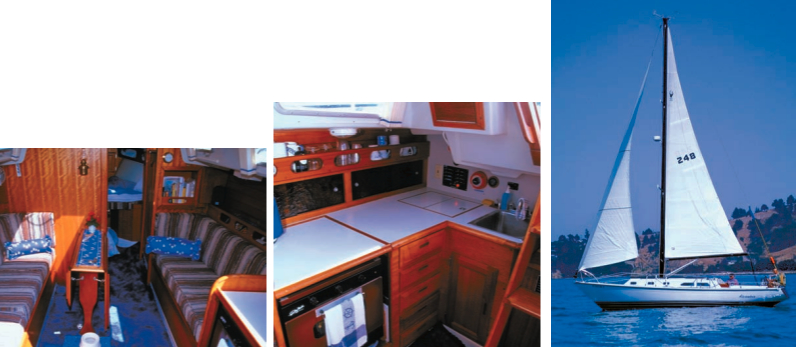
Spaces belowdecks are equally generous. I’ve spent many drippy evenings with the entire crew comfortably ensconced on long settees. The main saloon is 9 feet long and 8 feet wide amidships. With 6 feet, 1 inch of headroom, there is plenty of room for most guests to move about without banging their heads. An additional 8 to 10 inches of shelving outboard of the settees adds valuable storage area.
Well designed
Are spaces as bright and shiny as new French boats? No. But they are well designed and executed. Depending upon the model, bulkheads and cabinetry may be mahogany or teak with battens on the hull creating a warm, inviting, wide open space. The headliner and sole are fiberglass, less distinctive but easier to maintain.
The nav station is located to port at the foot of the companionway in an area described on one boat as “Carl’s Condo.”
“On long passages I sometimes go to sleep at the table, and fall backward into the quarterberth,” Carl says. Since the boat was built before Loran-C and GPS were household words, the chart table is 20 by 30 inches, large enough to spread a full-sized chart folded once. Cabinetry outboard is designed to accommodate navigation instruments and a VHF radio and stereo/cassette player.
The galley, located to starboard, is a cook’s delight. Its counter is 5 feet long and 2 feet wide, allowing plenty of elbow room to carve a bologna roast and toss a green salad. The size of storage cabinets outboard reflects the builder’s disdain for paper cups and plates.
The ice box is a cavern. Measuring 18 inches deep by 24 inches wide by 32 inches long, it would be a simple matter to lose several six-packs of cold drinks without noticing. However, insulation is so thin that ice cubes won’t last long. A better alternative is find a source for dry ice or get used to drinking warm beer, as I did in Mexico.
Unless retrofitted with propane, the stove is an alcohol unit. “Why not alcohol?” one owner asked. “Just don’t turn your back on it until it’s properly lit, and you’ll have no problems.” He should know, since he’s owned his boat for 13 years.
Fold-down table
Seating is at a C-shaped settee to port that seats six comfortably at a fold-down table. The 6-foot, 4-inch-long seat converts to a berth. Some boats were equipped with a drop-down table that converts the berth to a double, at the same time creating a quandary about where to store the oversized cushion insert. The star- board settee also converts to a 6-foot-long berth.
Forward to port, a head enclosed by a wooden door is large enough to allow showering without fear of bruising elbows. Depending on the year of manufacture, she may be equipped with a holding tank or electric head.
The skipper’s quarters are in a stateroom in the bow that also has 6 feet of headroom. The berth is nearly queen-sized and 5 feet wide at the foot. One enterprising owner converted the single-panel compartment door to a bi-fold, which allows the door to be opened without removing the insert at the head of the berth (more on this later). Storage is in a hanging locker and below the berth in a space shared with a water tank.
Perhaps the most striking difference belowdecks between models is the location of the engine. Early models were equipped with an Atomic 4 placed forward of the nav station. The location has the advantage of easy inspection and maintenance of the engine and placing the weight in a desirable location. Since gasoline engines are relatively quiet, noise was not a major consideration.
Newer boats have diesel engines mounted below the companionway, fairly typical of modern installations. The change allows use of a more reliable engine at the cost of less access and, absent a good sound deadener, adds an irritating noise.
Performance
In the past I’ve sailed the Mark II on picnic sails, long weather legs between the Golden Gate and Farallones Islands, and down the California Coast in 30-plus knots of wind. I would not hesitate to set sail on similar voyages tomorrow.
On long legs west, we typically beat to weather in 15- to 20-knot north-westerlies to make the north end of the islands, where we would jibe and set a chute for the return trip. In those conditions, the boat typically buried her shoulder and allowed the skipper to steer with one hand while seated on the rail. On one memorable occasion, gusts blew the cups off the windspeed indicator while sailing downwind, but she tracked in a straight line as long as the spinnaker trimmer was alert.
On a recent sail on San Francisco Bay, with a full mainsail and 100 percent jib in 10 to 12 knots of wind, she beat to weather at a comfortable 5.5 to 6 knots. Off the wind the Speedo pegged 8 knots.
But she’s no lightweight. So, when the wind drops below 5 knots the options are to employ the iron spinnaker or drop the sails and stretch out in the cockpit with a book.
Always more than a pretty face, and once a frontrunner, the Ericson 35 is now one of my favorite good old boats.
Owners’ opinions
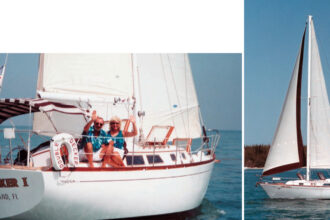
Dudley and Patricia Hattaway of Pt. Richmond, California, purchased The Hideaway, a Mark II, in October 1987. “During the first two years we worked almost every weekend and did very little sailing,” Dudley recalls.
“She was 10 years old. The deck was covered with small pieces of steel wool, the gelcoat was badly chalked, the varnish on the teak trim was worn off, and there were pieces of teak molding missing in the cabin. The port handrail was broken off at the mast, and the threaded inserts in the cabintop were stripped out. We purchased a new handrail and then cut both the port and starboard rails to end at the mast.
“The first thing we did was to strip and sand all the varnish off down to bare wood, and Patricia put on five coats of varnish. She also hand-rubbed the gelcoat with rubbing compound and then applied two coats of wax. She continues to put one coat of wax on once a year and will not let me varnish or wax. She claims I am not qualified. She removed all of the steel wool specks on the anti-skid on the deck with a miniature screwdriver.
“The forward hatch had been replaced by the previous owner with an oversized hatch, which did not match the Ericson design. We replaced it with one from Ericson and redid the mounting holes and filled the ones the previous owner had put in.
“In her spare time, Patricia made new curtains and pillows and Sunbrella covers for the cabintop and cockpit.
“While she was taking care of the topsides, I was below replacing the water heater, fuel tank, and all the plumbing associated with the head, and replacing the Lectra-San MSD with a 9-gallon holding tank. I also cleaned up the electrical wiring and added a third battery in the lazarette. We installed a Norcold refrigerator plate in the icebox.
“We also replaced four of the small forward cabin ports with Lemar ports and added a roller furling jib. We replaced the Atomic 4 in 1995 with a Yanmar 3-cylinder diesel and added an autopilot.
“We split the V-berth door down the middle and installed a hinge, so we can open and close the door with the V-berth insert installed.”
The Hideway couldn’t have looked nicer the day she left the factory.
Thank you to Sailrite Enterprises, Inc., for providing free access to back issues of Good Old Boat through intellectual property rights. Sailrite.com