Plywood-and-epoxy kits add up to easier boatbuilding
Issue 26 : Sept/Oct 2002
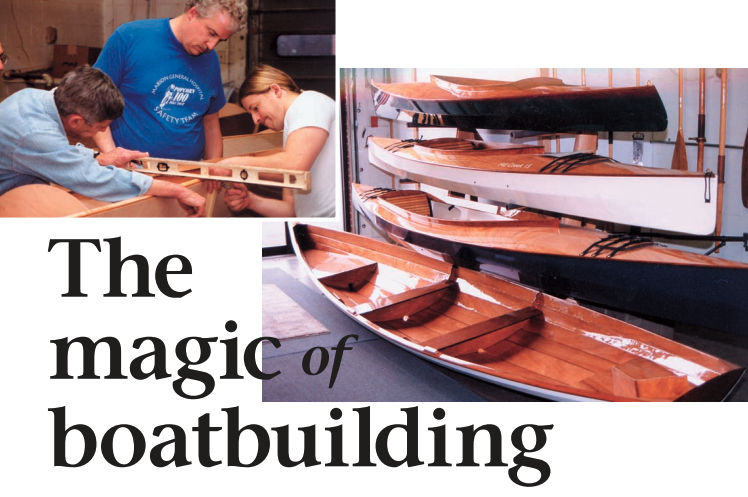
People have been building small wooden boats for eons in a process often shrouded in mystery. Steam boxes and molds for lapstrakes immediately come to mind. But with modern epoxies, high-quality plywood, and the advent of kits cut with computer accuracy, building a wooden boat has never been more popular or simpler.
Well, more popular, anyway. The simple part depends on your skill with tools (albeit minimal), your ability to follow directions and, perhaps most importantly, your patience. But building a small boat is no longer a black art, largely due to the efforts of Chesapeake Light Craft or CLC for short. As CLC president John Harris puts it, building a boat “isn’t witchcraft anymore.”
CLC was founded in 1991 in Chris Kulczycki’s basement. “The company started as a result of a series of magazine articles Chris wrote,” says John. “Chris was a journalist working for sailing magazines. He built a kayak for himself and wrote an article about it. He received such a huge response from readers asking for the kayak plans he decided to start a company selling them.
“He did that for a couple of years, and then people started asking for kits for the boats. In 1993, he started shipping kits. I came onboard in 1994 as a subcontractor building kits and joined the company as shop manager in 1995.”
Rapid growth
CLC’s kit business has grown to approximately 2,500 kits a year produced in its Annapolis, Md., facility. The company has expanded the product line along the way to include prams, canoes, dinghies, and small sailboats. “We realized we could do other boats besides kayaks,” John states. The new offerings caught on. CLC currently offers 29 kits, from a rowing shell to a wherry, with more models on the drawing board, many aimed at sailors.
John goes on to state the obvious: “We’re nuts about boats here. The people working here were drawn to CLC by an interest in boating and, more particularly, in wooden boatbuilding. They have a wide variety of backgrounds and talents, and we use it all. We’re lucky to have them. It’s a strange niche business we’re in. It’s a big sandbox here. We get to play with boats all day.”
John Harris himself is a good example of how CLC uses many talents. A music major in college, his avocation is performing as a jazz trombonist — as if playing with boats all day weren’t enough. If you buy the CLC video, The Zen of Wooden Kayak Building, for an entertaining peek into the process, John is the host and star of the show, which includes a trombone-playing clip. But his talents don’t stop there. He’s also the artist who draws the illustrations and schematics that grace the CLC catalog and website.
“I built my first boat at 14, a rowing shell,” he says. “I keep the bow of it here in the office for humility. The fit and finish were pretty awful. I eventually cut it up so no one would drown in it. I use that bow in talks today as an example of how not to build a boat. I got a lot better a lot faster after that. Later, I made a nice double-ender that was featured on WoodenBoat’s Launchings and Relaunching page. I was 16, and that was heavy stuff. I never looked back. I was building boats every chance I got all through college. I graduated with my music degree and went right into boatbuilding.”
Owns nine boats
In true CLC spirit, John admits to owning nine sailboats of varying styles and lengths. He readily ticks off the sailboats of other CLC employees as well. No doubt about it, these people are of and by the water.
It’s easy to spot that this company is nuts about wooden boats when you walk into the Annapolis showroom. Kayaks, canoes, and prams line the walls with customer testimonials and photos filling in the blank spaces. A fine layer of sawdust from adjacent production areas covers everything. The sweet perfume of wood greets the nose. It all blends in, alerting your senses to the special nature of what goes on at CLC.
“It’s become easier to build a wooden boat in the last 25 years,” says John. “In the 1960s if you built a wooden boat you had to use old plans from the 1930s, ’40s, or ’50s, and epoxy was largely unknown for this purpose. You would’ve had trouble getting the right supplies. The epoxies and high quality plywood available today make it possible for just about anybody to build a good-quality boat, especially with a good set of modern plans or a kit. I think that’s why people are more interested in trying it now.”
CLC uses a patented variation of the stitch-and-glue process called “LapStitch” to make some of their hulls. This process yields a hull with a lapstrake appearance and provides the builder with a way to have a very controlled jigging of the relationship between planks. The edge of one plank is milled to about half thickness in a complex curve that allows the mating plank to be precisely located against it.
The planks are then wire stitched together like conventional stitch-and-glue construction. The resulting hull shape can be very precisely created.
Controlled cutting
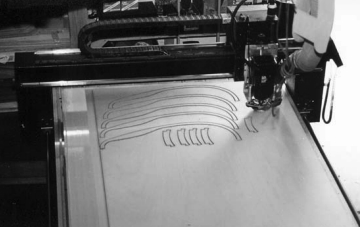
Several years ago, CLC spent $40,000 for a Computer Numerically Controlled (CNC) cutter, which is essentially a very large, computer-controlled router that cuts out preprogrammed parts. Previously, all parts were cut by hand using jigs or patterns, a time-consuming process that made it tough to keep up with demand. The CNC cutter is fast, and not only allows for very precise cuts, but also enables the various parts to be nested in a sheet of plywood, thereby reducing waste.
CLC also devised its own scarfing machine so kit builders don’t have to learn that difficult woodworking skill. The pre-scarfed parts make it a simple matter of gluing two pieces of plywood together with epoxy to make, for example, a 16-foot kayak from 8-foot-long sheets of plywood.
The kits come complete with everything the boatbuilder needs: plans, detailed instructions, epoxy, fiberglass, and fasteners. CLC ships them airfreight, usually in three cartons — a couple of them are rather large, so be prepared.
Even the plywood CLC uses is special. It’s okoume plywood, made in European mills from plantation-grown African mahogany. It’s marine-grade, made to a special British standard. This is not the case with cheaper plywoods sold in your neighborhood home center. Even exterior-grade plywood has voids.
Great lumber
“There’s a sense of craft with wood,” says John. “The wood we supply with the kits is the best wood you can find in the whole world. You can’t go to the local lumberyard or, in many cases, even a local cabinet shop and find wood of the quality we use. I like that part about building boats here — we always have some great lumber lying around.
“Once when I was in high school I needed a mast thwart for a sailboat I was building, but I was out of money and lumber. I needed 30 inches by 3 inches of clear wood. The basement of my parent’s house had rows of bookshelves with a lot of inherited books. I removed 30 inches’ worth of books and cut the piece I needed out of the middle of a shelf. I balanced the books back over the hole, and I had my piece of wood. My parents didn’t find the hole until they moved, and they immediately knew what had happened. I was out of college by then, so they couldn’t do a whole lot to me.”
According to John, “CLC started supplying kits almost right away to the WoodenBoat School in Maine for their classes. We work very closely with them. We’ve found that classes are a way to bring people into kit building a little sooner, especially if they’re unsure of their ability. We started holding classes ourselves here in Annapolis because they are a great outreach for our company.”
CLC also provides kits for boatbuilding classes held by the Alexandria (Virginia) Seaport Foundation, the San Francisco Maritime National Historic Park, the Mariner’s Museum (Newport News, Va.), the Lake Champlain Maritime Museum, and others.
“Probably 75 percent of our customers are first-time boatbuilders,” John says. “Word of mouth from our classes is huge. We bring folks into class, and they get off to a great start with their boats because they have an instructor available to help. They can take a week off to concentrate on the boat so the project isn’t spread out over 18 weeks at home. They can get at least 70 percent of it done in one week and just need some evenings or weekends at home to finish it. They get a big head start in class.”
Great experience
Bill Finnegan, a judge in Marion, Ohio, agrees with that assessment. He took a CLC class in Annapolis because “I had no woodworking experience at all. I had never even used a hand block or a sander. The class was a great experience, and I enjoyed it very much. Instructor and CLC production manager Bill Thomas was very patient. The things he pointed out were real helpful. I learned an awful lot from him. I could build another kit on my own now.”
Indeed, many students later buy other kits. For some, boatbuilding is a lot like eating potato chips — you can’t stop at one.
“We work really hard to make the classes universal in the skills people learn,” says John. “They learn to work with epoxy and with fiberglass — transferable skills they can use on a project on their big boat if they have one. It’s not just how to build a kayak.
“Our boats go to a wide range of people. A fellow named Brandon Nelson on the West Coast built a Chesapeake 18 and paddled it a thousand miles, all the way down the Baja — just a true adventure type. He was looking for the most boat for the least money, and one of our kits was a great way to do it.
“We also have retired guys who may or may not have worked with wood before, but have time on their hands. Building a boat is absorbing, challenging, and stimulating, so they’ll build a kayak. Maybe they don’t really like kayaking that much, so they’ll give it to the grandkids. Or they may advertise it in the paper and sell it.
“That’s one theme that seems to run through our funny little niche business . . . that half the fun of the whole project is building the boat. People may like using it, but they like building it just as much.”
Typical project
John Herr, of Mechanicsville, Md., is one CLC customer who built a Chesapeake 18 kayak at home, a process that took him “about seven months, but I was only working on it at nights and on weekends here and there.” His experience of taking several months to complete the project is probably typical of most people who build a kit at home.
He says, “It pays to take your time, to read the instructions, and to call CLC with questions or problems. I must have called them a half-dozen times. These guys are always there to answer your questions. They were great. And there also is nothing you can do to that boat that some epoxy won’t fix.”
He also provided CLC with comments on the manual, a process CLC invites to improve the instructions. Such customer feedback is invaluable to CLC and demonstrates how committed the company is to improving its offerings.
What lies ahead for CLC? “I think more and more people are going to discover that wooden boatbuilding is a fascinating life experience,” says John Harris. “It’s giving birth. You start with nothing more than a pile of wood and end up with a floating work of art. We can reach more people through classes and by offering more and different types of kits.
“We have a whole range of nice rowing and sailing boats coming out that will have lots of appeal, small rowing and sailing craft in particular. Right now about half of our business is in raw materials, too — fiberglass, epoxy, tools, and accessories. Most of our business now comes from the Internet, and that will only increase.”
Free information
In fact, all boatowners should visit the CLC website for information on working with varnish, paint, epoxy, and fiberglass, if nothing else <http://www.clcboats.com>. The site gets about 40,000 hits a day. “It’s just crammed with free information,” says John. “We have hundreds of pages of information on such topics as how to apply varnish, how to apply varnish over epoxy, how to apply marine polyurethane paints over epoxy, how to work with fiberglass. There’s lots of information there for everybody, not just kit builders.
“We have a strong presence in boat shows, mainly ones for canoes and kayaks, or for wooden boats. We also go to the Annapolis Sailboat Show because you see more and more of our kayaks on sailboats. It makes a lot of sense because they don’t take up much room, and they’re very light. Some of our wider ones are stable enough to get into and out of from a stern ladder.
“We’ll also be doing more prams and sailing boats in the next couple of years that can be used as dinghies.” CLC’s Eastport Pram is already a popular kit for sailboat owners to use as a dinghy. It’s also the simplest kit to build.
If you’re in the market for a dinghy, look at it this way. Instead of towing a piece of rubber or plastic behind your sailboat, you could be towing a work of art thanks to a CLC kit — and without a bunch of hocus-pocus.
Thank you to Sailrite Enterprises, Inc., for providing free access to back issues of Good Old Boat through intellectual property rights. Sailrite.com