This unique paint-stripping material won’t rip off your gelcoat
Issue 29 : Mar/Apr 2003
Chances are your boat has many years’ worth of paint on the bottom. Removing the paint buildup without ruining the substrate — wood, fiberglass gelcoat, aluminum, or steel — is a vexing problem.
For years, one method has been sandblasting. All blasting processes use pressurized air containing suspended particles that are projected onto a surface for the purpose of removing a coating. But recently a new variation of abrasive blasting has become popular with boaters: soda blasting. Instead of sand, baking soda, or sodium bicarbonate (NaHCO3), is used as the abrasive material. Although seemingly a bit bizarre, baking soda has many advantages over sand when removing bottom paint, especially on recreational boats.
Sodium bicarbonate is a unique blasting medium because its crystals are sharp, yet soft. When they hit a surface they fracture into smaller particles, intensifying the cleaning action. Abrasive particles that act in this manner are termed “friable.” This friable characteristic is especially effective in removing grease, dirt, and bottom paint without substantially affecting the boat’s hull. If the soda-blasting nozzle is aimed too long on one spot, gelcoat will eventually be worn through, of course, so the operator’s experience and technique are important. This blasting process produces a cleaner surface than other processes currently being used. After the surface has been washed of residue and neutralized, it’s ready to be painted.
Friendly and benign
Baking soda is environmentally friendly. With a benign pH of 8.2, the soda itself is water-soluble, biodegradable, nonflammable, non-toxic, and not hazardous to the health of the worker. (The coating being removed, however, can be very toxic and requires protective measures for the workers. Proper containment and waste disposal are also necessary).
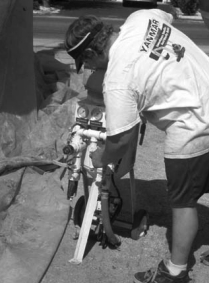
Although all baking sodas are chemically the same, the baking soda used for soda blasting is not your mother’s kitchen variety. There are over a dozen formulations of abrasive sodas available, depending on the application. The differences are mainly in particle size and uniformity, as well as the added ingredients for flowability and rinsability. These soda particles are delivered under relatively low pressure but at a high velocity that enables them to scour virtually any coating while softening the impact on the substrate.
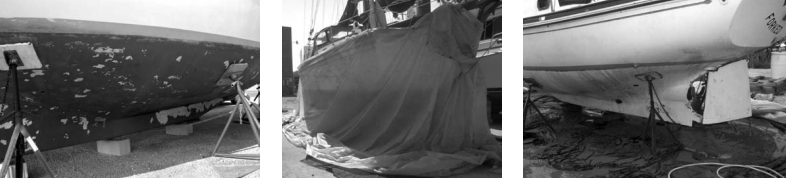
The blasting process begins with creating a tent around the boat. On the ground inside this tent is a tarpaulin to collect the residue — primarily bottom paint. The operator, dressed in a hazardous-materials suit with face mask and respirator, begins the blasting, which can take several hours for a sailboat with multiple layers of paint. Water is used with the blasting process to reduce the dust. After soda blasting, the boat is hosed down. It is then washed with a low-pH solution to neutralize the baking soda’s higher pH. This is followed by hosing or power spraying to remove the neutralizer. When dry, the hull is ready for painting.
The cost of the procedure runs in the neighborhood of $16 per foot of waterline length, plus the cost of each bag of baking soda used. The number of bags used will be determined by the number of layers and type of bottom paint being removed. For a boat with several years of accumulated paint, figure about a bag of soda for every 4 to 5 feet of waterline, at roughly $25 a bag.
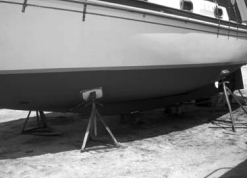
Don’t be surprised if your boat is sprightlier once the old bottom paint has been removed. The weight of paint removed can be in the hundreds of pounds. Powerboat owners report that their boats get up on a plane at much lower engine revolutions than before.
Thank you to Sailrite Enterprises, Inc., for providing free access to back issues of Good Old Boat through intellectual property rights. Sailrite.com