An expert tells how to pick the right stuff for the job

Issue 30 : May/Jun 2003
I’m going to suggest something that may sound a lot like the TV pitchman who promises miracles for only pennies. It is as simple as this: the biggest improvement you can make on your boat costs the least amount of money compared to almost any other project. I can all but guarantee that it will improve the safety, good looks, and possibly even the performance of your vessel, no matter what size or age. If I told you about a product that could do all this, I would probably have your attention.
The product I am describing is in a small bottle or tube, stuffed away in a dark corner of a remote locker on your boat. It is nothing more than one of the hundreds of inexpensive cleaning compounds available to you every day. In order to let the genie out of the bottle, it takes a little rubbing, a modest knowledge of how it works, and some of your time. However, like the salesman says, the most important thing is to act now.
The first step toward your boat’s transition to its old beauty is to learn how to choose the right cleaner from among the multitudes.
My education in learning about cleaners may be a good example. Like many of us who bought an older boat, I was driven to bring my sailboat back to life. She was sound, but needed a lot of tender loving care. In order to transform her, I had to learn how to clean and polish. Like few other possessions, boats require constant preventive maintenance. It simply must be done.
Like most of us who come to boats, I didn’t automatically know how to clean everything. I had to figure it out the hard way, learning through the tedious process of scrubbing and polishing without any clear idea of what I was doing. When I began, I bought a deck cleaning soap. It worked OK. Then someone told me about a biodegradable detergent called Sudbury Boat Zoap. It was remarkably better.
Next, I scrubbed at the tar and seagunk fouling my fenders, which had seen years of abuse and were so unsightly that I considered replacing them before my reputation was ruined. The marine store first recommended a popular fender cleaner. It failed to do more than smear the mess and ruin a good rag. Through trial and error, I finally discovered a tar remover in an automotive store that cleaned the fenders in minutes.
On and on it went. Reading labels provided minimal help. Most manufacturers gave no clue to the composition of their cleaning compounds except a warning if they contained toxic ingredients. Selection was pure chance. I never knew if I was using the best product or the worst. I found that high-priced marine products for cleaning, polishing, and renewing were often no better than supermarket staples like Fantastik and Windex.
On the other hand, I discovered some marine compounds that did what they promised and more. West Head Lube, for example, made my finicky toilet pump work like new.
In the course of bringing my boat back to civility, I devoured books on maintenance. Cleaning occasionally came up but was treated as a light-weight subject compared to engine repair, blister control, or rewiring. I searched for answers to my long list of cosmetic complaints: smudged fiberglass, scratches in the Lexan, mildewed fabric, faded woodwork, and the chaos of the bilge. I found some solutions in the popular boating books but almost never specific product recommendations.
With futility, I searched the shelves at marine stores looking for non-existent clues to selecting the best product. I learned slowly and often only through trial and error. Time and money were wasted as I narrowed down the choices. Finding the right product was frustrating, but with my background in chemistry, I took it further. What follows is a summary of what I learned.
Keep dirt off
The ultimate surface is the one that never has to be cleaned. But there are almost no surfaces that remain like new forever. All will tarnish, soil, corrode, or deteriorate in time. It’s a simple fact that dirt kept off the boat is dirt that doesn’t need to be cleaned. So, before we look at how to select the right cleaner, let’s consider some ways to prevent bringing dirt on board in the first place.
Place a welcome mat on the dock where you step aboard the boat. The fiber varieties will deteriorate quickly, but they offer a cheap way to keep dirt away. A square of Astroturf will work as well. Put a bathroom rug at the foot of the companionway to catch all inbound dirt and sand. And when you’re not actually sailing, take off your shoes when coming into the cabin.
Keep it dry and salt-free
Do everything you can to keep cushions, clothes, and sails dry and salt-free. Salt is a desiccant, meaning it absorbs and holds enormous amounts of water for an indefinite time. Once fabric is soaked with salt, it will almost never completely dry, as the salt continues to pick up water from the atmosphere.
Try to store sails dry and salt-free. On a calm, clear day when you can run the sails up at the dock, spray them with fresh water and let them dry in the sun. Racing sailors know that clean sails weigh considerably less than salt-encrusted canvas. Rinsing the sails has the added advantage of lowering the overall weight of their boats and will probably improve performance.
After an outing, rinse the deck with fresh water. Wipe the chrome and stainless with chamois. Get rid of the salt.
Water and fresh air
I can’t stress enough that the best, least expensive, and most readily available cleaner is fresh water. If their boats are kept in salt water, owners of well-maintained boats religiously wash down with fresh water after every trip. It is no accident that water is called the universal solvent. Often it is the safest and most effective cleaner available, though we tend to overlook it in the frenzied and expensive search for the magic cure.
Likewise, adequate ventilation is critical to creating a pleasant environment belowdecks. Get fresh air into closed areas as often as possible. Every few weeks, open all the lockers, floorboards, and lazarettes for an overnight airing. It will pay off in the long run by preventing bad smells, mold, and rot. But nothing can be kept clean, dry, or mold-free forever. Stains will appear on the hull. Birds will aim at the deck. Chrome will begin to pit. If left unattended, the value and safety of your boat will corrode as surely as neglected brass. The decision to bring fiberglass, sails, brightwork, and metal back to life is one-third of the battle. Selecting the right cleaner is next. A little elbow grease is last.
Selecting a cleaner
To begin with, it will be up to you to determine the severity of the soil problem. As an example, if all you have to do is clean surface dirt from fiberglass, a conventional boat soap like Boat Zoap will do an excellent job; if used as directed, it will not be so abrasive as to remove the polish or wax already protecting the surface. If there is moderate soiling, such as bird or spider droppings, scuff marks from street shoes, or waterline stains, a more robust cleaner will be required. Try Fantastik for spot cleaning and FSR for waterline scum. These cleaners will almost certainly remove wax or polish, so the protective wax or polish must be re-applied. Finally, in the most severe case we will consider, if the gelcoat itself has dulled or become chalky, you will have to literally rub away the topmost layer of the compromised gelcoat with an oxidation remover before protecting it with a wax or polish.
A few generalizations about the chemistry of cleaners are worth making. One of the determining factors in choosing a cleaner is the pH (the degree of acidity or alkalinity) of the product. A universally accepted scale has been established to classify the pH of chemicals. The scale runs from 1 (acid) to 14 (alkaline) with neutral products in the center at 7.
On the left side of the pH scale are the acid ingredients, such as oxalic, phosphoric, and hydrochloric acids, which, depending on their strength, run from 1 up to the neutral value of 7. The closer an acid gets to 1, the stronger its effect will be — and the more hazardous it will be to a user. Neutral or mild cleaners are in the middle at a pH near 7. The alkaline ingredients, such as chlorine (bleach), ammonia, and sodium hypochlorite fall between 7 and 14. The closer an alkali gets to 14, the stronger it is and the more hazardous it becomes.
A strong rust and stain remover like On & Off, which contains three different acids, will have a low pH and should be applied with protective gloves and glasses. A mild cleaner like Boat Zoap will fall in the neutral pH category. A degreaser will be on the alkaline side and should also be used with protective gloves and glasses.
Strong agents
Alkaline cleaners should not be allowed to dry in place. Rinse them off before they have a chance to dry. On the boat, you may well be cleaning a large surface area in direct sunlight without easy access to fresh water for rinsing, so be very careful.
Many heavy-duty household cleaners contain strong alkaline ingredients (such as lye or sodium hypochlorite) for their grease-cutting properties. They are intended for use on severely soiled household surfaces and, in general, are too harsh for surfaces on the boat, such as gelcoat.
Most of the high-powered stain cleaners, like On & Off, contain acids. In the marine environment, acidic cleaners are most effective on rust and waterline stains. Unlike alkaline products, acidic cleaners don’t have much effect on grime and oil.
Many specialized boat cleaners have a pH value near neutral to avoid the hazards associated with high acidic or alkali content. Some are distinctly acidic to remove rust and stains, and some are alkaline for cutting grease. Read the product labels and try to determine the specific intent of a product. Don’t just grab any cleaner at will.
Be aware that many marine cleaners are concentrated and should be diluted with water before use — don’t just pour the cleaner on a rag and wipe away. Read the label and follow the instructions. Quite often, a cleaner will do a better job if it’s left on the surface for a few minutes, but flush it away as soon as possible after it has done its work.
As a last resort, if you find an acid- or alkali-based cleaner is not doing the job, try an abrasive cleaner like Bar Keepers Friend or T. L. Sea Marine Cleanser. On surfaces that are deeply stained, tarnished, or oxidized, the finely abrasive ingredients in cleaners such as these will abrade away the stain. They will do no harm if used sparingly, but repeated, aggressive use of abrasives on fiberglass will wear away the gelcoat.
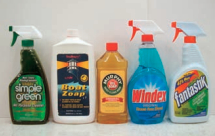
Cleaning compounds
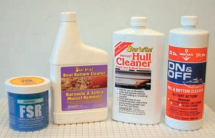
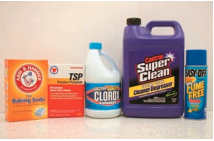
Though there are numerous types of commercial marine cleaning compounds, many other useful cleaners can be found at home. Look in your medicine or kitchen cabinets for everyday remedies such as rubbing alcohol, dish soap, bleach, and ammonia. In the kitchen you’ll probably find white vinegar, baking soda, salt, tea, and lemons.
These everyday natural products can often be used in place of brandname cleaners. Don’t overlook homebrew cleaners that have stood the test of time. Like the weather rhymes, home cures wouldn’t continue to be used if they didn’t actually work. Lemons aren’t plastered with promises like marine products but they often do the job just as well. For instance, you might try baking soda for cleaning any smooth surface. It is a mild, environmentally safe — yet effective — cleaner that has been used by professionals for years.
Marine products
Even as you discover effective natural and cheaper non-marine cleaning compounds, don’t forget that marine products are specifically designed to work in the harsh environment of salt, radical temperature change, and neglect. Most of these products are effective only if you follow the manufacturers’ directions. What separates one product from another is ease of application or longevity. If product A performs as well as product B but goes on more easily, it will become more popular. If product C lasts longer than product D, it will be a favorite.
Most of us stick with a product if we feel it does an adequate job. Complacent, we rarely find out if there is something better out there. It is human nature that we hesitate to try new products. Brand advertising was created to promote customer loyalty, and we seldom switch once we find a serviceable product. However, new and improved cleaners come onto the market on a regular basis. Try some of the products that are unfamiliar to you. Chances are you will find an improvement.
The fine print
Printed on the back of every product is a long list of instructions and cautions, often in the smallest print possible. Our tendency is to ignore the instructions and plunge right into the project. As I’ve said, most products do a decent job if they’re used as intended. Manufacturers always test their products and, in the process, determine how to obtain the best results. They want their products to succeed. Put on the reading glasses and pore over the fine print. It might make the job easier and will definitely make it more successful. Whenever you use commercial products, follow the label precautions exactly. For example, never mix cleaners containing ammonia and bleach. Harmful fumes can be created by the chemical reaction.
Specialized products
Single-purpose cleaners, advertised to do just one specific task, are sweeping the market. Products were once touted as being do-everything cleaners because they were capable of many cleaning jobs, but some companies are now expanding their lines by offering a whole slew of single-purpose cleaners to increase sales. Often there are only subtle differences among them; the intended result, apparently, is that buyers will fill their cabinets with half-used containers. This can be a problem if you postpone a chore because you don’t have the single-use product you were told was necessary for the particular job you’re tackling.
Putting off a job may mean forgetting it. Why wait to get a specialized product when a more generic cleaner would do the job just as well? There’s probably a product already on the boat that would suffice. For example, if there were no black-streak cleaner in the locker, you’d probably have success removing the streaks with ordinary boat soap. Solve this quandary by trying Windex or Boat Zoap.
Environmental concerns
The environmental impact of adding chemicals to the waste stream is a large and comprehensive subject beyond the scope of this article. However, it behooves us all to be aware of our relationship with the marine environment and to use chemical products responsibly. The careless use of cleaners can introduce harmful chemicals into our environment. Obviously we must exercise great caution with highly toxic products like acetone. Likewise, ingredients that are not toxic, but are highly disruptive to the natural environment, must be used carefully. For example, most manufacturers of cleaning products have stopped using phosphates because their excessive nutrients can trigger algae blooms and die-offs, upsetting entire ecosystems. Whenever possible, we should consider using “green” or biodegradable products — cleaners that will break down biologically into harmless byproducts. Responsible manufacturers are rapidly bringing more green cleaners to the market.
Government regulations aimed at producing environmentally friendly products continue to multiply. Some states, such as California, have established laws calling for more rigid labeling and information than the federal government requires. Thanks to legislation (notably the Clean Waters Act) and public concern about the environment, major steps have been taken through the Environmental Protection Agency and corresponding state agencies to minimize the impact of chemicals being introduced into our waste stream.
Marinas and ordinary gas stations have receptacles to collect waste oil and fuel. Batteries are returned to the manufacturer for disposal. The nozzles of fuel pumps are fitted with collars to capture fumes. Tributyltin, a highly toxic chemical, has been removed from most bottom paints. Many solvent-based paints are now manufactured with higher solid contents, which means that smaller amounts of toxic solvents evaporate as the paint dries. Manufacturers of cleaners have consistently moved toward biodegradable ingredients. All of this is progress, but it’s far from finished. Until the consumer refuses to purchase products that disrupt the environment, harmful chemicals will continue to be released into the waste stream.
Many of us assume that environmentally friendly products are less effective than their harsher counterparts — that using “green” products will always involve a tradeoff in effectiveness. This simply isn’t true. For example, Simple Green is a concentrated, powerful grease-buster that is nontoxic, noncorrosive, and biodegradable and contains no harsh chemicals. Even consumers for whom environmental impact is not the top priority should try some of the “green” products.
Go easy with harsh cleaners
It’s human nature to reach immediately for a product you know will clean anything. But why not try a gentler cleaner first? Being kind to your boat and the environment might mean taking a few extra minutes but it’s
worth it. Start with the mildest cleaner and work up to the stronger stuff only if necessary. As an example, begin cleaning dirty fiberglass with a gentle, environmentally safe cleaner like Boat Zoap. If this doesn’t do the job, move to a medium-grade stain remover like FSR. If all else fails, pull out Castrol Super Clean, your killer cleaner that can take the skin off an alligator. But save this as a last resort. You’ll be surprised how often a gentle cleaner will do the job.
Worth the trouble
Generally, homemade cleaners (like baking soda or lemons) are non-toxic and best from an environmental standpoint. They tend to be milder, less expensive, and friendlier to your health. Consider these remedies instead of powerful, harsh cleaners that will do the job easily but might damage the surface permanently. If used incorrectly, aggressive cleaners can sometimes etch the surface, allowing dirt and corrosion to adhere more easily the next time. For example, if alkaline household cleaners like Fantastik are allowed to dry on fiberglass, they may eventually etch the surface. When you use them, be certain to rinse thoroughly before they have a chance to dry.
Not all environmentally sound ingredients used in commercial products are completely innocuous. Some are, in fact, quite harsh or toxic. It is a well-known fact that lye can burn your skin or that ammonia will produce noxious fumes.
How safe are they?
Currently, it is nearly impossible for consumers to determine the health and safety effects of every cleaning compound on the market just by reading labels. This information is available, but the customer will rarely see it. The U.S. government requires manufacturers to file Material Safety Data Sheets (MSDS) that identify the major hazardous ingredients in each product. But it is unusual to find a retailer who will provide MSDS sheets. All a consumer has to go by is the primary hazardous ingredient nearly always identified on the label. However, the ingredient listed may not be the only unsafe or environmentally harmful agent; it may not even be the worst offender. Some lesser ingredient that falls below the government mandated minimum percentage level may not be listed though it may be environmentally unsafe. Current labeling regulations don’t give us a foolproof system, but they’re the only protection we have.
Rules to follow
Though your boat may show the ravages of the years, it is not difficult to have it look like new again. Follow a few simple rules: Keep it as clean as possible with frequent fresh water hose-downs. Determine the severity of the problem so you don’t indulge in overkill when cleaning. Learn a little about chemistry so that your choice of cleaners will give the best results. Read the label to help determine if the cleaner is designed for grease cutting or soil removal. And, finally, don’t overlook home remedies or environmentally correct cleaning products.
By following a few simple steps in selecting the right cleaner you can bring the lost sparkle and shine back to almost any boat.
Thank you to Sailrite Enterprises, Inc., for providing free access to back issues of Good Old Boat through intellectual property rights. Sailrite.com