South Pacific cruisers think smaller is smarter
Issue 30 : May/Jun 2003
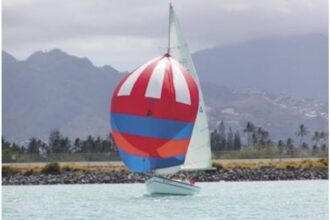
As I write this article we are anchored in the lovely bay of Taahuku on the island of Hiva Oa, having just completed a 24-day passage from Mazatlan, Mexico. My boat is a wonderful Ericson 39 flush-decked sloop. The passage here was easy, even relaxing at times, in direct contrast to buying the boat, outfitting her, and building up the cruising kitty . . . all of which were very difficult. If I were to do it all over again I would do it differently. I would buy a much smaller boat.
There is a saying among yacht brokers and almost everyone who looks forward to going cruising. The saying is: “Buy the biggest boat you can afford.” We whole-heartedly subscribed to this when we bought Pneuma. However, in hindsight (after cruising two years), instead of a 39- foot boat I would have selected something less than 32 feet.
When Melissa and I were looking for a sailboat in which to sail around the world, we saw many boats that we knew would take us anywhere . . . all beautiful 40-foot or larger yachts. They were way out of our price range. We knew that we needed a good older boat in solid condition.
We saw an ad in a Northwest regional boating magazine for a Seawind 31. I learned that it was not an Allied Seawind at all, but a locally built boat called a Seawind. That weekend we looked at the boat. It was in Bristol shape. The owner said he had recently purchased another boat, an Alajuela 38, and that he needed to sell the Seawind as soon as possible.
Crisping bread
We went back the next weekend to sail her. The owner spent most of the trip below in the galley crisping up bread for us to spread Brie on. We drank a bottle of wine and sailed along the Olympia waterfront. To say that the boat was a dream to sail might be an understatement. Every time I needed to make an adjustment to a sail, I would simply extend my hand, and there was the correct line. We brought her back into the dock and walked down to the owner’s other boat.
The Alajuela was gorgeous inside with teak everywhere and all the fit and finish one could want. He gave us the Cook’s tour and told us about the ample tankage and heavy displacement. The boat looked the part of the world cruiser, and we were impressed. We drank another bottle of wine and talked of his plans and ours. He spoke of buying the Alajuela and of trying to set a departure date for a world cruise. We spoke of our plans to buy a boat, live aboard, and head off when we had a big enough cruising kitty.
By the end of the evening, we were all discussing the amount of money that it took to go long-term cruising. He told us the price that he had just paid for the Alajuela and how many more years he was going to have to save to get away. I asked why he didn’t consider taking the Seawind. “Not big enough, and she only holds 30 gallons of water and 30 gallons of diesel,” he said.
Maintain her
As we were leaving he said, “I really can’t afford two boats, and I would like to sell her to someone who will
maintain her well; I would consider an offer less than $20,000.” Melissa and I drove home talking about the Seawind. While we were sure we could live aboard the beautiful little boat, we worried that it would mean buying another boat before we left to go cruising. After all, the little boat was too small, wasn’t it?
A year later we found and bought Pneuma, our Ericson 39. With some help from an unexpected windfall, it took us three years to pay off the boat and another two to build up a small cruising kitty. Our jobs paid well but were extremely frustrating and counter to our natural tendencies. The emotional toll of earning the money to pay for the boat and to put a little away for cruising was large. Even now the emotional issues created in those years haunt us.
When we arrived in Hiva Oa, we were greeted by crews of three boats that had left Mazatlan two weeks before we had. They were all in boats less than 30 feet long. All had wonderful passages, arriving in the Marquesas in about 30 days. We spoke at length, comparing passage notes as cruisers do. Their passages and the things that they encountered and had to deal with were very similar to ours. The wind was the same, the squalls had the same effects on the boats, and there were no differences in the problems adapting to watch schedules. The one difference seemed to be that when they had minor gear failures they had fixed them a lot more easily than we had fixed ours. Later in the week, a 24-foot boat came in. The sailor had come all the way from Denmark through the Panama Canal.
Everything possible
When most of us think of going cruising, we imagine 40- or 50-foot yachts fitted out with every possible piece of equipment. Bigger yachts can be more pretentious; they can speak of wealth and of place in society. But impressing people and going cruising are two different things.
We all think we are going to cruise forever. We picture ourselves out among the tropical islands with the wind in our hair and the surf sounds from the beach in our ears. Indeed there are people who continue cruising for all their days. But most cruises are three to five years in duration. When we think of the boat in terms of a three- to five-year commitment, are we looking for a posh floating condo or a nice sturdy vehicle to get us to exotic ports of call and places that few others have visited?
The bigger the boat, the more expensive it is to purchase. If your goal is to get out there and go cruising, then which boat is going to allow you to do it more quickly, the $150,000 45- footer or the smaller 27- to 32-footer that can be purchased for less than $30,000? By the time you have paid off the $150,000 boat, you could have been cruising in the $30,000 boat with a $120,000 cruising budget. Had we purchased the Seawind instead of the Ericson, we would have started cruising three years earlier than we did, with the same cruising kitty.
Have you ever noticed that the big boats spend more of their time tied to the dock than the little ones do? Look at the boats that are out on any weekend around where you live and sail. Are the majority 50-footers, or are there a lot more boats in the 25- to 35-foot range out on the water? There are a number of unavoidable reasons that the little boats are out sailing while the big boats are parked at the dock.
Heavier loads
It takes more effort to sail a big boat than it does to sail a little boat. The loads on the rigging are higher, and the strength needed to operate the boat is greater. Sails are heavier on the bigger boat and take more effort to move around and change. The anchor gear is heavier, necessitating specialized anchor windlasses and more time and effort when anchoring. It is often argued that on the bigger boat there is specialized gear to handle these higher loads. While this is true, each piece of equipment adds maintenance cost and time to the boat. A smaller boat needs less specialized equipment because less force is required to perform any specific function. This equates to less time needed for maintenance and less cost.
Melissa found it impossible to grind and tail at the same time when bringing in the genoa on our boat. In order to make sailing the boat safe, we felt we needed to purchase selftailing winches at a cost of more than $2,000. But when sailing on a friend’s 31-foot boat, Melissa never has a problem grinding and tailing.
Repairs and maintenance costs are less for smaller boats, often 20 percent of the cost of maintaining a bigger boat. Even a simple block for a 40-foot boat costs four times as much to replace as a block with the same function on a 30-footer. For the cost of replacing the genoa and mainsheets on a 40-foot boat, you could purchase the entire running rigging on a 29-foot boat.
My friends on a Vancouver 27 recently painted the bottom of their boat; it took less than a gallon of paint. It takes two gallons for the bottom of our 39-footer. Just in materials it cost me twice as much to paint mine. Friends on a 45-footer need three gallons to paint the bottom of theirs. One 7⁄16-inch Sta-Set X halyard on our boat costs roughly $120. A 5⁄16-inch halyard of Sta-Set X for the average 27-foot boat costs $45.
Specialized tools
In addition, repairs to bigger boats require bigger and more specialized tools that may not be available in small ports or at sea. The tools and spare parts for the larger boat are more expensive and larger to stow, taking up more storage space and costing more money that could be invested in the cruising kitty instead. It also takes more time to repair the larger gear than it does to repair the smaller gear. The time you save on maintenance could be time spent lazing on the beaches of paradise.
Insurance costs are a significant part of cruising for people with larger boats. A boat costing $200,000 represents a substantial amount of most people’s net worth, so to feel comfortable cruising with such an expensive boat to far-off, unfamiliar places, insurance seems to be a necessity. The smaller boat can be a much smaller investment, so an owner is less likely to feel the need to insure it. Another part of the insurance game is that if you need and purchase insurance, the insurance company can demand that you have more crew, or that you alter your cruising itinerary to fit the insurance company’s preferred risk profiles.
When we looked at boats, we were concerned about the tankage, comfort in a seaway, and living space. These were necessities for us, and we did not believe they could be met by the smaller boats we looked at. After cruising for more than 10,000 miles in the last two years, our opinion on each of these perceived shortcomings has changed.
Smaller boats often have tankage of about 35 gallons of water and a similar amount of fuel. With conservation, 35 gallons of water can suffice to make the longest passages of a circumnavigation. Every place that we have been so far while cruising has had potable water available.
Add a watermaker
Carrying water to and from the boat can be a time-consuming, labor-intensive task, however. Knowing also that conservation can be a difficult skill to acquire by those of us who are used to unlimited amounts of water coming out of a city-supplied tap, I would recommend the addition of a watermaker to the boat (see Good Old Boat, January 2003). Adding a watermaker to the smaller boat, one could cruise indefinitely without fear of running out of water or the need to conserve as much on water usage. A small watermaker with a capacity of three to five gallons an hour would easily meet the cruising needs of two people, with less than a couple of hours run time a day.
Fuel tankage is often limited to 35 gallons of internal tankage and perhaps an additional 12 or 18 gallons in jerry jugs lashed on deck or in the cockpit. Let’s assume that the smaller boat has a usable fuel capacity of 42 gallons. Smaller boats have smaller engines, which in turn use less fuel. Since it is easier to hoist and trim sails on a smaller boat than on a larger boat, smaller boats will sail even short distances between anchorages while bigger boats will choose to motor. This ability to sail more easily means that the smaller boats sail more often and use less fuel. Smaller boats with engines that burn less than half a gallon of diesel per hour with a cruising speed under power of about 4 knots would be able to motor about 300 miles with a conservative margin of safety. This is more than enough range to get safely in and out of harbor and to motor through periods of light air on most passages.
Even comfort in a seaway is more of a product of the configuration of the boat’s underbody and its interior layout than its size. Rolling is a product of the shape of the underbody of the boat, not the size of the boat. Round bottoms with shallow keels tend to roll more than flatter bottoms with deeper keels. There are boats of all sizes that roll badly and boats of all sizes that have comfortable motions in a seaway; smaller boats can be as comfortable as larger boats.
Easier to move
By the very fact that they are smaller, most small boats are easier to move about in while in a seaway. In smaller boats you have less distance to travel to complete a given task, more handholds are available, and should you fall or be thrown about the cabin, you have a shorter distance to build up momentum. Smaller boats also allow you to prop or wedge yourself into places more easily than larger boats do.
We have spent time on a number of smaller boats and have not found the smaller space available for living to be as much of an issue as we had thought. Most of the time below is spent either sitting or working in the galley. The need for comfortable seats and standing headroom in the galley does not eliminate the smaller cruising boat as an option; there are many that fit these criteria for most of us. Entertaining in most cruising situations occurs in the cockpit, not in the main cabin. Having a comfortable cockpit, with well-thought-out cushions and a small cockpit table will take care of most entertaining requirements.
The reasons so far that I have listed have focused on bluewater cruising. But coastal cruising offers even more reasons. Smaller boats are cheaper to dock than larger boats; they can anchor in shallower water and can sneak up smaller rivers to anchor closer to sites of interest or activities.
Perhaps the best reason for a smaller boat may be that you already own one. The boat you own is almost always a better boat to go cruising in than the one you are dreaming of buying. The boat you own now can be made ready to go and get you out there cruising a lot sooner than the lovely 63-footer down the dock that you have been eyeing for the past year. Smaller often means going cruising sooner and staying out longer. This means going to more places, seeing more things, and tasting more of the cruising life.
Thank you to Sailrite Enterprises, Inc., for providing free access to back issues of Good Old Boat through intellectual property rights. Sailrite.com