Why there will be no magnetic compasses for future generations
Issue 34: Jan/Feb 2004
AROUND A.D. 1090 THE CHINESE first reported the use of a magnetic needle to indicate north. This primitive compass was an iron needle, magnetized by a lodestone, inserted into a straw, and floated in a bowl of water. In Europe, the discovery of the magnetic compass didn’t occur until more than a century later, in the early 1200s, and historians don’t know whether this European discovery was independent or whether it came to them from the East.
The compass finally allowed 13th-century European mariners to determine direction, even under overcast skies or during stormy weather. It was such a simple device, with only one moving part, it seemed like magic. Many captains were afraid to use it. It was the age of the Inquisition, and sailors feared that if they were seen using this device they could be accused of witchcraft, which could result in torture or death. It wasn’t until nearly a century later, during the 1300s, that seamen could finally use the compass openly and without fear.
For the next 100 years, mariners believed the compass pointed to true north, but during the 1400s scientists determined that there was a difference between compass north and true north. Finally, in the 1590s, the Portuguese developed surprisingly accurate tables that showed the difference between true and magnetic north (variation) at various places on the globe.
In the 1600s, it was discovered that the magnetic poles changed location from year to year and that the intensity of the magnetic field also varied. Our concepts of a simple magnetic planet were beginning to change.
Magnets
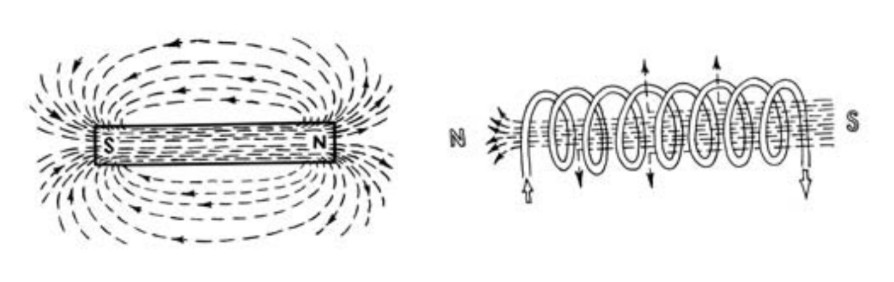
There are basically two types of magnets: a simple bar magnet and electromagnets, which are created by the flow of electricity.
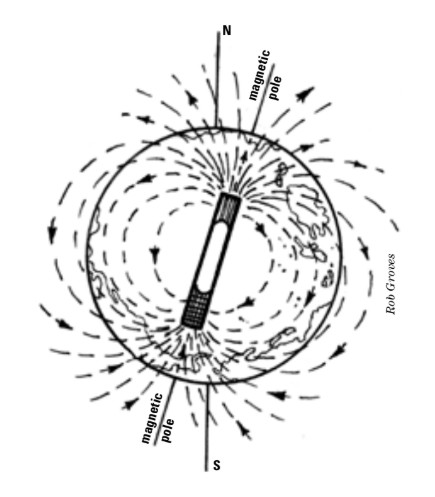
In nearly all representations of the Earth’s magnetic fi eld, the Earth’s magnet is represented as a simple bar magnet. In reality, the Earth’s magnetism is more closely related to that of an electromagnet.
The Earth’s magnetic fi eld is created in the molten iron in the Earth’s outer core, about 1,850 miles below the Earth’s surface. The Earth’s magnetic fi eld is produced by electrical currents that originate in this hot, liquid, outer core of the Earth, which is moving around the solid inner core and acting like a huge electromagnet. The field is influenced to some extent by the solar wind — those charged particles streaming from the sun.
Wandering poles
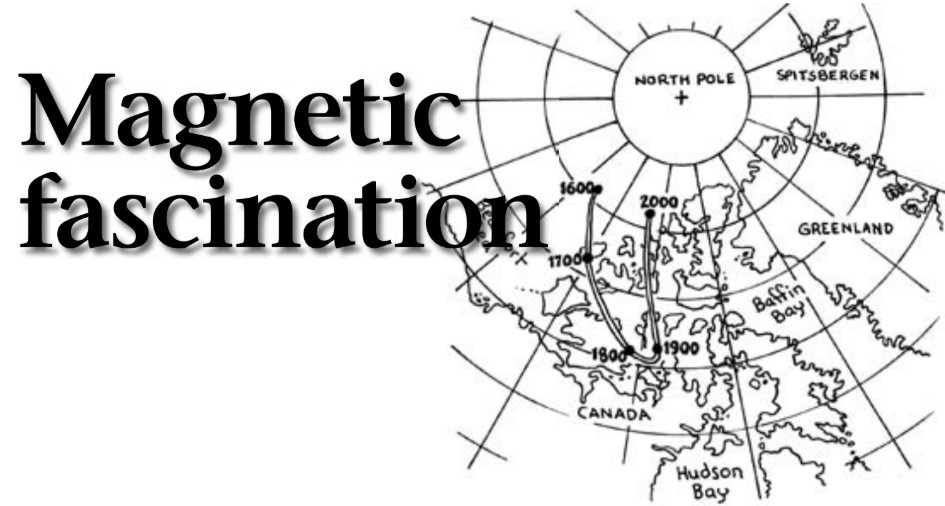
The magnetic north pole has been wandering around the polar regions for millions of years. By using data from the 1500s to the present, we see that during this relatively brief period in the history of the Earth, the magnetic north pole has made a trip from the Arctic Ocean into northern Canada north of Hudson Bay, and it is now on its way back to the Arctic Ocean at an average speed of about 10 to 15 miles per year. The magnetic north pole will probably be exiting Canada’s borders as early as 2004. This, however, is strictly a guess, and as Larry Newitt of the Geological Survey of Canada says, “Although it has been moving north or northwest for a hundred years, it is not going to continue in that direction forever. Its speed has increased considerably during the past 25 years, and it could just as easily decrease a few years from now.”
In addition to the long-term movement of the magnetic poles, there is also a daily (diurnal) movement of the poles. This daily movement of the poles roughly follows an elliptical path around the pole’s average position. Sometimes this daily movement follows the path of a very small ellipse and sometimes a very large one. This can cause the pole to move more than 100 miles during a 24-hour period. It’s believed that this diurnal movement is caused by the solar wind and that solar storms on the surface of the sun can cause a change in the size of this elliptical path.
To make things even more confusing, most scientific organizations, such as the American Geophysical Union, consider the term “magnetic pole” to be an oversimplified representation, and prefer to describe at least three different sets of poles, with the International Geomagnetic Reference Field (IGRF) Model Dip Pole as the closest to what most cartographers, and the public in general, refer to as the magnetic pole.
Variation and isogonic lines
The difference in angle between magnetic north and true north is called variation by mariners. In the scientific community this difference is often called magnetic declination or deviation. This is unfortunate since, for the sailor, deviation means something quite different.
Although the magnetic lines of force shown around simple magnets are smooth and regular, the magnetic lines of force around the Earth are extremely irregular, primarily due to the non-uniform distribution of magnetic material within the Earth. Those erratic lines that show the same variation are known as isogonic lines, and maps are available that show these lines worldwide. But these large-scale maps don’t show the many small irregularities existing locally that, in many cases, can be enormous. Off the Australian coast, for example, there is a position where, in the distance of two football fields, the compass changes by 90 degrees.
Reversing magnetism
There is another bizarre event that occurs with the magnetic poles. About every 250,000 years the poles reverse themselves — the north pole becomes the south pole and vice versa. During the last 5 million years, this has happened about 25 times. But it has been 780,000 years since this last happened, and a reversal is long overdue. However, since the timing of this reversal has always been erratic, it’s impossible to tell when it will happen again. Nevertheless, the planet’s magnetic field is showing signs of wanting to make the gigantic switch once more. The prelude to this changeover is the gradual weakening of the Earth’s magnetic field until it becomes zero. Results from measuring the Earth’s magnetic field in 1980 by the MAGSAT satellite and in 2000 from the Ørsted satellite show a reduction in strength is in progress. When the Earth finally becomes non-magnetic, it will remain that way for possibly several hundred years. Then the magnetism will begin to build up in the opposite direction. For the last 4,000 years, this weakening has continued to progress. Just in the past century, the strength of the magnetic field has decreased 5 percent, and scientists predict the Earth’s magnetic field will cease to exist in several hundred to a few thousand years — just an instant in geological time.
During the time when the Earth is non-magnetic, compasses will point nowhere in particular. They will be relegated to museums and children will ask their parents, in awe, “Was the Earth once really a magnet?”
Perhaps the many centuries it will take for this to happen will give migratory animals, such as birds, who make use of the Earth’s magnetic field, a new way to locate their seasonal destinations. And it’s probable that harmful radiation levels reaching the surface of the Earth will increase during this period, when the protection of the magnetic field surrounding the Earth has vanished.
The compass rose
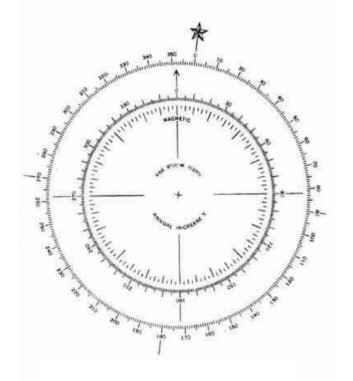
For the mariner, the nautical chart’s compass rose distills all this theoretical information into a convenient, simple, and usable form. The outer ring of the rose shows bearings to the true north pole — the axis of the Earth; the next inner ring of the rose shows magnetic bearings — the direction to the magnetic north pole; and on the inside ring is printed the variation, in degrees east or west, as well as annual predicted change in that variation — along with the date that this change was predicted. The yearly predicted change in variation is only applicable for a few years from the date shown since, as we have seen, the movement of the magnetic north pole is erratic and unpredictable in the long term.
Although it can be intimidating to reflect on all the changes that are taking place in our magnetic Earth, don’t throw away your compass yet. In our lifetime it will remain as our basic tool for non-electric navigation.
Thank you to Sailrite Enterprises, Inc., for providing free access to back issues of Good Old Boat through intellectual property rights. Sailrite.com