Down below, the weight wars are raging
Issue 31 : Jul/Aug 2003
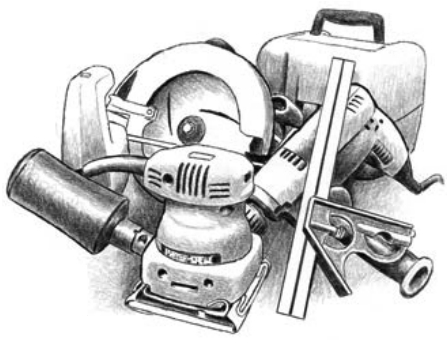
Aboard our cruising home, Siandra, battlelines are drawn. It starts innocently enough. Jamie announces his intention to buy one of those natty angle-drive battery drills. Handy for tight corners and will serve as a backup if our regular drill dies, he says.
“Sounds useful,” I say. “Which tool are you getting rid of to compensate for the extra weight?”
“Tool?” His eyes slide toward the groaning bookshelf. “I thought we could unload some of those books.”
“Huh? Forget it, chum. New tool on, old tool off — you know the routine.”
If it sounds too trivial for warfare, bear in mind that we’re talking about the entire belongings of two packrats, and a stowage area smaller than your average cupboard-under-the-stairs. No garage or spare room, remember. Furthermore, that bit of space under the stairs has to be shared with charts, sails, spare parts, and sufficient cruising gear to survive both in the tropics and above the Arctic Circle. And did I mention that this cupboard’s sinkable and doesn’t sail well if overladen?
Weight was the least of our worries as we prepared to leave Sydney, Australia, 10 years ago. After all, we didn’t own much compared to friends living in five-bedroom houses. And we’d need all those cans of food: we were about to cross an ocean. Those oddments of secondhand cruising gear from other family boats would surely come in handy. You never know when you’ll need a chart of Tonga — even if we were heading in the opposite direction.
Just afloat
Forty carloads later, the boat was still floating (just), but the crewmembers were tearing their hair out. Where on earth would we stow it all?
Our first passage was a shock. We were used to racing Siandra with barely enough equipment on board to make coffee. The thoroughbred had turned slug. Not only was she slow, but she sailed through waves instead of over them. Her boottopping was nowhere to be seen, and slime was growing up the topsides. At the first opportunity, we raised the antifouling paint six inches.
Since then, we’ve been on a mission to lighten the load. Some excesses are obvious: we bought so many dried beans before we left, we were eating them six years later. And 35 polo shirts between two people on a 35-foot boat is ridiculous. Then again, we’ve found a few canny ways to solve problems without specialized cruising gear, like using our bosun’s chair as a swim ladder (Good Old Boat, July 2001).
Inevitably, we’ve made mistakes. Everything has some value or it wouldn’t be on board. The question is: is it valuable enough? We voted no when it came to the garden hose. The damned thing had been coiled up in the quarter berth for as long as we could remember. A month after we threw it out, we needed a hose so badly we had to buy a new one. That hurt.
On balance, we’re getting lighter and smarter. If it weren’t for the tools and books, we could have the old girl leaping the waves like she used to.
It’s his fault
Jamie’s to blame, of course. He comes from a family of hoarders. His dad collects vintage sailboats, wacky chess sets, and thrift-store shirts. His brothers are into bronze boat hardware and tired BMWs. Jamie’s passion is tools. Not a bad one to have when cruising a wooden boat, especially when you earn your living as a shipwright. But surely there are limits?
Perhaps not. Veteran cruiser Lin Pardey once confided that she’d given Larry an ultimatum. Either he rid Taleisin of some redundant tools, or she would sort through the drawers and throw out anything he hadn’t used during the previous year. “Suddenly I found him tackling all kinds of obscure jobs,” she laughed. “And guess what? Every job required a tool from the very back of the drawer.”
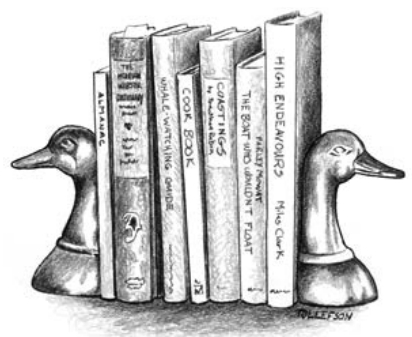
Now books are a different matter altogether. You need lots of books. How could we navigate without those cruising pilots and the almanac? The dictionaries and whale-watching guides are vital. We’d survive without the recipe books, although the grub would be grim. But how could we bear to give away Jonathan Raban’s Coasting or Miles Clark’s High Endeavours or Farley Mowat’s The Boat Who Wouldn’t Float . . . even if we have read each of them three times?
The final arbiter has to be the boat. All tools are stowed on the port side, all books and paperwork to starboard. The simplest way to resolve the battle is to hop in the dinghy and check out which way the old girl is listing.
Hmmm . . . well, OK. Could anyone use a well-thumbed, much-loved copy of High Endeavours?
Thank you to Sailrite Enterprises, Inc., for providing free access to back issues of Good Old Boat through intellectual property rights. Sailrite.com