The short course — the first in a series of overview articles for those who want just the big picture
Issue 31 : Jul/Aug 2003
Two thousand years ago, during the age of the Roman Empire, weights were molded from lead to replace the stone tied to a string that had been used previously to measure depths off the side of a ship. This lead line was one of the first navigational instruments and remained relatively unchanged for two millennia. It was the only method of measuring depth until the late 1930s.
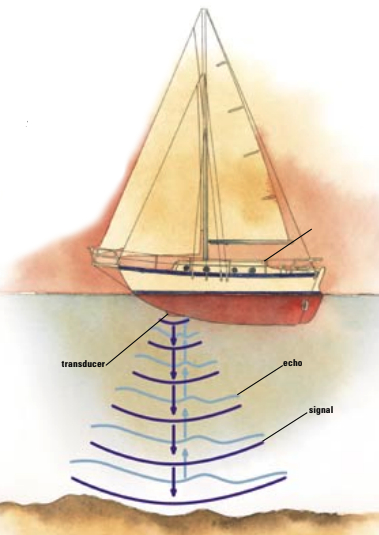
In the 1920s, someone got the brilliant idea of measuring depth by using an echo from the sea bottom. The first attempt was by firing a cartridge into the water on one side of the ship and listening for that sound and the return echo on the other side of the ship. But, since sound travels about four times as fast in water as it does in air, the echo, which returned in milliseconds, was too short a time to measure with the relatively crude technology of that decade. At 24 feet, the sound would be returned in a hundredth of a second.
It wasn’t until the late 1930s, when electronics was progressing by leaps and bounds, that echo depth sounding became practical, using an electrical phenomenon known as the piezoelectric effect.
The piezoelectric effect was first discovered in 1880 by scientists Pierre and Jacques Curie. They discovered that if you take certain crystalline substances, such as quartz, put a metal plate on each side of it, and apply a voltage to these metal plates, the crystal physically changes shape. Now, if you put this mechanism under water and hit those electric plates with a sudden, short, high voltage, the crystal changes shape so suddenly that it creates an underwater sound. This sound could then be used to replicate the crude method of firing a cartridge into the water that was used in the 1920s experiment.
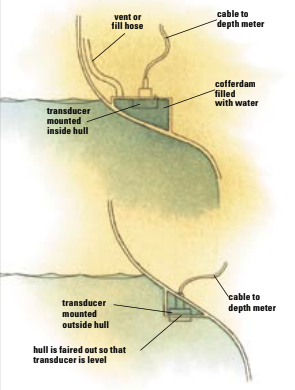
This same quartz crystal also works similarly in the reverse direction. If you put pressure on this crystal, a voltage is developed between the two plates, and if tension is applied to the crystal, an opposite voltage is developed. Using this reverse technology, the quartz crystal can be used to receive the return sound (a pressure-wave), which strikes it and creates a voltage. By measuring the time difference between the sound initiated by applying the sudden voltage between the crystal’s two plates and the voltage generated when the return sound strikes the crystal — and knowing how fast sound travels in water — the depth of the water can be determined. A device that can change energy from one system to another — in this case from electrical energy to sound and vice versa — is known as a transducer. Although the same crystal can be used to generate and receive the sound waves, in some applications two separate crystals are used.
The problem is that this transducer can pick up other sounds, such as the boat’s hull striking the waves or the sound of the engine. To eliminate these unwanted sounds, the voltage impressed on the crystal is via short bursts of a specific frequency (usually ultrasonic). In the reception mode, the receiver is tuned to receive only this same reflected specific frequency, excluding all other un-wanted sounds.
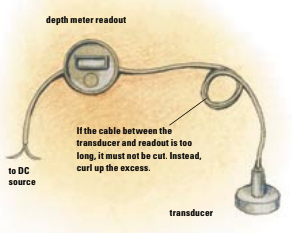
The sound radiated into the water is in the shape of a cone. This shape is determined by the frequency of the pulsed signal and the physical characteristics of the transducer. The area of the bottom covered by the cone is a function of depth. A reflection occurs whenever the sound strikes a boundary whose propagation characteristics are different from those of the water into which the sound was transmitted.
Although much of the early experimentation was done with quartz crystals, other crystalline substances are now generally used for the transducer.
So now we have a system for measuring depth that is just as accurate as the lead line — or do we? Sound travels faster as the transmission medium becomes denser. So sound travels about four times faster in water than in air — about 4,800 feet per second. But there are varying densities of water. If you measure a depth using an echo sounder in the Great Lakes and then measure that same depth off the New England coast, you’ll get two different readings. Since the salt water of the Atlantic is denser than the fresh water of the Great Lakes, the sound will travel faster, the return time will be shorter, and the depth finder will indicate a shallower depth. Similarly, if you measure the same depth in the Gulf of Mexico, there will be yet a third reading because the Gulf of Mexico has lower salinity than the waters off New England. So there is always some difference between the actual depth and the depth indicated. Although these differences are relatively minor, often bathymetric depth measurements are still being done by the most accurate method — the 2,000-year-old lead line.
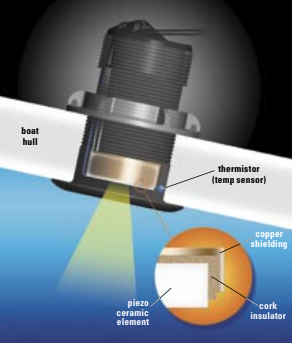
Other factors can also affect the accuracy of the echo depth sounder, such as seaweed or grass, a soft mud bottom, a school of fish or plankton, or a thermocline (a horizontal interface between cold and warm water). Also, since the sound pulses are propagated down in the shape of a cone, the first reflected sound will be interpreted as the depth beneath the boat, when these reflections may actually be coming from objects at the edge of the cone. Another source of error is the heel of a sailboat or rolling of the boat, which causes the transmission cone to become canted. Compensation must also be made for how deep the transducer is below the surface of the water.
However, the modern depth sounder is much more user-friendly than the old lead line and is now the instrument of choice on modern sailboats.
Thank you to Sailrite Enterprises, Inc., for providing free access to back issues of Good Old Boat through intellectual property rights. Sailrite.com