It was one of those endeavors that go beyond financial reckoning
Issue 31 : Jul/Aug 2003
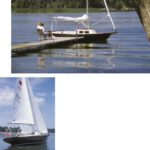
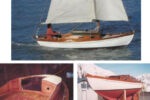
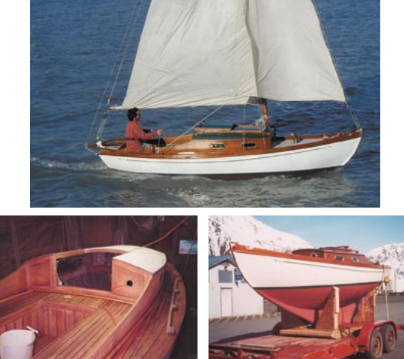
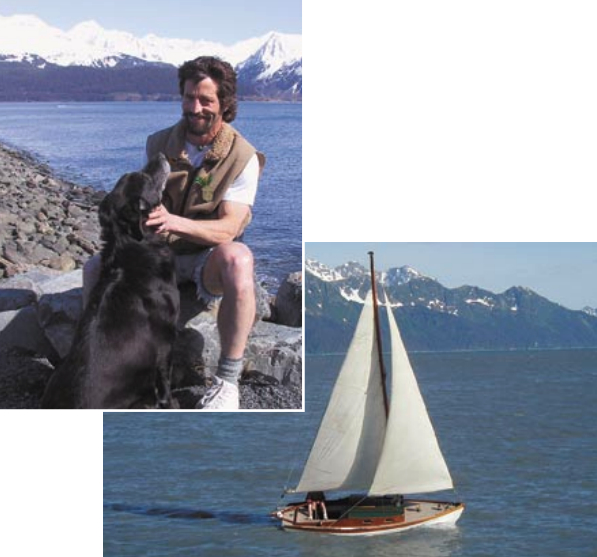
Teak ladies are heavy-displacement cruisers, 17 feet long with a 6-foot beam. This petite cruiser tips the scales at 2 tons. Esmarelda is Teak Lady hull #26, commissioned in 1958. She somehow made her way to Seward, Alaska, where Drake Diteman bought her from Cornelia Daley in 1989. Drake restored her until time pressures caused him to sell her. Esmarelda was eventually forgotten.
I first noticed this charming little boat in 1998, neglected at her slip. The bronze portholes, brass ventilators, spruce spars, and teak decking all showed that she had been formed by excellent craftsmen. On each occasion that I visited the little boat, I fully expected to see her spar sticking out of the water. Fortunately, that did not happen.
Doug Olson bought Esmarelda in the autumn of 2000. He came to Seward from Aspen, Colorado, where he had spent time designing and building snowboards between bouts of being a ski bum. In Alaska, he began doing finish carpentry with a particular interest in boat joinery work.
His first challenge was to evict a family of river otters that had taken up residence in Esmarelda’s cabin.
The first encounter ended in a stalemate. The angry otters hissed and advanced on Doug, forcing him to the end of the dock.
Next, Doug arranged for some shop space with Drake Diteman. Drake was astonished to see the little boat show up at his doorstep once again. He would be an invaluable help and source of advice throughout this project.
The mast was lifted out from the dock gangway while Esmarelda floated below. Doug then devised a plywood cradle mounted on 6 x 6 beams that sat on a 20-foot flatbed trailer to move Esmarelda to the shop.
Scraping and priming
The task of restoring a very dilapidated Teak Lady to her former state began. Doug spent two days scraping the hull and then primed it for eventual painting with sign paint. Then he stripped all the hardware, coamings, and trim. He removed the canvas covering from the cabinroof. The bronze slotted screws holding the coamings in place resisted impact hammers and all other attempts at removal. He resorted to a Sawzall with a metal blade to slice the screws where the coaming meets the deck.
As he became immersed in this project, Doug would find himself hard at work until 2 a.m. some mornings, unaware of where the time had gone. He has more than 1,000 hours invested in Esmarelda. Drake was beginning to suspect that his friend was obsessed.
Doug removed more than 600 screws from the teak decking and made a Plexiglas template to allow the use of an offset router to rout the gap between the teak planks on deck. This was followed by inserting cotton caulking that was first spun between the fingers and then pulled tight. The cotton was then forced into the gaps with a Plexiglas wheel Doug made for the purpose. The edges of the planks were then cleaned with alcohol-soaked rags to remove the oils in the teak. He used blue tape to protect the teak planks so that TDS (Teak Decking System) could be caulked in.
Around this time, Doug admits, he began to consider selling Esmarelda. The project seemed to be taking much longer than expected. Fortunately, no takers could be found.
He used Irish felt on the cabinroof. This was, in turn, covered with 10-pound duck canvas. The canvas was stretched and fastened along the edges with bronze wedge tacks into predrilled holes. The canvas was then primed and painted.
Split in two
The Sitka spruce mast had partially delaminated. Doug wrapped wet rags around the remaining part of the mast until it, too, had delaminated. The mast was hollow and in symmetrical halves. He sanded, cleaned, and dried it. The interior of the mast was sound, with no signs of rot. However, delamination had caused the two half cylinders to be slightly sprung. Doug used more than 40 clamps on the seam to draw the mast halves back into true. Slow-cure epoxy and lots of blue tape kept them together.
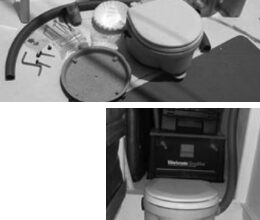
I sold Doug an old Yanmar 8-hp engine. He made a plywood mockup of the engine to help fit it into the tiny hold. He bolted aluminum stock to the Yanmar engine mounts and lowered the engine, with aluminum stock attached, into position. He lag-bolted the aluminum stock to the existing engine bed.
Was it worth it?
A nominal rate of $20 per hour, Doug’s investment of 1,000 hours in this project makes this a $20,000 boat. Factor in the cost of teak, epoxy, canvas, fasteners, paint, and miscellaneous other parts. It will be hard to recover this in hard cash. But the grin on Doug’s face when he brings Esmarelda about on a series of short tacks up the harbor is a million-dollar grin if ever I saw one.
Bean counters will no doubt weep with despair, but I believe some endeavors go beyond financial reckoning. The restoration of Esmarelda to a state of grace was a defining moment in Doug’s life. What price could be placed on that?
The rest of us surely benefit from the opportunity to admire a creature such as Esmarelda and to be amazed at the skill and perseverance of a man like Doug Olson.
Thank you to Sailrite Enterprises, Inc., for providing free access to back issues of Good Old Boat through intellectual property rights. Sailrite.com