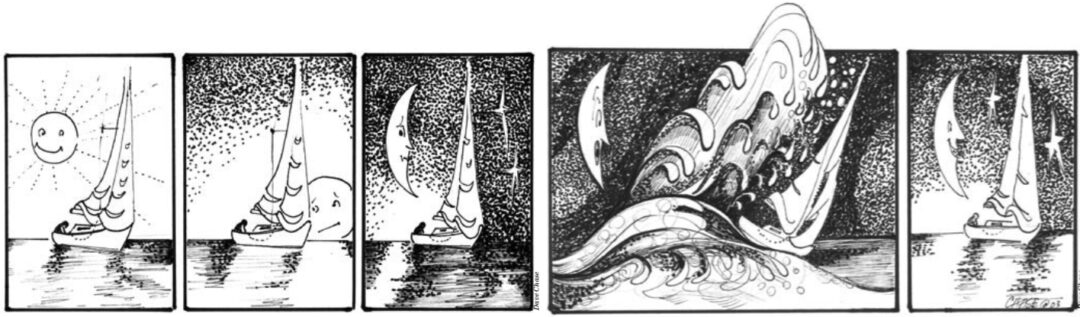
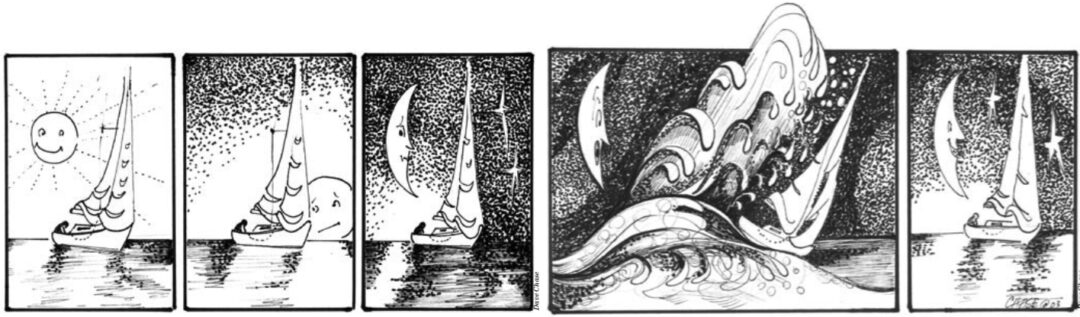
What was it that struck in the dead calm of the night?
Issue 31 : Jul/Aug 2003
We were about 500 miles south and a little west of Bermuda, midway on a delivery trip from the United States to the Virgin Islands, smack dab in the middle of the doldrums. To say that it had been a slow sailing day was an understatement — we were dead in the water.
The complete lack of wind, coupled with a broken alternator belt and its missing replacement, meant that we were engaged in a drifting race with the sargassum weed and losing badly. The vane on the Aries self-steering gear had taken on a bewildered “search me?” air as it lay slumped to port, as if to say that it had no idea of what had become of the wind that had blown so steadily since leaving the North Carolinia coast.
The main and the big genny were up, trying heroically to capture any passing zephyr, but the folds were deep and long in the Dacron as they hung straight down, unable to get up the energy to support even themselves. The only positive thing was that the sea was inordinately quiet, without even enough motion to drive that annoying “whump!” of sailcloth battling to balance ballast. The sea was still, the earth was flat, and we were the only thing in sight.
Earlier in the day, Dennis had taken a sun sight and, as Barry and I gathered in the cockpit for sundown socials, he started to fiddle with Venus. The sunset was incredible, with the puffy tropical clouds glowing rosily in the dying rays of the day. With the sea so still and the light just right, the horizon was extremely well defined, and Den was exulting in his ability to kiss the stars with his sextant. As Barry and I sipped soft drinks and worked our way through a can of peanuts, he danced around the cockpit, shooting the stars as they appeared, peering down from the warm blanket of darkness that quickly enveloped us. Below, the stereo softly sang.
Five-minute sinking
A can of nuts has a habit of evaporating once the lid has been removed, and Barry and I performed an experiment. As the last limb of the sun slipped behind the world, we dropped the empty can overboard, and with Dennis’ stopwatch, timed how long we were able to see it. For well over five minutes we watched each flip as it sank below us, sending back just a little less light through the crystalline pelagic water. It had a motion similar to a fishing lure; I kept waiting for the ghostly silhouette of a shark to interrupt the progress of science. Laissez-Faire was so still, we were able to monitor our research from our seats in the cockpit.
After a while, Barry went forward to adjust something on the foredeck, while I stayed in the cockpit “on watch,” and Dennis finished up his sight reductions down below. A few minutes later he came on deck with the announcement that we had just set a new record for the trip: nearly seven miles sailed in just over eight hours. Shortly thereafter, I left the two of them in the cockpit, prognosticating over the duration of the trip at that speed and went below to sleep a bit before my midnight-to-four watch.
When I returned a few minutes before midnight, Barry was snoring away below, and Dennis’ boredom had become an entity unto itself. Nothing had changed except that we were pointing northeastward, toward home, with the rudder hard over to starboard, and the Aries vane still perpetually slumped to port. As I climbed up the ladder, Dennis quoted, “Sighted nothing, reporting same!” I told him he’d been working on that one for far too long. “If that’s the way you’re going to behave,” I said, “we’ll turn this boat around right now and go home!” His haste in leaving the cockpit should have prepared me for what was to come.
Dragging hours
The first hour wasn’t too bad, except it seemed to be three. I may have been responsible for its passing, mentally forcing the hands of my Timex around the dial. It’s surprising how a little forward motion seems to carry your thought processes along with it, how the thoughts and ideas slip by like bubbles in the wake of the boat’s passing. Even a little motion gives you a goal to chase as you try to tweak that last little bit of speed out of the sails, by hand steering or trimming the sheets. Being becalmed is like being a kid again, banished to a corner where you know the whole world is still going on around you, and you can’t be a part of it. It’s one of those instances where time takes on a dimension even Einstein couldn’t fathom.
The problem was that I had nothing to do. I had prowled the boat three times in the first hour. Nothing was out of place or needed attending to. Dennis had seen to that. I couldn’t read, as the moon hadn’t risen yet, and the stars were obscured just enough not to cast enough light. With the alternator belt broken, we weren’t running the lights to conserve the batteries. We felt safe enough. We hadn’t seen a ship for days and were off the beaten path, so we weren’t particularly concerned about being seen until we could see something. The idea of colliding with something was definitely not a concern at the rate we were not moving. At that point, I think I would have almost welcomed one of those semi-submerged containers you keep reading about — I would have taken the opportunity to moor Laissez alongside and gone for a walk.
Temptation wins
The idea first crept into my mind sometime early in the first hour, but I quickly put it right out again, or tried to. Like temptations and character flaws, bad ideas creep silently into the front stage of your mind, where they begin to speak softly and eloquently, try as you might to drag them back to the wings. Man is ultimately a weak animal, and force of will isn’t as well implanted into the genetic code as, say, the desire to breathe. Confront me long enough with the last cookie or one more beer and, like most people, I’ll eventually succumb.
Aboard Laissez, down in the galley, we had a neat little timer. It was small and had a pleasant little tone to let you know when the time was up. It could time things from a minute to a day. Its cheery face and big numbers were easy to set, easy to read, and easy to fit into the palm of my hand. It was also easy to reach from the cockpit.
I also knew, from previous experience, that the designers at Camper & Nicholsons had built Laissez’ bridge deck with me in mind. It was just the right length and just the right width. With the dodger up, I could be as comfortable stretched out there as I would be in my own bunk.
I struggled valiantly, but in the end the gremlins of temptation were too much for me. Reaching below, I found that cute little clock. With the battle of wills over, I took a last long look at the boat, a long look at the horizon, and then looked again. Finally, I stretched out on the deck, propped my head on the coaming, and set the alarm for 15 minutes. Aries, keeping his thoughts about the matter to himself, looked on with his permanent shrug.
Really just resting
My inner voice wasn’t at all convinced that this was the right thing to be doing, that I could just as adequately protect myself and those below, innocent in their slumber, in a horizontal position as in a vertical one. I answered the little voice that I wasn’t sleeping, I was just “resting.” After all, hadn’t I opened my eyes at least 10 times before the alarm sounded? And hadn’t I thoroughly checked things out, both before and after the alarm rang? At the end of the first interval, the only thing that had changed was that the earth was a quarter of an hour closer to sunrise.
At the end of six cycles, my outer voice was spinning smug little “I told you so” circles around my inner voice, which was grumpily reminding me that it’s just inherently wrong to be sleeping on watch, when there was a roar louder than words, louder than any freight train caught in an earthquake, shaking the whole boat!
I lept to my feet and was met by a wall of water, coming over the starboard rail! Instantly drenched, instantly awake, I looked a hundred directions at once for the approach of the end of the world.
It never came. There was no ship looming clifflike, about to smash Laissez into a billion pieces, death churning at its bow. There was no squall line, a mass of clouds blacker than the inside of a witch’s heart, swallowing the horizon. There was no giant squid, tentacles twining about the rigging like some denizen of a Jules Verne fantasy. There was nothing. Nothing but Laissez-Faire, quiet on an empty sea, and me, standing in utter disbelief, unequivocally dripping in a puddle in the middle of the cockpit, with a pulse rate racing into triple digits.
Hiding the mystery
One of the marvelous things about the sea is that she can hide her mysteries instantly, and she hides them so well, giving them up only to the greatest of efforts on the part of the discoverer, and only then if she wills it. Standing there, soaked to the skin, starting to shiver from more than just cold, my numbed senses were useless to explain my condition — all clues had disappeared in the instant before my eyes opened. I could see no excited tracings of plankton in the water, hear no sound of blowing or splashing that might indicate the passing of a whale. Neither Barry or Dennis were standing there, bucket in hand, grinning and saying, “There, now, let that be a lesson to you.” Despite our location, I didn’t have even the dubious pleasure of the company of a little green man standing behind the wheel, promising fame and fortune in the supermarket tabloids. What I did have was a set of wet clothes and a serious case of confusion.
Decidedly awake now, with my heartbeat returning to near normal levels, I eventually slipped into the cabin for dry clothes and a warm Pepsi to settle my nerves. I literally slipped below, sliding in a puddle at the foot of the ladder. With fresh shorts and a towel through my hair, I climbed back on deck and sat out the rest of my watch and part of Barry’s, scanning the water around the boat for help in easing my confusion. Hours later, with the late rising of the moon and the first rays of the dawn, the wind finally started to fill in, and soon we were footing our way slowly south again.
Ever since, I have found myself searching the surface of the sea, seeking insight into what awakened me that night. Part of me, the logical left-brain side, knows what it must have been, knows all the standard answers. But my inner voice keeps asking, “What was it? What was it, really?” Since then, I’ve never been tempted to sleep on watch, and to the end of my days, I’ll wonder what I might have seen had I stayed awake one night in the middle of a quiet sea.
Even today, years and other ocean passages later, there is still a mysterious, magical quality about sailing at night that intrigues me. When sailing with friends, I usually tell a sea story, softly, after the sun has gone down and there is that luminous quality to the sky, when the pen-and-ink water is reflecting its mysteries back to the Technicolor of the sky.
Thank you to Sailrite Enterprises, Inc., for providing free access to back issues of Good Old Boat through intellectual property rights. Sailrite.com