Successful cruising means knowing what you don’t need
Issue 34: Jan/Feb 2004
TWENTY YEARS AGO, FITTING OUT A boat for cruising was less complicated because products such as solar panels, 12-volt refrigerators, inverters, navigational electronics, and communication systems were scarce — not to mention pricey, compared to the actual cost of the boat. When the era of electronics and electrical appliances was relatively young, it was easy to make do without these “newfangled items.”
Nowadays, the glut of advertised goods can make us feel old-fashioned unless we load our hybrid boats with all the latest and greatest. It’s human nature to want just a teensy bit more than we already have or can afford. This attitude is what the marketing gurus count on. Lately, it is also human nature to expect around-the-clock comfort and convenience. On a boat, catering to comfort is where it starts getting expensive. If the dream to go cruising is ripe but the budget is rotten, sacrifices are inevitable.
What saddens me is hearing tales of financial woe from folks who want to go cruising, but have given up on their dreams because they believe that fitting out a boat is too expensive. Well, fitting out a boat can get expensive — if you let it. The truth is, the magical cruising lifestyle is no different from a shore-based lifestyle; to ultimately succeed requires spending within your means and being happy about it. The hard part is having to suppress how you’d prefer to be doing things.
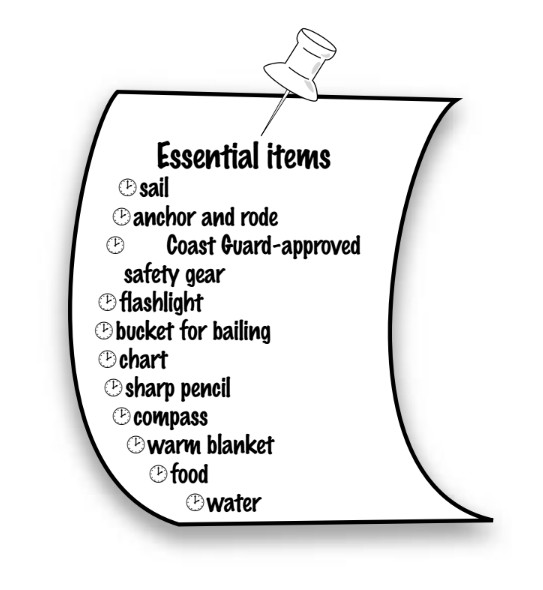
So what does one actually need for a successful cruise? That depends on the individual. Assuming the hull of my boat is sound — and by that I mean predictably watertight — here is a list of essential items needed to get me cruising:
A sail, an anchor and rode, Coast Guard-approved safety gear, a flashlight, a bucket for bailing, a chart, a sharp pencil, a compass, a warm blanket, food, and water.
My boat is now ready for cruising. Everything else I might think of is not essential. Period. All right, this is a sparse list, but it’s important to understand the bottom line.
Most of us will want a tad more gear than what is on this list. However, instead of wondering what gear should be added, ask this: What gear can be ignored? The following guide highlights some of the non-essential gear (expensive stuff you can live without) that is taken for granted on most cruising boats today.
Electronics
In this age of electronic overabundance, if there were just one 12-volt navigational system I was allowed to bring along, it would be a basic depth sounder. Knowing the depth at a glance is a valuable aid for piloting and safe anchoring. GPS would be my next choice. It not only gives an accurate position, it also renders the knotmeter obsolete. And if I have GPS, I really don’t need radar. Radar is a luxury item. An autopilot is another luxury item that can be avoided if money is scarce. A VHF radio is handy for receiving weather bulletins and calling for information or assistance.
Refrigeration
This is one of the most expensive luxury items of cruising. A well-insulated refrigerator robs a boat interior of valuable storage space, and trying to keep up with the power demand can be expensive. A successful refrigerator power system usually requires high-amp-hour batteries with a complicated regulator sparked by a big alternator. There is no greater waste of an engine’s horsepower than to use it to spin an alternator on a daily basis to charge batteries — all for the sake of cold food and drinks. And unless one has a good working knowledge of refrigeration, paying for repairs will be costly.
Solar panels and wind generators
Solar panels are my first choice for charging batteries because they are quiet, do not have moving parts, and don’t require fossil fuels for operation. They are maintenance-free. Although solar panels are great for basic onboard energy demands (lights and electronics), they often fall short when trying to keep up with refrigeration.
Wind generators pack more amps, but they have moving parts and require maintenance. Some models are extremely loud. The last thing I want when I’m on my boat is to listen to superfluous noise. A paradox with wind generators is they need wind, but the definition of a good anchorage is one without wind.
Hard vs. inflatable dinghies
Inflatables are expensive. They have a relatively short lifespan in the tropics, and they are difficult to repair. It’s not a good idea to drag them over barnacle-covered rocks and up coral-encrusted beaches or to tie them to splintery pilings. They don’t tow well, and they are challenging — if not impossible — to row. More often than not they require an engine. Outboard engines are expensive to buy and operate, and they require a long list of spare parts for maintenance.
A hard dinghy, on the other hand, is relatively cheap (especially if home-built), and a good design can be easily rowed, towed, or sailed. A hard dinghy without an engine provides exercise. Getting around in a hard dinghy takes longer, compared to zooming around in an engine-driven inflatable, but what are you going to do with all that extra time? Repair something? An engineless hard dinghy is also less likely to be stolen.
Anchors
Most boats are pathetically under-anchored. This is somewhat understandable because the weather, for the most part, is relatively benign. But all it takes is one storm to send a boat dragging onto the beach or into another boat. As soon as your boat bumps into anything but water, a repair bill is the likely result. Think of a big anchor as cheap insurance.
Often I see advertisements for anchors that are relatively light, but tout the holding power of a heavier anchor. The advantage is they are easier to deploy and retrieve. Isn’t that a contradiction? I want my anchor to be difficult to retrieve. That means it’s doing its job. Regardless of what the manufacturers advise, you can’t go wrong with a large heap of metal at the end of your rode. Here’s a good rule of thumb for all anchor types: for light-displacement boats, one pound of anchor per foot of boat length; for heavy-displacement boats, one pound-and-a-half of anchor per foot of boat length. When people tell me that my anchor is too big, I know I am on the right track.
Anchor windlasses
Electric windlasses are convenient, but they require huge amounts of 12-volt power. If the boat loses power, the electric windlass is useless. Now that you have a big anchor, it will be heavy work to retrieve it. A manual windlass embodies self-sufficiency and reliability. I wouldn’t install a windlass at all on a boat less than 28 feet in length.
Self-tailing winches
Ordinary winches cost less and work just as well. Dollar for dollar, I would rather buy a bigger winch than a smaller one that self-tails.
Sails and rigging
Sails and rigging should follow the same worst-case psychology as anchors. Best to err on the stout side, especially if the cruising itinerary includes offshore sailing.
A flimsy, running backstay-dependent rig has no place on a cruising boat. A sailboat’s gear should be capable of handling a 40-knot line squall under full sail. If a boat is caught out and the sails get blown to pieces before they can be doused or if the rigging snaps, the boat and the crew might be in grave jeopardy. Also, it is quite a job to replace a mast that has fallen down.
Cockpit cushions
I’m astounded at how much money can be spent on custom-made, closed-cell foam cockpit cushions. They look nice, but I can get equally comfortable results by going to a sporting-goods store, buying sleeping-bag pads or closed-cell pool floats, and cutting them into squares.
Upholstery
Cabin upholstery can also cost a fortune. Fortunately, sewing is not very complicated. A trick I use when making cushion covers is to use semi-lightweight fabrics that an ordinary sewing machine can cope with. I don’t care if my friends think my cushions look homemade; it makes my boat more homey.
Deck canvas
I can usually find Sunbrella cloth at a well-stocked yardage store. Seconds- quality material is often thinner but it works well and is easier to sew — especially with an ordinary machine.
Pressurized freshwater systems
Foot or hand pumps work well, are less complicated, and don’t require 12-volt electricity. Most importantly, however, manual pumps save water.
Watermakers
Reverse-osmosis desalinators are power-hungry luxury items right up there on the list with refrigeration. When cruising in regions where water is scarce or tainted, a sailor has to be water conscious. Even if fresh water costs 25 cents a gallon to buy, it is cheaper than buying a watermaker and coping with power demands and maintenance.
Shorepower
Marine-quality shorepower cables and related fixtures can be expensive. I use an ordinary extension cord and snake it down the companionway. Cheap and effective. Actually, if I need shorepower on a regular basis, it means I am spending too much time in marinas.
To spend or not to spend?
When I do make a gear purchase for my boat, I would rather spend a little extra and buy a quality product. I know this contradicts my observation about the high cost of gear discouraging folks from going cruising, but I would rather have a few choice pieces of gear than a boatload of second-rate liabilities.
Purchasing cheaper stuff may allow me to start my cruise with more hard cash, but cheap stuff tends to wear out or break when it is least convenient to replace or fi x it, or when I am least able to afford it. If I have to replace a cheap item, it means that I have actually bought the same piece of gear twice. Worse yet, if it fails during a storm or while I am maneuvering, my life might even be in jeopardy.
Marine gear is like any other type of equipment — you get what you pay for. Quality gear usually looks the part; it is pleasing to the eye. I get suspicious when something is out of proportion or painted a weird color. Why would a manufacturer invest in a product that’s funny-looking? For the most part, I stick with dependable brand names.
Before purchasing a mechanical item I consider whether it will enhance my self-sufficiency or merely hinder it. If the piece of equipment has to be taken somewhere for repairs (everything that has moving parts eventually wears out), then I am no longer self-sufficient. Even if a product has a great warranty, it doesn’t help me if the item breaks when I am mid-ocean, in a remote anchorage, or in transit on a foreign shore. I like gear that I can take apart and fi x myself. Many products offer spares or rebuild kits and come with schematic instruction manuals. There is no worse feeling than relying on equipment that fails and then not being able to do anything about it.
For my wife, Jaja, and me, a boat and its gear are essentially a means to an end. The basic premise for our cruising is to feel free and to shed some of the material weight typical of shoreside living. Cruising is all about picking up the anchor and experiencing the thrill of being under way, meeting people, and sharing experiences. We have learned that onboard whistles and bells can enhance our cruising experience, but they don’t automatically buy the feeling. In fact, the feeling is the thing money can’t buy.
Thank you to Sailrite Enterprises, Inc., for providing free access to back issues of Good Old Boat through intellectual property rights. Sailrite.com