An eminent naval architect looks at variations on a theme
Issue 31 : Jul/Aug 2003
In the good old days of wooden yachts and iron men, it was widely accepted that no sailing yacht under 30 feet could have standing headroom or four berths. That was perhaps a bit restrictive, but we did enjoy our two-berth, sitting-headroom, 25-foot Folkboats in the 1950s and often wondered how anyone could ask for more. If you wanted a four-berth cruiser, you made sure the cockpit was long enough to sleep two guests under a boom tent.
Then, with the advent of fiberglass in the 1960s, boatbuilding became big business. Madison Avenue got into the act, and advertising put the emphasis on headroom and the number of berths. So now we see 25-footers with full headroom and six berths. As a result of this emphasis on sleeping a mob, far too many of today’s small yachts have an excess of berths and a great lack of amenities. They would be better cruisers — except perhaps for chartering to a school band — if one or two berths were given over to a larger galley, a decent wet locker, better stowage, or any of the other comforts that make cruising more relaxed and pleasurable.
Generally, one berth for each six feet of length is the maximum that can be stuffed into a boat without sacrificing too many other desirable features. Yet I’ve seen 22-footers with five berths but no decent head compartment, a galley fit only for making sandwiches, no wet locker, and the under-seat stowage in the all-too-short cockpit given over to unnecessary quarter berths. You can cruise four or five people aboard such a boat, but would you want to?
Comfort and stowage
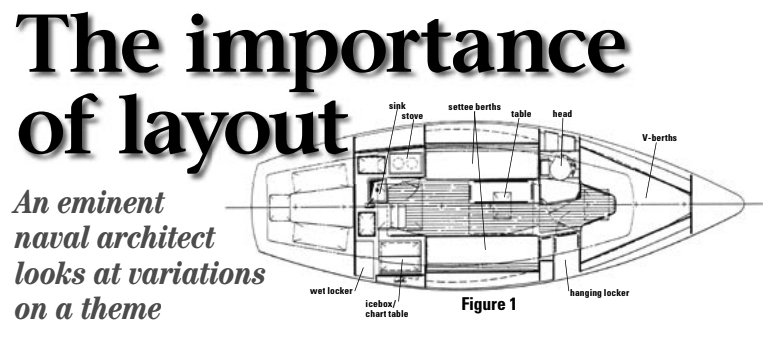
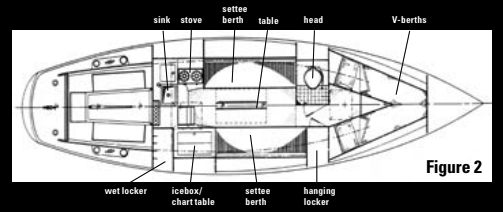
The standard small (27- to 32-foot) boat layout for years had two V-berths forward, followed by a small head compartment with lockers opposite, the saloon amidships with settee berths port and starboard, and the galley aft, usually with the icebox across from the stove and doubling as the nav table. This was pretty much de rigeur from the earliest small production fiberglass cruiser, the 28-foot Triton, right up to the time when the waterlines became longer and the beam greater. Figure 1 shows a typical 27-footer with all the essentials. The 22-foot 6-inch LWL Douglas 31 arrangement (Figure 2) is another example of that old standard, bearing in mind that the narrower and long-ended, short-waterline boats of the 1960s were not the roomiest things afloat. The 27 and 31 have two features that were common to many yachts in those days, a large icebox that does double duty as a stand-up chart table and a good-sized wet locker for foul-weather gear.
Not far from land
The icebox/chart table still makes sense for most small cruisers, as few of them ever get very far out of sight of land. As a result, the typical chart table is often a cockpit seat, and the usual instructions from the navigator to the helmsman are along the lines of, “Head for the point of that island just off the port bow.” A dedicated sitdown chart table is not essential for most summer-vacation, coastal-cruising voyages and eats up a great deal of stowage space that is better given over to more important things. Indeed, the sit-down chart table is not necessary on larger yachts either. Three of my designs, a 52-foot yawl, a 53-foot motorsailer, and a 58-foot ketch, had stand-up chart tables at the owners’ requests. Those owners were very experienced sailors with thousands of miles of ocean passages behind them.
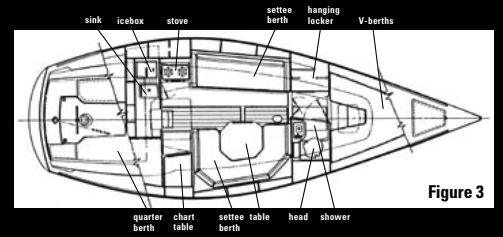
A six-berth layout that has been ruined by the desire to squeeze in a sit-down chart table and quarter berth is shown in Figure 3. There is no wet locker and, when you look at the galley, you’ll see that, with a pot simmering on the stove, it’s almost impossible to get anything out of that tiny icebox without risking a serious burn. Indeed, it has to be difficult to get at anything in the bottom of the icebox at any time — and almost impossible to clean it. It must have been terribly frustrating for the cook. It would seem that the designer of the 30-footer’s interior never did much small boat cruising, but he must have been a super navigator.
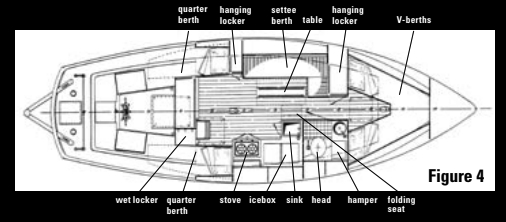
In Figure 4 we see an unusual layout that works reasonably well on this chunky 32-footer. She’s slightly beamier but only a foot longer on the LWL than Figure 2, yet features a very large cockpit, four permanent berths, a better head, and a roomy galley. There’s no chart table but she was not designed for ocean passages so the cabin table will suffice for most coastal navigating, and she still has a useful lazarette plus two modest cockpit sail bins.
Excludes sail bin
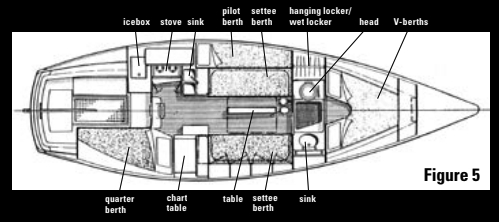
The 31-footer in Figure 5 features lots of berths and a sit-down chart table. However, one of the major problems of her sit-down chart table/quarter berth plan is that it wipes out the starboard cockpit sail bin, and the same can be said for many of the contemporary wide-sterned cruiser layouts with their “private” double-berth aft cabins. With only one sail bin and no lazarette in this six-berth “bluewater cruiser,” where in the world do you store all the gear that I’ve shown on the equipment list on Page 17, most of which is essential on a weekend vacation cruise as well as on an ocean passage? The reader may also note that, as in Figure 3, the icebox may be inaccessible when needed most, and neither interior boasts a proper wet locker. Presumably, the dripping foul weather gear will be dragged through the cabin and stowed in the head. How very convenient!
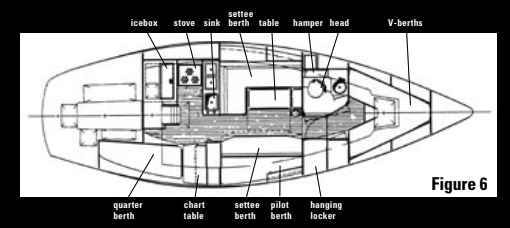
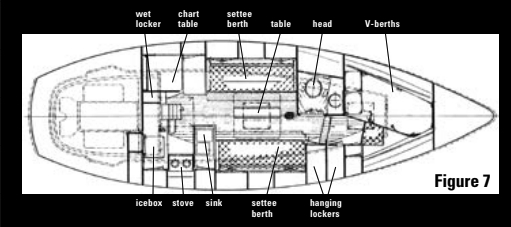
In Figures 6 and 7 we see two 33-footers with very different approaches. Figure 6 features four permanent
berths with a quarter berth/chart table and an excellent U-shaped galley. Also the pilot berth above the starboard settee is very handy at sea, as it gets the sleeper out of the bouncy V-berths. The four-berth layout in Figure 7 has a large sit-down nav area without a quarter berth. But the double forward berth, while nice in harbor, may not be the best solution at sea, depending on the crew. This boat could well use a pilot berth and is beamy enough to handle it.
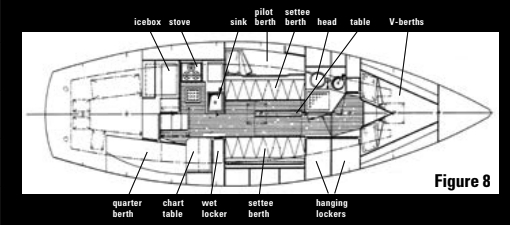
Two of the 35-foot cruisers, as in Figure 8, have made circumnavigations, so the layout is proven workable. The wet locker has been moved just forward of the chart table and the pilot berth eliminates the problem of sleeping in the bouncy V-berths in heavy seas offshore. The lazarette access is tight on each side of the tiller but can be widened to good advantage if wheel steering is fitted.
Useful layout
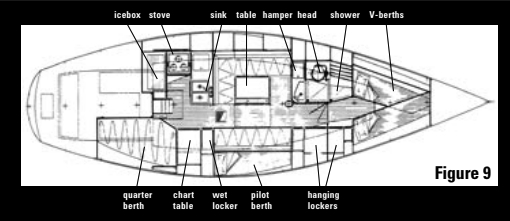
The boat in Figure 9, a 38-footer, has what I feel is a very useful layout for a yacht of her size. However, the over/under forward berths are not everyone’s cup of tea, and a normal V-berth is standard. The stall shower is, perhaps, an unnecessary convenience but was certainly well accepted, and about 500 of this design were built. Again, the pilot berth and the wide quarter berth provide good sea berths while the roomy galley with its double sinks is the delight of many a seagoing chef. The sail bin and lazarette volume is reasonable, although full-length seats, rather than the T-shaped cockpit, would be my choice for added stowage. You can never have too much!
None of the foregoing layouts is perfect, of course. I have used them to illustrate the trends as well as what I consider to be good and bad features in interior design of the typical aft-cockpit yacht. I deplore the layouts in many contemporary craft that fit jammy little dog kennels in the stern and call them “private staterooms.” The owner who needs that much privacy probably has the wrong crew aboard and, in any case, the privacy given by a thin plywood panel is purely illusory.
When you get down to it, the essentials on any yacht, regardless of size, are comfortable sea berths; friendly off-watch seating; a useful head; a workable galley; good access to the engine, stuffing box, and steering gear; and stowage, stowage, stowage for everything.
Thank you to Sailrite Enterprises, Inc., for providing free access to back issues of Good Old Boat through intellectual property rights. Sailrite.com