This famed designer of ocean cruisers is the son of a son of a sailor

Issue 31 : Jul/Aug 2003
Do you ever wonder what goes through a yacht designer’s mind while reading a review of one of his boats? If you’re Bill Crealock, it’s often this: “I’m always pleased,” he says with a smile, “when a reviewer says one of my boats must have been designed by someone who spent some time at sea.”
There’s a reason for this pleasure. Boats have played an important part in three generations of the Crealock family. Bill also spent the better part of his 20s cruising the Atlantic and Pacific oceans at a time when almost no one else was out there. Who better to design a boat for long-range cruising than a man with salt water in his genes, one who had “been there and done that” long before world cruising was fashionable?
William Ion Belton Crealock was born in Essex County in the southeast corner of England. What year he won’t say. His father and grandfather had both grown up sailing small boats, so it was only natural for him and his brother to do the same.
“From the beginning, as little kids, we were always sailing small boats or making play boats wherever there was water,” he says. “I always knew I wanted something to do with the sea when I grew up. I thought about the navy as a career, but those big ships didn’t interest me much. My brother chose that as a career. Because I liked drawing boats as a kid, my father suggested that I look into designing. That was the beginning.”
In the early 1940s Bill entered Scotland’s Glasgow University, which at the time “was the Mecca for people from around the world who wanted to go into ship design and building.
“It made for a fascinating naval architecture class with people from China, Turkey, and Poland, among others. I spent two years there but realized I could never study yacht design there because at that time there was no such thing as a degree in yacht naval architecture.”
Bill soon found a small college in Glasgow that offered evening classes in yacht design, but it didn’t offer a degree. He took evening classes there and during the day began a five-year apprenticeship in a ship-design office. He spent those five years working on designs for large, steel merchant ships, “which was a little boring,” as he puts it. Contrary to working one’s way up the ladder of success, Bill found it more to his liking “to work my way down to a firm that designed smaller commercial vessels.” It was closer to his true love of yacht design.
Retire early
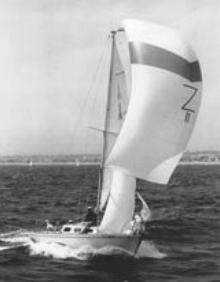
Then the cruising bug bit Bill in a big way. He found three other young men of like mind, and the four of them decided to take to the sea. He says, “The four of us decided the time to retire is in your twenties. Otherwise, what was the point of working all your life and being too old to go sailing?”
The group sold all their possessions and pooled their money, having just enough to buy a wooden, 40-foot gaff-rigged cutter called Content. They set out from England in the summer of 1948 with no particular destination, figuring they had enough money to last a year. “We thought that by the end of a year we could find a way of earning money en route to keep us going into the Pacific. We also were doing a series of articles for a magazine in England, and that brought in some funds.”
For the next two-and-a-half years, the quartet sailed the Atlantic, spending as much time as they pleased wherever they touched port. Says Bill with his typical self-deprecating humor, “The magazine went bankrupt, no doubt as a result of our articles, and it was that money that was to take us across the Pacific. We did have some money waiting in New York from National Geographic for photographs of ours they had published, so we went up there.”
But it was in New York that the quartet, still close friends, set off in different directions. Two returned home to England and a third stayed in the United States to get married. Bill hadn’t had enough of the cruising life and was able to join a couple as crew on their boat, a husky, 69-foot wooden ketch, just before they set off for the South Pacific from Panama. According to Bill, “We went through the Pacific in leisurely fashion and ended up in Tahiti. I finally figured it was time I returned home, so I took passage on a ship to England via France.” Bill later chronicled these voyages in two books called Vagabonding Under Sail and Cloud of Islands. (Both are now out of print, but Mark Busta at Good Old Boat specializes in finding used and out-of-print books. Just call or email. –Ed.)
He spent a year living aboard a boat in England and returned to the States (as the only passenger aboard a small freighter) to visit the married member of the original quartet who was living in California. Just before he was to return to England, fate again stepped in to set up the next chapter of Bill’s life.
Meet in six months
He met a wealthy gentleman who made the following offer: “My doctor tells me I must take off three months from work each year or possibly die.”That man wanted to use this time to pursue his hobby of shell-collecting by setting up a foundation to study seashells. He asked Bill to find a suitable vessel, locate an amateur crew, and meet him in the Western Pacific “in six months from this date, and I’ll pay all costs with a little extra for pocket money.”
Bill found a 105-foot steel schooner, redid the deck and rig, rounded up a crew, and off they went just two hours after the last shroud was in place. They were less than eight hours late for the appointment with their benefactor in the Western Pacific. The group spent a year exploring that part of the world, from New Guinea to Japan. The only misadventure was a huge typhoon off the coast of Japan, in which the ship lost its wooden mainmast. They made it to Japan under jury rig and secured a new metal mast very cheaply because, as luck would have it, the Emperor was a shell-collector. “All very interesting, but a trifle damp,” is the way Bill puts it.
Bill returned to California with every intention of heading back to England. But once again, fate intervened: “Someone asked me to do some design work, and one thing led to another. I opened an office in Newport Beach in 1958.”
Bill’s first designs in California were in wood. “What I did was design boats at night,” he says, “and during the day I worked in a boatyard to find out how boats were built in California. When fiberglass came along, I gradually got into designing fiberglass production boats. I didn’t specify a lamination schedule in the early days because the builders knew more about that material than I did. Gradually, we all formulated our ideas of what was required, applying engineering to it for stiffness and strength. Even Lloyd’s Rules were feeling their way and watching the experience of builders.”
His first production fiberglass designs in California were for Columbia Yachts, but his first successful racing design was a 26-footer for Excalibur Yachts. “It was a little different from the other boats of that era,” he says. “The keel was a different shape, the lines aft were relatively fine, and it did well in racing. One year on Long Island Sound they called it ‘The Year of the Sword’ because the Excalibur had done so well.”
First in Costa Rica
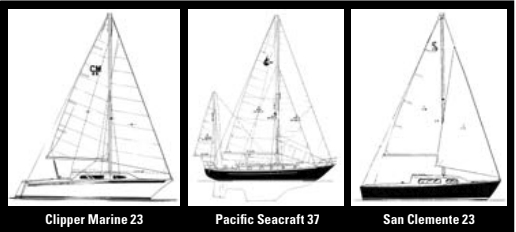
Bill designed for many of the early West Coast boatbuilders, including Westsail, Clipper Marine, Ericson, Islander, and other smaller companies. He also designed boats for Cabo Rico, which were the first boats built in Costa Rica. “They produce an excellently built go-anywhere cruising boat,” he says.
According to Bill, “I was working on a larger design for Excalibur Yachts when they went bankrupt, which was not unusual. The real trouble in those days was that boatbuilding was, for the most part, a backyard business that grew very quickly. It sometimes wasn’t very efficient, however.”
Alas, as many builders have discovered down through the years, building boats has never been the path to riches, despite the apparent romance of a boat under sail.
Early on, Bill had another collaboration on a design that would help establish his name in yacht-design circles. “In those days [early 1970s] there was no real production cruising boat,” he says. “Then a fellow who had been building a wooden 32-footer came and asked me if I thought there would be a market for a fiberglass version of it. I said he just might sell a dozen, and I helped him convert the design to fiberglass. We kept the underwater lines unchanged because it was a William Atkin design based on a Colin Archer boat. I modified the rig, gave it a new interior, and that became the Westsail 32. Eventually they built 700 of them. It was a market no one had suspected.”
Continues Bill, “Success for the company came too quickly in a way. Time magazine came out with an issue featuring the Westsail 32, and requests for the boat came in from all over the world. The company made the fatal mistake of taking orders at a given price with the boats to be delivered one or two years down the line. When the price of resin shot up in the 1970s, they had financial troubles. But with the success of the 32, they thought it was time to go bigger. I designed a 42 and a 43 for them that proved to be rather successful.” But perpetual financial problems led to Westsail’s bankruptcy in the late 1970s.
Pacific Seacraft
About this same time, Bill entered a design contest sponsored by a sailing magazine. The 37-footer he submitted “was the only chance I’ve ever had to design a boat that didn’t have to please anyone else but me,” he says. His design did not win the contest, but it did garner an honorable mention. This didn’t surprise him. “The boat that won was a very modern design for the time, actually a rather hideous boat, I thought. It quickly disappeared.”
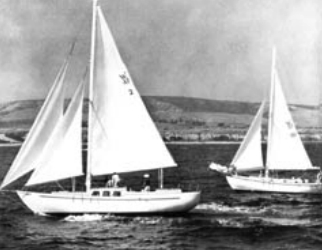
A company called Cruising Consultants bought Bill’s 37-foot design, built the molds and sold 20 boats. “Through no fault of their own, they, too, ran into financial problems,” he says. “The molds became available, and Pacific Seacraft bought them. It’s what Pacific Seacraft was looking for at the time (in the late ’70s). They were a small company just starting up and had built a couple of in-house designs that were nice little boats, but they needed something new. So Pacific Seacraft and I sort of grew up together.”
Bill’s design, now known as the Pacific Seacraft 37, is in the Sailboat Hall of Fame.
“It’s funny how things work out,” says Bill. “I never expected that. What was courageous of Pacific Seacraft was that the 37 didn’t have as much volume as boats with the same overall length. It compares in volume more to a 35-footer. They went against the marketing practice anyway and built the boat. It’s been quite successful.”
So why has the 37 been so popular? “People tell me that initially it’s the visual impact,” says Bill, “and after that it’s the boat’s sailing ability and balance. I’m keen on the question of balance in a boat, especially at the helm when cruising long distances. Nothing pleases me more than hearing people say their child was able to steer the boat in 20 knots of wind without a problem. People forget about the fatigue factor when cruising.”
After the 37, Bill designed the Pacific Seacraft 34. Then came the 24-foot Dana and the 31, both of which lack the canoe stern most often associated with his designs for Pacific Seacraft. On a trip Bill came across a 28-foot, William Garden-designed motorsailer that he thought was a very attractive boat. Back home, he approached Pacific Seacraft about building a pilothouse boat that might appeal to buyers in the Pacific Northwest. The end result was the Pacific Seacraft Pilothouse 32, which was based on the 31. The Pilothouse 32 sold well, but to a different buyer than expected. According to Bill, “where they sold principally wasn’t in the rainy Pacific Northwest, but in the sunny southeast. People in Florida really took a liking to them.”
More performance
Next up was something larger to meet the demand for a boat in the 40-foot range. The idea had been kicking around between Bill and Pacific Seacraft for quite a while. The new design proceeded with the emphasis slightly more on performance. Pacific Seacraft wanted to go larger yet and asked Bill to design a 44-footer. It later was followed by a Pilothouse 40. The company also came out with two trawlers (not designed by Bill), expanding the product line to powerboats that sailors could move into as their needs changed.
One of the most well-known Pacific Seacraft owners is Nigel Calder, noted ocean sailor and author. A few years ago Nigel bought a Pacific Seacraft 40 and worked closely with the factory to customize it to his liking.
Says Nigel, “We were looking for a 40-foot boat, and the Pacific Seacraft 40 is the quintessential cruising boat. I knew that any design from Bill Crealock would be beautiful and well-balanced under sail, and this boat certainly is. We all get seasick and I have two slipped disks in my back, so we needed a boat that would take care of us. The boat also has excellent systems and good livability. It’s in the little details, and Bill and Pacific Seacraft made no compromises in those details for seaworthiness. There are no curves where you don’t need them, leecloths and handholds are in just the right places, pots and pans in the galley won’t take off and hit you, and it has the best head I have ever seen on a 40-foot production boat.”
As for performance of the 40, Nigel says, “It’s a heavy boat aimed at family cruising. It handles those compromises very well. But surprisingly enough, the boat is a good performer in light air even though the numbers don’t reflect that. The underbody is more refined than people give it credit for and gives the boat a good turn of speed.
“Pacific Seacrafts are exceptionally well built,” Nigel continues. “Down below the blend of laminates and wood is just about spot on. The kids are teenagers now and able to help sail the boat. So we are selling the 40 and looking at something larger with a longer waterline for more performance since we have more hands for crew.”
True gentleman
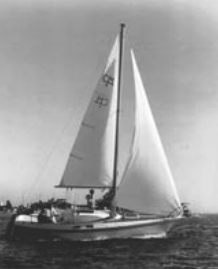
Don Kohlmann, president of Pacific Seacraft, emphasizes the importance of Bill Crealock to the company, not just as a designer, but also as a person. “Bill is one of life’s characters,” says Don, “a really good person and a true gentleman. His designs are always creative and interesting. He knows how to design a beautiful boat that performs well, a melding of function and aesthetics. He has a real attention to detail and a fine sense for drawing good lines. He’s true to the purpose of the boat and imparts his personality onto each design. Bill is such a fine ambassador for us. He’s personable and has a way of grabbing people’s imagination.”
It’s obvious that the relationship of designer to builder is a special one in this case. “It is a symbiotic relationship,” says Don. “It’s a combination of his designs attracting attention and acclaim and then the reputation of the company in building quality boats.” Indeed, Fortune magazine twice has recognized Pacific Seacraft as one of the top 100 producers of quality products in the world.
“We always fight the battle of interior volume when compared to some of our competitors,” says Don. “It’s true that other boats may offer more volume. But Bill’s designs with lower freeboard and moderate beam for ultimate stability mean a more seaworthy boat. Plus, Bill can combine all those elements into a beautiful shape.”
Nancy Cann, founder and president of Crusader Yachts in Annapolis, Maryland, has been a Pacific Seacraft dealer since 1986. “Pacific Seacrafts have an amazing following,” she says. “It’s almost a cult thing in some ways because the reputation of the boats is so good. They are purpose-built boats and not market driven, which attracts knowledgeable buyers. People buy them because of their beauty and performance and because these boats hold their value. There are very few boats built to go around the world, and even though most Pacific Seacraft buyers may never use the full potential of their boats, they like knowing that the boat is fully capable of going a lot farther than they ever intend. And if they decide to do some bluewater sailing, they already have the right boat.”
Design philosophy
By now it’s clear that Bill Crealock has a design approach honed by years of personal experience on the water and by many years of successful design work. The end result of a Crealock design is always the same — beautiful, well-balanced boats that are extremely seaworthy.
For one thing, he doesn’t follow the crowd. “I’ve tried in most of my boats to be a little bit different,” he says. “I’m always working on new ideas. I’m lucky in having worked on a wide variety of boats in addition to cruising sailboats. They range from an 8-foot circular sailboat, which had comfortable seating capacity for six and actually did sail, to a 90-foot brigantine. I’ve worked with the Mexican navy on a patrol boat, on high-speed powerboats capable of 70 miles per hour, and on low-speed fishing boats. This is all in addition to my cruising sailboats. One of my favorite designs is a 65-foot wooden, gaff-rigged schooner, which is the kind of boat I’d like to go cruising on myself.”
Bill also has a keen sense of aesthetics. “I’m perpetually fascinated by things like sheerlines and how an inch or an inch and a half can make such a difference in the look of a boat. I look at something in a magazine and often think that an inch-and-a-half difference in the bow or stern would be just right. For some reason an inch-and-a-half always seems to be the magic number. I get a great deal of pleasure fiddling with sheers in proportion to bows and sterns. Of course, sheer does help a boat stay dry. Probably the most logical thing is a reverse sheer with high shoulders near the forward end because usually when you take green water it’s not so much over the stem as over the shoulders of the boat. I used a reverse sheer on a smaller boat but never felt comfortable with it on a larger one. It’s a mental thing. I just like the traditional sheer.”
Besides balance, Bill also finds that “motion in a seaway is so important, especially on a long cruise. Motion directly affects performance with a small crew.” Bill’s aim is to produce a shape that “neither cuts straight through waves, drenching the crew, nor rises to every wavelet, making the crew seasick. There’s no doubt that weight is the biggest single factor in comfortable motion, but clearly has to be limited.” Some of his boats have narrower beams than other popular boats today, “but if you take the ratio of beam to waterline length, rather than overall length, most are about average,” he says. “Yes, fat boats give you more interior volume and a little more initial stability, but if you do ever get rolled by a freak wave, the slightly leaner boat has a better chance of righting itself.”
Always compromises
States Bill, “Almost every feature of a cruising boat is a compromise. The best of them keep close to the middle road. One must remember that speed on a passage is quite different from speed round a racecourse on a weekend afternoon.”
When asked why so many of his designs have canoe sterns, Bill says, “People always ask me about that. I don’t think there’s anything magical about a particular stern, although I do think the canoe has a slight advantage under some conditions. I believe it’s important to have plenty of reserve buoyancy, something the pure double-ender tends to lack. As much as I admired the achievements of the Westsail 32, I felt her stern was a little cramped. To a following wave, the canoe stern, or a modest transom stern, offers little to grab onto. But a big, wide sugar-scoop stern seems to beckon to a following sea and could lead to broaching.”
Further to the subject of handling in bad weather, Bill says, “When I do a design I start with the stern and not with the bow because in extreme conditions the stern may become the bow. For ocean work I aim at a boat that will take care of its crew in the very worst conditions. Then the other conditions will take care of themselves.”
Who are some of his favorite designers? Bill answers with, “The late Laurent Giles, of England, who had such a wonderful sense of proportion, and others whose boats pop up out of the page because their lines seem just right, such as German Frers, Aage Nielsen, Bruce King, John Alden, and Thomas Gillmer among others. And not to forget our patron saint, Francis Herreshoff.”
Talk to Bill Crealock for more than a few minutes, and it’s easy to tell how important the cruising life has been to him. Read his books about his adventures as a young man, and you can still sense that certain faraway look in his eye all these years later.
“Usually when you think about something as being very desirable,” says Bill, “when you have it, it’s not quite as good as you thought it would be. But for me, the cruising life was even better. It’s very seductive, the ultimate freedom, the ultimate story with a surprise on every page. It’s a wonderful way of life. It can get you into such wonderful situations. Many people think that ocean sailing is dangerous, but it’s coastal cruising that’s dangerous — more things to hit.
Keeping it simple
“The main thing for us back then was to enjoy our cruising by keeping it simple,” he says. “We nearly always were the only boat in the places we went. Even in Gibraltar, the crossroads of the world, we only saw a handful of other boats in those days. That was the golden age of cruising. Even today I still love looking at maps and charts.”
Bill’s design work now is about evenly split between sail and powerboats. He strives to keep his workload manageable, keeping the office to three people total, including Bill Luther, who has been with him for many years. He prefers to work on his own designs rather than running a larger office and “running around the country bringing work in to keep others busy. That doesn’t appeal to me. There are 7,000 of my boats out there, mostly smaller ones, and that means 7,000 owners could call me up at any given time — a terrifying thought.”
One of his recent projects was the design of two wooden, 90-foot brigantines for the Los Angeles Maritime Institute. “The institute runs programs to help disadvantaged youngsters,” says Bill, “and performs near miracles with some of the youths. I’ve seen their letters. Naturally the institute is always in need of donations.”
According to Bill, the ships are of “traditional design above the waterline with more modern and quite slippery underbodies. They also were built using traditional construction methods.” Both ships have completed their sea trials and are now in service. They also will serve as the official tall ships of the City of Los Angeles.
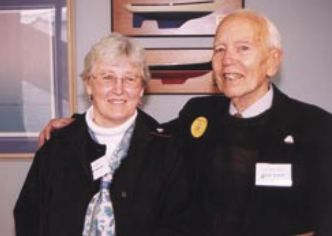
Bill and Lynne, his wife for more than 30 years, lead very active lives. Lynne is a well-known painter and travels whenever she can with Bill. She also is an experienced sailor, having sailed in the Mediterranean and Caribbean for six years when she was younger and before marrying Bill. “But he and I have never cruised together,” she says. “Cruising is a great life. You don’t have to change hotels; you take your own things with you. It’s a wonderful way to learn about other cultures.”
What about retirement plans? States Bill, “My ambition would be to work only five days a week. That would be semi-retirement for me.”
Don’t count on that too soon. Bill Crealock is having too much fun. After all, he has already retired once.
Thank you to Sailrite Enterprises, Inc., for providing free access to back issues of Good Old Boat through intellectual property rights. Sailrite.com