Designer Ted Brewer ruminates about the development of these popular designs

Issue 33 : Nov/Dec 2003
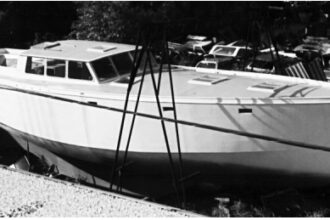
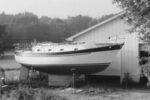
The first center cockpit yacht that intrigued me was the British-built 26-foot Atlanta, a laminated wood Uffa Fox-design based on his famous World War II lifeboat by Fairey Marine. These lifeboats were dropped from airplanes (true!) to rescue downed flyers and torpedoed seamen. The yacht version — fitted with twin bilge boards, a sloop rig, and a rather streamlined cabin — was turned into a delightful small cruiser. I saw my first Atlanta almost 50 years ago. It struck me then, and still does, as a very sensible and seaworthy small yacht. However, with its reverse sheer and rounded cabinhouse it may have been far too advanced in design and aesthetics for the average sailor of that era and thus never received the attention it deserved. The same could be said of the Bluebird of Thorne, built in the 1950s. Her center-cockpit arrangement, however, is still worth studying as an example of a true seagoing yacht.

Many years later, in 1969, I did my first center-cockpit design, the Amee. She was a shoaldraft, light, 37-foot racer/cruiser, but her aft cabin, with good sitting headroom, was little more than a comfortable weekend dog kennel. In 1971 I was commissioned to do a custom 43-footer, the Black Velvet II, which permitted me to play with the center-cockpit arrangement in a larger, more comfortable cruiser than Amee. The Black Velvet II’s spacious aft cabin provided full headroom, a complete head, and decent stowage, but she still lacked a fore and aft passageway between the saloon and owner’s cabin. That can be a real disadvantage on a cold, wet, and stormy night at sea. In my defense, I must say that there are custom yachts of that era, of 50 to 60 feet LOA, with the same drawback: no passageway between the cabins.
About that time Pearson came out with its 390 and Charlie Morgan produced the Out Island 41, both with roomy aft cabins that could truly be called staterooms. I remember writing a review of these two yachts in 1972 for Sail magazine in which I expressed surprise that Charlie had not graced the 41’s very shoal 4-foot 2-inch draft with a centerboard to improve windward performance. It did not occur to me to ask why neither of these yachts had a passage conveniently connecting the cabins.
Fore and aft passage
Perhaps the first center-cockpit production boat with a fore and aft passage was the Irwin 37 of the late 1960s. It made great sense to me, but the appearance was, perhaps, less than aesthetic. That is quite possibly the reason the idea was slow to catch on despite its advantages. As one yachting writer once said, “The only person more conservative than the average yachtsman is an Anglican bishop!”

Fortunately, in 1972 I was given another opportunity to tackle a center-cockpit design when Kurt Hansen asked for “a new design, exactly the same as the Black Velvet II except . . . ” The “excepts” became the Whitby 42 in which I was able to better the Black Velvet II’s arrangement with the addition of the essential passageway along with other refinements, including a separate nav area and a small workbench. Headroom in the passageway was necessarily limited, but it beat the dickens out of going across the cockpit on a wild night at sea or a cold and rainy night in harbor for that matter!

Larger size always provides more amenities so following the success of the 42 came the Olympic 47 in which we fitted in a third cabin for a paid hand, albeit at the expense of engine room space. Next on the scene was the Constellation 44, which added a stall shower aft along with a larger and more convenient galley than the Whitby 42. Finally, in 1983 came the Whitby 55, which was large enough to include everything described in the foregoing plus an additional guest cabin. That was the swan song of Whitby Boats though. Kurt Hansen had one built for himself, closed the company, and sailed away into a well-deserved sunset, as many of us would like to do.

Center-cockpit advantages
The advantages of the center-cockpit arrangement are many. Let’s first eliminate the idea that since you are seated so far forward the center cockpit is wet in a seaway. This is not exactly true. The cockpit of a Whitby 42 may, I say may, take more spray than that of a typical aft-cockpit 42-footer, but the difference is slight because you are up higher and in a wider part of the vessel. However, compared to the average 32- to 33-footer, the cockpit of a typical 40- to 43-foot center-cockpit yacht is no further from the bow and is certainly higher and drier in any kind of a chop.
One problem that can develop is that most owners want direct access from the cockpit to their aft cabin. In really heavy going when the spray is flying everywhere, that aft companionway facing forward can let a lot of
water in. It’s not dangerous, but it is annoying. There may be perfectly tight companionways, but I’ve never seen one that will stand up to a gale at sea.

The true advantage of the center cockpit is the privacy afforded by the separate aft cabin, which makes the yacht ideal for families, charter, and living aboard. The cockpit is usually wider and roomier, of course, and the central helm location can assist in coming alongside, due to better visibility from the wheel and quicker access to the deck. Finally, and with the usual exceptions, a center-cockpit yacht often provides better interior accommodations than an aft-cockpit craft of the same length.
That can contribute to the one major disadvantage, as I see it: the tendency of the owner or builder to insist on filling the center-cockpit hull with people accommodations at the expense of equipment stowage. I am no less guilty than others — when a client has insisted — of eliminating a large lazarette in favor of a roomier owner’s cabin or eliminating cockpit sail bins for a passageway or engine room space. It’s too much like the old Madison Avenue approach: “More berths make better boats.” Contrary to popular opinion, this was never true!

Pilothouses came later
The pilothouse arrangement was a late comer to the scene. I’m being honest when I say I can recall few great pilothouse auxiliaries of the 1950s and 1960s. I’m sure there were some, and some readers will remind me of them, but none sticks in my memory, with the exception of Bluebird of Thorne. Philip L. Rhodes designed some lovely large pilothouse yachts but, by and large, they would be classed as motorsailers, not true auxiliaries.
My first auxiliary pilothouse design, in 1976, was the Victory, a 44-foot FRP (fiberglass-reinforced plastic) double-ended cutter, beautifully built by her owner. However, he specified a very low pilothouse on a flush-deck hull with a perky sheer, and the result was that visibility forward was quite restricted. That is not altogether a bad thing for a bluewater cruiser, mind you, as the pilothouse is primarily a watch-keeping station when offshore. On the crest of a wave you can see forever, and in the trough you are blind even with a pilothouse 10 feet high! In coastal waters you need maximum visibility so, naturally, you’d be at the helm in the cockpit regardless of weather or time of day.
Victory was the first aft cockpit design on which I stuck a cabin below the cockpit. That seems to be common now, but at least it was a full headroom cabin and not a dog kennel. And you didn’t have to go on deck to get to the galley.

Forward visibility problems
Kingsland, a steel 45-foot custom yacht built by her owner, was based on Victory, but with a slightly higher pilothouse. This was followed by the Oceanic line of 46-, 43-, and 38-footers. The 46 was similar to Kingsland, but in the 43 I flattened the sheer to provide somewhat improved forward visibility. Reese Palley, the owner of Oceanic 46 No. 1 — one of my favorite writers, a good friend, and a wonderful old curmudgeon — circumnavigated in his 46 and has many fascinating stories to tell of Unlikely’s adventures in foreign waters and strange ports. (See article by Reese on Page 33.)

Oceanic skippers seem to have adapted well to the visiblity problems of the type, and one 46 owner, a professional yacht delivery skipper, has put close to 200,000 miles under her keel and is very enthusiastic about her all-around comfort and heavy-weather ability. Still, the modern flat-sheer, short-ended style of yacht lends itself well to the pilothouse arrangement, as the designer can obtain reasonably good forward visibility without the need for an ungainly high pilothouse.

Categories of pilothouse plans
The usual pilothouse designs fall into several categories: a) smaller craft with a pilothouse and aft cockpit, b) slightly larger craft with a pilothouse, aft cockpit, and owner’s cabin below the cockpit, and c) larger craft with a center cockpit, pilothouse forward, and owner’s cabin aft. These can be broken down into two subtypes: the yacht where the pilothouse is a fairly small watch-keeping station and the main saloon is below, and the yacht where the pilothouse and the main saloon are combined.
To my way of thinking, the smaller pilothouse and separate saloon are to be preferred for any yacht that will spend nights at sea. For safety at night, the helmsman must be in a darkened area or he’ll be blinded by any lights. If the saloon is up in the pilothouse, even the cockpit helm is next to useless if there are any lights on in the saloon. With a small pilothouse up and the main saloon below, the off watch can read, the cook can cook, and the helmsman can keep sharp watch from either the cockpit or a darkened wheelhouse.
On the other hand, having the saloon seating in the pilothouse is pleasant for coastal cruising, as the saloon area is high, bright, and convivial whether under sail or lying snugly at anchor or in a slip. You can watch the passing parade, yet stay out of the hot sun and not feel as if you are down in a hole. Many couples prefer this setup. It’s a personal choice depending on how the yacht is to be used, of course, and I’ve found it to be increasingly favored for tropical waters with owners who want to be out of the sun as much as possible for comfort or health reasons.
The choices are many: center cockpit, pilothouse, center cockpit with pilothouse, aft cockpit with pilothouse, and so on. If you are considering buying one of these popular plans, give some thought to which will work best for you. Fair winds!
Thank you to Sailrite Enterprises, Inc., for providing free access to back issues of Good Old Boat through intellectual property rights. Sailrite.com