And there was light: from Alpenglow on high, in the Montana Rockies
Issue 35 : Mar/Apr 2004
You know how difficult it can be to reach Someone In Authority (SIA) on the phone. It typically requires negotiating an automated phone tree that may eventually route you to a human being, usually not the person you’re attempting to reach.
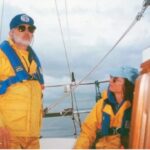
The opposite occurred when I attempted to reach Bob and Marie Stoeckley, co-SIAs at Alpenglow Marine Lights, to schedule a meeting at their facility in Montana. Bob answered the phone after two rings, extended an invitation to visit, then worked hard to fit me into his busy schedule.
Me: “What’s your schedule in July?”
Bob: “We’ll be gone sailing in the San Juan Islands.”
Me: “How about August?”
Bob: “We have a family reunion in Indiana.”
Me: “So when will you be working?”
Bob: “By early September.”
Presto! Directions to the factory followed. Bob asked, “Got a pencil and piece of paper?”
A big piece of paper, as it turned out. The first step involved finding Eureka, Montana, in the northwest corner of the state within a stone’s throw of the Canadian border. The closest body of water is Lake Koo-can-usa (Kootenai River + Canada + USA). An 80-mile long reservoir, Lake Koocanusa can produce a wonderful downwind sail, if the wind cooperates.
“The problem with the lake is that it’s so narrow that winds swirl. I’ve sailed a 360-degree course without touching the sheets,” Bob says.
Closing in
More directions: “Go south of town two miles to a junction and look for a Fire Route sign on a tree . . . ” When I eventually found Forest Service Road 3668, I was closing in on the target. At the end of the road sits a two-story house in the center of a compound surrounded by 160 acres of trees and mountain greenery, two sailboats under protective covers, a road grader, and other assorted machinery.
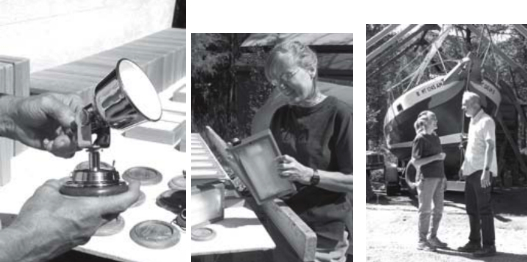
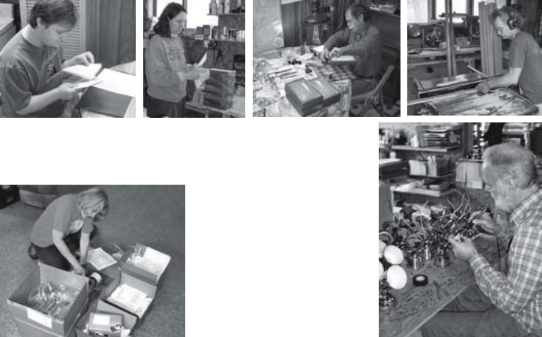
The antithesis of a Fortune 500 company, Alpenglow is a small dot on the map of boat-accessory manufacturers in the U.S. The company produces interior lights that are among the finest in the marketplace. Unlike mass-produced fixtures, each Alpenglow light is handcrafted by Bob and several part-time workers.
The factory occupies four structures and four outdoor tables that serve as open-air tanning booths. A garage has been converted to a cabinet shop occupied by an assortment of power saws, welding tools, and a wood-burning stove. Here Bob’s crew cuts, planes, and sands sections of mahogany and teak, converting them from slabs of wood to precisely joined furniture. “After machining and sanding, teak often has light and dark splotches, and sometimes even salmon and green colors,” Bob notes. “It can be quite ugly. The nice color we associate with teak is the result of oxidation which is accelerated in the presence of ultraviolet light.”
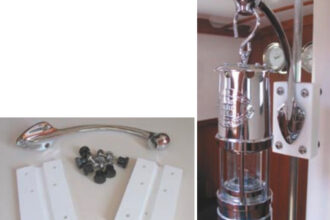
So frames and other wood components are placed on “sunning tables,” something of a euphemism between December and March. There, for days or months, they are exposed to the sun to produce the typical teak look. In theory, the objective is to tan a year’s worth of frames during the sunny months. Then winter months are spent installing the components required to produce the finished product. The company also produces shiny brass reading lights with wooden bases.
Spray booth
Even the couple’s residence and guest house get into the act. A corner of the guest house is partitioned off with a thick plastic tarp, creating a spray booth where the interior of each fixture is sprayed with a reflective paint. What had been the family room doubles as an assembly shop, and Bob has been known to handle the firm’s accounting chores on a computer in the master bedroom.
That Alpenglow’s manufacturing operation is located in the northern Rockies — rather than Marblehead or Taiwan — is of no consequence. Its location, though, speaks volumes about the couple’s ability to combine their professional goals with a lifestyle choice.
Bob’s sailing life began at age 12 on lakes in Indiana. In 1982, he and Marie purchased a 23-foot Venture of Newport (see the Ravensail article on Page 33), which lives under a blue tarp. They named it Alpenglow. In 1993, when the family grew too large for the Venture, they added a trailerable 26-foot Kent Ranger, named Tumbleweed, that occupies a wood-framed shed.
While Bob received an undergraduate degree from Michigan State, majoring in physical geography and education with postgraduate studies in forest recreation, Marie received a degree in interior design and housing. Following graduation they loaded up the buggy “and spent a year on the road.” They scoured the west before landing in Montana which, Marie says, offered “mountains, a summer garden, and skiing.”
Neighborhood guru
After beginning work with the U.S. Forest Service as an engineering technician in 1975, Bob transferred to Eureka two years later. At that point, he also became the neighborhood’s electrical guru, since the bare land the couple purchased was so far from an electrical outlet that adding power lines was a budget buster.
As a consequence, lighting their new home became the responsibility of the “Bob and Marie Stoeckley Power Company,” which solved the problem with a combination of solar energy and a generator.
”That’s when we began building 12-volt lights,” Bob says. “We wanted lights that were highly efficient, attractive, very durable, and which produced a pleasant light similar to incandescent bulbs. For several years we tried just about everything available but found none that were satisfactory. We eventually began building our own [fluorescent lights], using the latest and best components available. These lights are now the primary light source for many alternative-energy homes in this area, and the owners won’t consider using anything else.”
Envisioning a future world filled with low-voltage lighting and enamored of the area, the couple declined the Forest Service’s offer of another transfer in 1987. Instead, they opened the doors of Alpenglow Marine Lights.
“It took six months to design the components and a fixture specifically for marine use, so we were able to begin offering lights to the marine community in 1988. I was immediately told by the owner of a marina in Montana that the product was too expensive,” Bob recalls.
Planets converged
They were undeterred. “We offered the prototype to Rick Proctor, owner of the Cruising Equipment Company in Seattle, who immediately came aboard as our first dealer,” Marie says. “Our first order came from the advertising manager for a magazine who ordered the lights after selling an ad to Bob.”
Then in a short period of time several planets converged, and Alpenglow became a star. A sample mailed to Practical Sailor resulted in two positive results: a favorable review was published and Bob’s criteria for evaluating lights became the publication’s standard. Attendance at a series of boat shows resulted in positive acceptance of the product and invitations for Bob to conduct seminars on boat power systems.
Eventually the lights became standard equipment on new Valiants and the Samuel Morse-built Bristol Channel Cutters and Falmouth Cutters. They were also offered as upgrade options on several other boats being manufactured, including Pacific Seacrafts and Osprey Offshore Yachts. The phone began ringing off the hook, and it hasn’t stopped.
Sitting on a porch sheltered from the mid-day sun, Bob and Marie share a swing and a view to a marsh while listening to a squirrel chattering in a tree as Bob conducts a half-day discussion on boat lights. In the process, I learn that there’s more to the subject than toggling a switch and accepting the result.
“Cabin lights can be divided into two basic types: area lighting and spot lighting. Round dome lights and most fluorescent lights are examples of area lighting.
“High-intensity lights, reading lights, and swivel lights are examples of spot lighting. Spot lighting is a good choice when only one person needs light for a task at a specific location or if you need very intense light for detailed work,” he says. Spot lights are also vital when the captain wants to snooze while the first mate is engrossed in the latest from John Grisham.
Spots create contrast
“If light is required at more than one spot at a time, area lighting is usually more effective than using several spot lights, because spot lights create contrast that can cause eyestrain. Area lighting is accomplished with a fixture mounted overhead, which greatly reduces shadows.”
A marine environment adds two additional challenges: the lights must work in damp or wet conditions without failing, and power consumption must be minimized.
Bob’s lights are equipped with an innovative compact fluorescent bulb that produces color rendition nearly identical to standard bulbs, so a saloon won’t have the feel of an all-night truck stop. Those bulbs use less power than incandescents and may have a life span of 5,000 to 10,000 hours. Add state-of-the-art electronic ballasts built by the company that provided the lighting for Sky Lab, and the starting delay and flickering associated with fluorescent tubes is eliminated.
Bob also developed a new night-vision option using light-emitting diodes (LEDs) that produce a red light bright enough for reading that requires 1⁄20 the amount of power of a comparable incandescent. “Power consumption is less than 1⁄10 amp. It would take 2 amps to get the same red light from an incandescent bulb. But I am still not convinced the technology of white LEDs is as good as necessary,” he says.
“While red LEDs are far more efficient than even compact fluorescents, it is a common misconception that the same is true of white LEDs,” he explains. “They are about twice as efficient as incandescents, making them ideal replacements for many things that would otherwise use incandescent bulbs, such as flashlights, small spotlights, courtesy lights, and anchor lights.
“For large amounts of light, however, where other sources (like compact fluorescent) can be used, white LEDs are only about half as efficient. The leading manufacturer of high-power white LEDs states an efficiency of 25 lumens per watt, while compact fluorescents typically exceed 60 lumens per watt.” He concludes, “White LEDs will continue to improve, and I anticipate we will eventually offer an LED version of our reading light once the efficiency and color quality have improved sufficiently.”
Fewer shadows
Since light transmission can be reduced by some lenses, Bob has designed a highly efficient thermoformed lens.
“Our philosophy for area lighting is to brighten the whole cabin, not just a spot in the center of the table. The benefit of a wide-angle lens is fewer shadows because the wide-angle light bounces off bulkheads and cabin sides. We accomplish this by using a lens designed for extreme wide-angle illumination combined with a prismatic pattern that is very effective in scattering light rays,” he says.
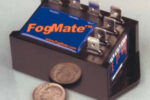
As anyone who has ever purchased boat accessories knows, high-tech products carry a higher price tag, and Alpenglow’s products are no exception. There is a reason for this, of course. The raw materials include ballasts, compact fluorescent tubes, switches, sockets, a backplate Bob manufactures from aluminum sheets, and a circuit board. The assembly of each unit requires more than 100 individual tasks that are completed by hand.
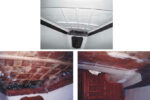
The good news is that they are as attractive as they are efficient. Teak frames mounted overhead on a wooden or fiberglass deck liner add to an interior’s nautical appearance. A brass fixture on a bulkhead adds a shiny accent piece to a stateroom.
And a red light saves a navigator’s eyes. Fifteen years after forming the business, it’s no surprise that Alpenglow fixtures are found on so many notable boats. “The USS Constellation, sistership of Old Ironsides, has about 120 of them,” Bob says. Other well-known boats using Alpenglow lights include the Pride of Baltimore II, PlayStation, Kalmar Nikel, Mahina Tiare, many large custom-built boats, and of course many good old boats.
Self-contained life
Like Frank Sinatra, the Stoeckleys are “doing it their way.” Though they also sell through dealers, experience shows that they are most qualified to extol the virtues and pricing of their products. On a personal level, they enjoy the balance many of us seek, living an essentially self-contained life in idyllic surroundings.
“We’re working about as hard as we want to,” Bob says of opportunities to increase the firm’s production. That the firm is an unlikely takeover candidate is of no importance.
One condition won’t change, though: when you telephone the company the odds are very high that you’ll be talking with one of the SIAs. Unless, of course, they’re sailing. Or just away.
Thank you to Sailrite Enterprises, Inc., for providing free access to back issues of Good Old Boat through intellectual property rights. Sailrite.com