The best way to join fabric to hard surfaces
Issue 38 : Sept/Oct 2004
There occasionally comes the time when you need to fasten fabric to wood, fiberglass, or some other hard object. Sometimes eyes and rope ties do the job, and sometimes stainless-steel snaps work. But there is another, in many cases superior, method: the “boltrope and track” (sometimes called the “awning rope and track”). This system works well under conditions of wind and spray, such as when Sunbrella sides are attached to a hard-top dodger.
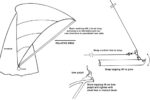
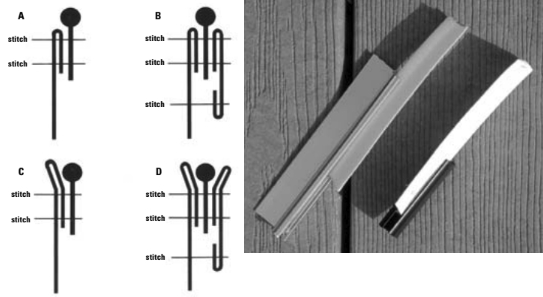
A preformed boltrope with a handy sewing tab is sewn to the edge of the fabric. This can then be fed into a boltrope track fastened to the wood or fiberglass.
The boltrope with the sewing tab is made of Dacron or vinyl. Dacron rope, which is more expensive, has a diameter of 7⁄32-inch and slides easily into the track. It is ideally used in situations where the attachment and detachment needs to be made quickly and easily. Vinyl boltrope provides a tighter and more waterproof fi t, but since it is just slightly larger (1⁄4-inch), it is more diffi cult to slide in place, especially if there are bends in the track. It cannot be used at all when the bends are less than a 10-inch radius. It is best suited to semi-permanent installations where the track is relatively straight.
The tracks into which the boltropes slide come in either extruded PVC or aluminum. PVC Flex-a-Rail is handy when the track needs to have bends in it. For really tight bends, Flex-a-Rail can be softened with steam from a teapot. It is fastened in place with flathead or machine screws that go through holes drilled in the center of the track. These tracks come in 45-inch lengths and are available in white, black, or cream.
A heavy-duty PVC track is also available. It has a flange for panhead screws or bolts and, although much stronger, can follow gentle bends only. It comes in white in 48-inch lengths. Anodized aluminum tracks are also available and come in 48-inch lengths. These tracks are even stronger, but can only be bent over a very large radius. This track has a mounting flange that will take panhead screws or bolts. It is best suited for heavy-duty applications with relatively straight paths.
Thank you to Sailrite Enterprises, Inc., for providing free access to back issues of Good Old Boat through intellectual property rights. Sailrite.com