It’s easy to make some versatile sink covers
Issue 39 : Nov/Dec 2004
If your boat is anything like ours, the galley sink seems to get a lot of stuff stowed in it just as you are leaving the dock. It seems like a great place to store all that small stuff that would roll around and make a racket or break when the bow swings into the waves. A lot of small boats can use safe storage for small items, and they can also use more counter space. I came up with a solution for both issues that works for us.
Last year we were building a new dining table. To try out the size, we bought an inexpensive piece of wood to test. Although it was to be a temporary dining table, we wanted it to look decent while we were evaluating it. We bought laminated pine, which looks similar to butcher block. Our local Home Depot sells the laminated pine board. A 2-foot by 4-foot sheet costs $17; an 18-inch by 4-foot sheet runs $12. We cut it to size, used it for a month, then cut more off.
We continued this process until we arrived at the size of table that suited us. We then made up a proper teak table.
What to do with the leftover laminated pine? It looked too good to just toss. We decided to make a cover for each galley sink. It keeps the area down below looking shipshape and prevents that stuff thrown in the sink from going adrift. As inexpensive as it is, it’s easy to make a couple of covers, some with a special purpose.
While at the Home Depot, we worked out a method for holding these new covers in place. We purchased a 3-foot length of 7⁄8-inch wooden dowel rod for $2 and found rubber tube ends for feet. They come four to a pack for $2.60. We planned to make four tops, so we purchased four packs.
Measured overall size
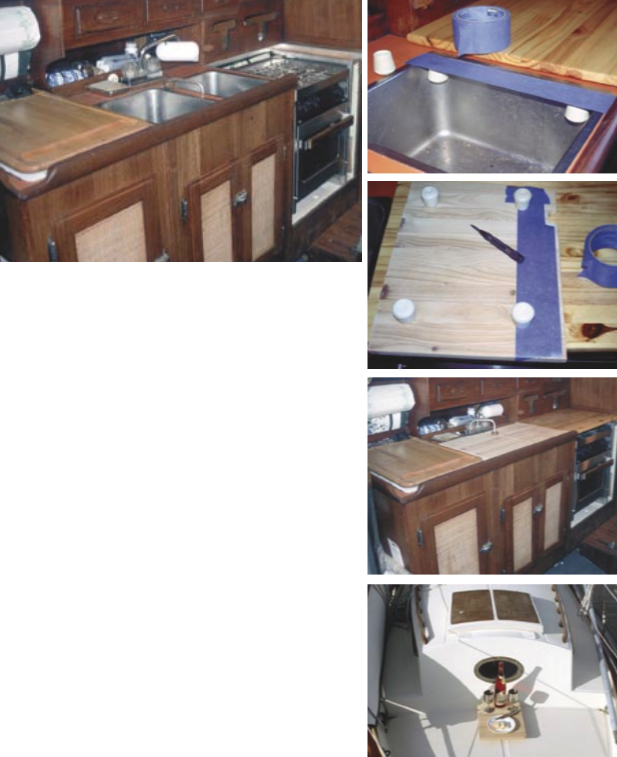
To start off the project, we measured the overall size of the galley counter we wanted to cover. As we have two deep sinks, we measured out the overall size and cut the board to this size. There is a foot-pump-operated water faucet between the two sinks. We measured where this was and drilled a 1 1⁄4-inch hole to fit it, then cut the overall board in half, through the middle of the water faucet hole to make the two tops. Next, we sanded them, and ensured each panel fit just right.
To hold each panel in place, we took the dowel rod and cut 8 sections, each about 3⁄4-inch long. The idea is to cut the length less than the depth of the inside of the rubber feet. By cutting them short, the rubber feet, once installed, will all be the same length, and your board will not wobble when used other places on the boat.
One at a time, hold each piece of dowel with Vise-Grips and drill a hole in the center that will allow a #6 wood screw to go through it. We countersunk the holes so the screw would extend through the dowel and out enough to anchor it to the top but without going all the way through the board.
We then used blue tape across the sink to determine the placement for the rubber feet on the underside of the covers. By taping across one side of the sink, then sticking the rubber feet to the underside of the tape, the correct spacing can be transferred easily to the underside of the cover board. Once the placement has been transferred to the bottom of the cover, screw the dowels to it, then put the rubber covers on them. Place the covers back in place on the sinks to ensure the fit is correct.
Retighten screws
Once you ensure the fit, sand the dowel feet. Then remove the rubber ends, loosen the screws in the dowels, put a bit of glue under each, and retighten the screws. When the glue is set you need only add the finish that suits you: they can be oiled or varnished.
These covers are so easy to make, I made four one afternoon. And they are inexpensive. I cut a small hole in one set so it can hold our Thermos upright when we’re sailing. The covers can also be removed from the sink and used as trays on the table or in the cockpit for snacks. One could also be made into a preparation cutting board by installing a screen material in a hole cut to drain veggie scraps.
Thank you to Sailrite Enterprises, Inc., for providing free access to back issues of Good Old Boat through intellectual property rights. Sailrite.com