How to put that water back outside where it belongs
Issue 39 : Nov/Dec 2004
There is an enormous variety of bilge pumps on the market. Some are electric, some manual, and some are belt-driven from the engine. Bilge pumps are designed to get rid of the routine water that enters the bilge from a dripping stuffing box, water that comes down into the cabin through keel-stepped masts, or rain or spray that enters the cabin through hatches or ports, but virtually no bilge pump is large enough to keep up with a catastrophic leak caused by hull damage.
Regardless of the type of pump that is used, it won’t be able to do its job if the bilge is full of foreign matter such as sawdust, wood shavings, or other debris. A little oil in the bilge can coagulate this foreign material and make things even worse. Although regular cleaning of the bilge is not the most pleasant of jobs, it’s a necessity if the bilge pump is to operate properly. Even with relatively clean bilges, a strainer is necessary. This strainer should have the largest area possible, at least twice the suction hose area, but the holes in the strainer should be small.
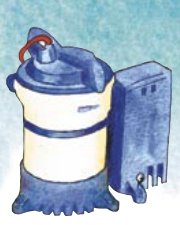
Nearly all cruising sailboats have an automatic electric bilge pump and at least one manual pump as a backup. However, for offshore racing sailboats, race requirements usually specify two permanently installed manual pumps, one in the cockpit and one down below.
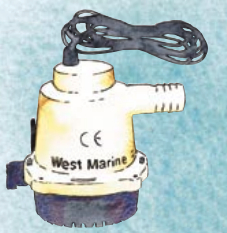
Electric centrifugal pumps cost little, are easily installed, and move a good amount of water. The general rule is: use the largest electric pump that is practical. When purchasing an electric bilge pump, some things to consider are: Is it self-priming? Can it be run dry? Is it submersible? Will it be able to lift the water to the desired height?
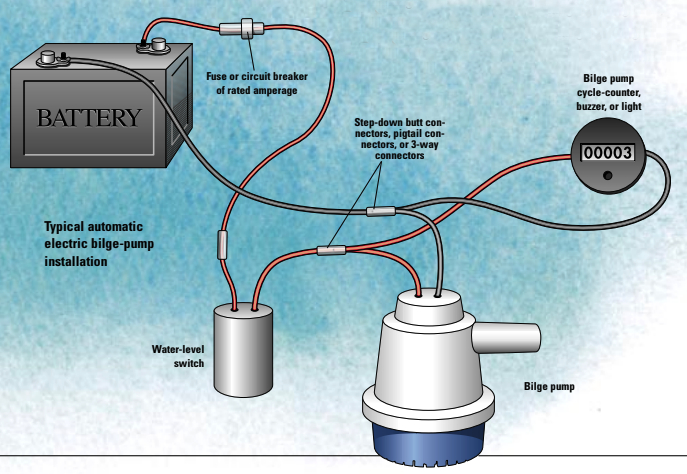
Installation usually includes an automatic switch that will actuate the pump when there is water in the bilge. These switches, especially on small pumps, are often integral with, and mounted on, the pump. On larger pumps the switches are separate.
Prone to jamming
A large variety of automatic switches is available such as the simple open float switch, which is prone to jam when there is debris in the bilge, or the enclosed float switches that usually eliminate the jamming problem. There are solid-state non-mechanical switches that operate in diverse ways, such as sensing the water level by sonar, or by using differential field sensors. Some of these solid-state switches have an extended running feature, which lets the pump run for several seconds beyond the time of normal shut-off. This is handy for boats with small bilges, where return water from the discharge hose, after the pump turns off, can make the pump cycle again.
All electrical connections to a bilge pump should be with connectors with waterproof heat-shrink sleeves. It’s important that electric bilge pumps be on their own electrical circuit, protected by a fuse or circuit breaker with the recommended amperage printed on the pump, and using properly sized wire. When a pump is not fused properly, a jammed float switch can cause it to run continuously without water. Overheating, in such a scenario, has been the cause of many boat fires.
Boats that are left unattended for long periods often power the automatic bilge pump directly from the battery, bypassing the main electrical panel, which can then be turned off when the boat is left unattended. This practice is acceptable, provided that the pump is protected with a fuse or circuit breaker of proper size.
Unfortunately, automatic bilge pumps have a flaw that can lull the boatowner into a false sense of security. With an automatic pump, every time you check your bilge you see no increase in the water level — even though a cracked hose, severely dripping stuffing box, or leaking seacock may be constantly dumping water into the bilge. To alert you to this problem, a cycle-counter with reset button, such as those available at many marine-supply stores, will let you know if the bilge pump is cycling on more often than normal. A light and/or buzzer will also do the job for live-aboards.
Manual pump too
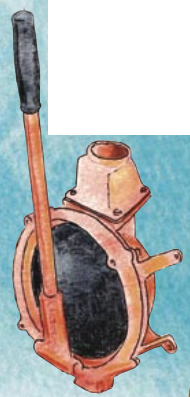
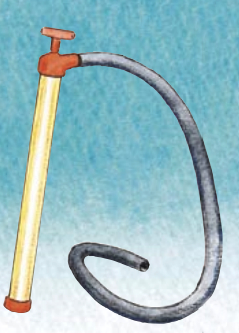
Needless to say, automatic electric pumps will only operate if the electrical system is functioning, so at least one manual pump should also be available. The most common manual pump is the diaphragm pump, which is able to move a large amount of water and can pass small debris without clogging. These may be either permanently mounted or mounted on a board and stowed away for emergencies. A permanently mounted cockpit pump should have the handle within reach of the helmsman.
The discharge hose from any bilge pump should have a smooth interior to reduce friction. Most bilge pumps discharge through the transom or through the side of the hull well above the waterline; but remember, the higher the water has to be lifted, the less efficient the pump. Sometimes bilge pumps discharge into a self-draining cockpit or onto the deck. In these cases, however, any oil in the bilge can create a hazardous walking surface. If there’s any possibility of water coming back through the discharge hose when the boat is heeled, a loop can be used, an external neoprene flap, or a one-way valve (however, a one-way valve is very prone to clogging).
Finally, a reliance on bilge pumps is not a substitute for checking all your underwater fittings on a regular basis.
Thank you to Sailrite Enterprises, Inc., for providing free access to back issues of Good Old Boat through intellectual property rights. Sailrite.com