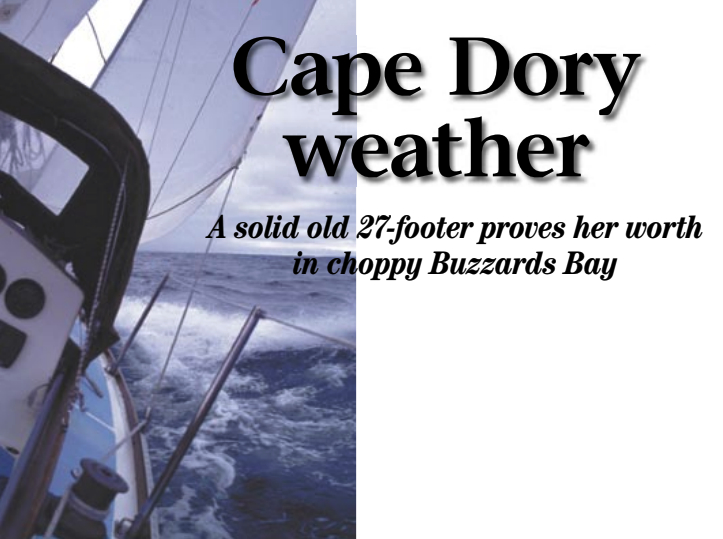
A solid old 27-footer proves her worth in choppy Buzzards Bay
Issue 40 : Jan/Feb 2005
I drew a long cool breath in the summer of 1998 when I first saw the hull of a 27-foot Cape Dory hull sitting in a Massachusetts backyard. I had been looking for a sailboat with a full keel, a solidly built boat with an inboard diesel, one I could buy cheaply and fix up. I bought Loon and worked on her. She was launched as London the following spring. (See articles about this refit in Good Old Boat, January and March 2001.) We are still sailing off the New England coast five years later.
On the coastal charts of Massachusetts, the spot where the Cape Cod Canal enters Buzzards Bay looks sheltered and calm. It is protected from open ocean swells by long peninsulas and a scattering of islands. The chart does not show how, on some days, the fast ebb current from the Cape Cod Canal conspires to run into a fresh southwest wind focused by the shape of Buzzards Bay. This bay wind blowing against the strong canal current can build a quick and impressive sea. Many yacht captains have wished they were far out at sea instead of in this “sheltered spot.”
This past summer, London and I had the good fortune to be out there on one of those warm lively days when, by early afternoon, the breaking crests of the waves are blown away and atomized by the warm mist of a smoky southwester, a wind that will puff and blow until evening.
Picture this, for example: at 1:55 p.m. London is heeled well over, just out of the Cape Cod Canal, and heading south when the first wave breaks over her the bow. At 2:10 I am hit in the face with about 3 gallons of warm salty water. I begin to laugh. The waves have suddenly become steep and breaking. They’re running 4 to 6 feet. At 2:15, several more gallons of the sea drop through the open companionway hatch and into the cabin. I reach forward, close the hatch, and grab the harness to clip myself in.
Swivel on the crests
The boat is close-hauled and I am singlehanding as we tack across the mouth of Hog Island Channel. After the first dunkings, I learn to steer London at an angle up the face of the larger waves and to swivel on their crests and slide into the following troughs as gently as I can. London is doing 6 knots. The turnbuckles of the lee shrouds will spend the next three or four hours in the water. This is why I love Buzzards Bay in summer. It is clean. It is warm. It blows like heck.
My sloop is old but solid. She was built for conditions just like these: steep green salty waves breaking over the bow, water washing the deck and pouring over the cabintop to drain down her sides and drop off the stern. Water spills over the rails, water streams off the jib. It is fine. I feel great. I am not afraid. I am soaking wet. My bilge is dry. London’s track through the sea is steady.
I watch big cruising sailboats emerge from the canal channel with their sails furled tight to the boom. Under full throttle they smash head-on into the steep oncoming waves. The large waves lift these big hulls out of the water, expose their keels, and drop them into the next trough with a shudder. Other boats hurry off the open bay for the refuge of a harbor, their masters hunkered down at the wheel, peering forward to the shelter they know lies just ahead, past the sea gong and under the shelter of their own soft and familiar headland.
I’ve had no lunch but do not want to eat. I am absorbed in moving the boat upwind. Everything else is forgotten for the next four hours as I trim sails, set and undo reefs in the main, and trim the jib in an effort to find the best combination, the best set. My goal is to move forward against the fury of a summer sea that is trying with an increasing vigor and elemental fortitude to press me back.
Kind of meditation
My actions, my thoughts, become a kind of meditation. I focus on the elemental forces of water, sail, and wind. I bruise my hands, bang my knees, and once slide across the steep, slopping-wet deck toward the sea.
I feel nothing but the exultation, the pure luck, the good fortune to be out here on this bay on an afternoon when the moon and the big tides, the winds and the currents, have conspired to set up a really exciting sea on a warm afternoon in late August.
Before each tack I get my lines clear and set to run, center the traveler, and then yell out loud, as I always do, even when sailing solo, “ready about,” followed by the deep sonorous, “hard alee.” I heave the tiller over with my hip and duck under the boom. All about is noise and chaos as the wind tries to shake the jib to pieces and tear the sheet from my hand. Some tacks are beautiful, and we sprint ahead in the new direction; others are complete disasters and we are kicked back by sea and wind as waves slop over the gunwales.
On one tack in a moment of inattention I backwind the jib. Instead of letting the windward jib sheet loose and tightening the lee one to attempt the tack again, I leave the jib as it is, to go with the error, and steer hard downwind. We spin 270 degrees and come round to the very close-hauled course I was trying to achieve. In a breeze like this there is little room for subtlety. The afternoon is filled with noise, motion, and creaming spray. Time and waves race by.
Much later, near the end of the afternoon when I am beginning to tire and find myself muttering, “I will not tack again,” I am able to sneak past the last point of land off Mattapoisett and slip past Ram Island into the lee of West Island where the sea surface suddenly becomes quiet. At last I am nearly home.
All drenched
Here I can slack off, brush the crystals of salt off my eyelids and wonder at the day, wonder at the boat I restored and know so well. The cockpit, the lines, the sails are all drenched. For hours the salt water scooped from the sea was running off the jib in a constant stream. Everything looks very clean, glossy wet — new again. I ease back and breathe deeply. I no longer have to brace myself. For a few minutes we just glide.
There is a final spot ahead, just before the entrance to my harbor’s channel, where the wind is always strong. It accelerates over and around the back of West Island and then out across Nasketucket Bay. The island magnifies the southwest current of air as a lens bends light. I wait for the extended gust and, when it comes, let London lift up one more time, rails back in the water, and bless the day I bought this old boat. The water flows by in an evening stream of molten gold. Waves rush by. I stretch and lick my salty lips. A cormorant croaks at our passing. Just up ahead I can see the red and green buoys that mark the entrance to the harbor channel.
Thank you to Sailrite Enterprises, Inc., for providing free access to back issues of Good Old Boat through intellectual property rights. Sailrite.com